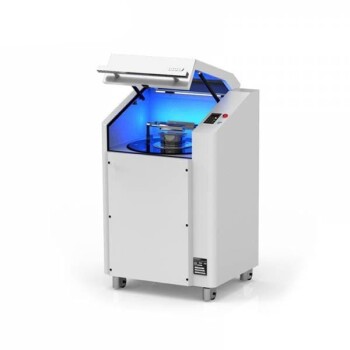
Planetary ball mills drive secondary pore development through high-energy mechanical fracture. By utilizing intense centrifugal forces to generate impact, shearing, and grinding, these mills refine biochar to the micron level. This process physically breaks open previously closed internal pores, significantly increasing the total pore volume and external specific surface area available for adsorption.
The secondary development of biochar pores is a result of mechanical activation where high-energy impacts fracture the carbon skeleton. This process transitions biochar from a coarse material with "hidden" porosity into a high-surface-area powder with exposed active sites and enhanced chemical reactivity.
The Mechanics of Pore Exposure
High-Energy Centrifugal Forces
A planetary ball mill operates through the high-speed revolution and rotation of grinding jars. This movement creates powerful centrifugal forces that cause the grinding media to collide with the biochar at extreme velocities.
Opening Closed Internal Pores
During initial pyrolysis, biochar often contains "closed" pores that are inaccessible to external fluids or pollutants. The intense mechanical fracture provided by the mill breaks the carbon walls surrounding these voids, effectively "unlocking" the internal volume.
Surface Area Expansion
By reducing the biochar to the micron or micro-nano scale, the mill exponentially increases the external specific surface area. This refinement ensures that a higher percentage of the carbon structure is directly exposed to the environment, facilitating faster reaction rates.
Mechanochemical Activation and Surface Modification
Breaking Chemical Bonds
The high-frequency rotation does more than just reduce size; it provides enough energy to break chemical bonds on the carbon surface. This mechanical stress creates unsaturated carbon atoms that are highly reactive.
Introduction of Functional Groups
This process, known as mechanochemical action, often introduces oxygen-containing functional groups like hydroxyl (-OH), C=C, and C-O groups onto the surface. These groups significantly enhance the biochar’s ability to capture pollutants like arsenic or methylene blue.
Enhancing Adsorption Activity
The combination of new physical pathways (pores) and new chemical hooks (functional groups) creates a synergistic effect. The resulting biochar is not just smaller, but chemically more active than its unprocessed counterpart.
Synergistic Effects in Composite Development
Embedding Mineral Particles
When biochar is milled alongside minerals like palygorskite or diatomite, the high-energy environment facilitates the embedding or attachment of mineral particles directly into the biochar pores. This creates a composite material with specialized adsorption properties.
Uniform Dispersion and Matrix Integration
Finer, milled particles achieve better dispersion uniformity when used as fillers in matrices like rubber or polymers. The increased surface area enhances the physical entanglement between the carbon filler and the polymer chains, improving the strength of the final product.
Improved Ion Transport
Refining bulky pyrolysis products into uniform fine powders increases the contact area for subsequent chemical treatments, such as acid washing. This facilitates the removal of templates (like calcium oxide) and leads to better ion transport rates in electrode applications.
Understanding the Trade-offs
Heat Generation and Thermal Degradation
The intense friction and impact within a planetary ball mill generate significant heat. If not managed through cooling cycles, this thermal energy can potentially alter the very functional groups the process intended to create.
Risk of Over-Grinding
Excessive milling time can eventually lead to the collapse of the newly opened pore structures. Finding the optimal milling duration is critical to ensure that the skeletal structure of the biochar remains intact while maximizing surface area.
Energy Consumption vs. Yield
High-energy milling is an energy-intensive process. While it produces superior technical properties, the operational costs must be weighed against the specific performance requirements of the final application.
Making the Right Choice for Your Goal
How to Apply This to Your Project
- If your primary focus is heavy metal adsorption: Prioritize longer milling times to maximize the exposure of internal pores and the formation of oxygen-containing functional groups.
- If your primary focus is composite material strength: Aim for a specific median particle size (e.g., ~19 μm) to ensure uniform dispersion and optimal physical entanglement within your matrix.
- If your primary focus is electrode efficiency: Use milling to refine particle size before acid washing to ensure complete template removal and faster ion transport.
By strategically applying mechanical activation, you can transform standard biochar into a high-performance engineered carbon tailored for advanced environmental and industrial applications.
Summary Table:
| Feature | Mechanical Action | Impact on Biochar Structure |
|---|---|---|
| Pore Exposure | High-energy fracture | Breaks open closed internal pores to increase volume. |
| Size Reduction | Centrifugal grinding | Refines particles to micron level, expanding surface area. |
| Activation | Mechanochemical stress | Breaks chemical bonds and introduces reactive functional groups. |
| Composite Prep | High-speed rotation | Facilitates uniform dispersion and embedding of mineral particles. |
| Optimization | Controlled milling | Balances pore development against the risk of structural collapse. |
Elevate Your Material Research with KINTEK Precision
Ready to transform standard biochar into a high-performance engineered carbon? KINTEK specializes in premium laboratory equipment designed to meet the rigorous demands of material science. Our advanced crushing and milling systems, including high-energy planetary ball mills, are engineered to provide the precise mechanical activation needed to unlock secondary pore structures and enhance chemical reactivity.
Beyond milling, KINTEK offers a comprehensive suite of tools for the modern lab:
- Thermal Processing: High-temperature muffle, tube, vacuum, and atmosphere furnaces.
- Material Preparation: Hydraulic presses, sieving equipment, and high-pressure reactors.
- Consumables: High-quality ceramics, crucibles, and PTFE products.
Whether you are optimizing adsorption for environmental cleanup or developing next-generation electrodes, our technical experts are here to support your workflow with reliable, high-performance solutions.
Maximize your lab's efficiency—contact KINTEK today to find the perfect equipment for your processing needs!
References
- Mariem Zouari, David DeVallance. Effect of demineralization and ball milling treatments on the properties of Arundo donax and olive stone-derived biochar. DOI: 10.1007/s13762-023-04968-9
This article is also based on technical information from Kintek Solution Knowledge Base .
Related Products
- High Energy Planetary Ball Mill for Laboratory Horizontal Tank Type Milling Machine
- Laboratory Planetary Ball Mill Rotating Ball Milling Machine
- High-Energy Omnidirectional Planetary Ball Mill Milling Machine for Laboratory
- High Energy Planetary Ball Mill Milling Machine for Laboratory
- Laboratory Horizontal Planetary Ball Mill Milling Machine
People Also Ask
- What is the role of a planetary ball mill in sulfide-based solid-state batteries? Engineer High-Performance Cathodes
- What are the parameters of a planetary ball mill? Master Speed, Time, and Media for Perfect Grinding
- What is the function of a planetary ball mill for nanostructured eutectic steel? Essential Prep for High-Strength Alloys
- What role does a planetary ball mill play in the preparation of NASICON-type solid electrolytes like LATP and LAGP?
- What is the function of a planetary ball mill in solid-state electrolyte prep? Milling vs. SDS Methods Explained