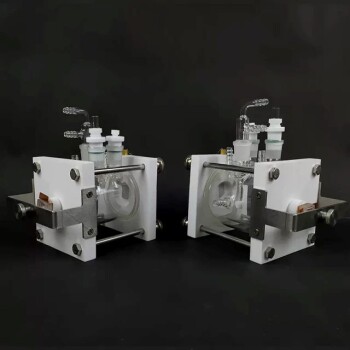
Precision in electrochemical testing is achieved by decoupling the control of electrical potential from the flow of electrical current. Standard electrolytic cells use a three-electrode configuration to isolate the working catalyst from external electrical interference, ensuring that measured data like overpotential and Tafel slopes reflect the true kinetics of the reaction rather than the limitations of the testing environment.
The core mechanism for data accuracy lies in the separation of the reference, counter, and working electrodes. This configuration allows for the precise control of the catalyst surface potential while eliminating errors caused by solution resistance and electrode polarization.
The Architecture of Potential Control
The primary challenge in electrocatalysis is measuring exactly what happens at the interface between the catalyst and the electrolyte. A standard cell addresses this by assigning specific, isolated roles to three distinct components.
The Stabilizing Role of the Reference Electrode
The reference electrode (such as Ag/AgCl, Hg/HgO, or RHE) provides a constant, known chemical potential that does not fluctuate during the experiment. Because no significant current flows through this electrode, it serves as an unwavering "ruler" against which the working electrode's potential is measured.
The Current-Carrying Counter Electrode
The counter electrode, often made of inert materials like platinum wire or titanium mesh, completes the circuit and carries the polarization current. By separating this from the reference electrode, the system prevents "potential drift" that would otherwise occur if the current were to pass through the measurement baseline.
The Working Electrode as the Kinetic Focal Point
The working electrode serves as the substrate for the catalyst being tested, such as a glassy carbon electrode coated with the active material. This setup ensures that the electrochemical workstation captures the specific current-potential response of the catalyst alone, rather than the collective response of the entire cell.
Eliminating Measurement Artifacts
Standardized systems are designed to suppress physical phenomena that naturally distort electrochemical data. Without these protections, researchers would likely miscalculate the efficiency and activity of their materials.
Minimizing Ohmic Drop (iR Drop)
Electrolytes possess an inherent resistance that causes a "voltage drop" as current flows through the solution. The three-electrode configuration minimizes this ohmic drop by placing the reference electrode close to the working electrode, ensuring the measured potential is as close to the catalyst surface as possible.
Preventing Counter Electrode Polarization
In a simple two-electrode system, the potential of the second electrode shifts as it facilitates the balancing reaction. A three-electrode cell ensures that polarization at the counter electrode does not influence the controlled potential at the working electrode, maintaining the integrity of the kinetic analysis.
Maintaining Environmental Consistency
Accuracy also depends on the chemical environment within the cell, which must remain stable during testing. Standard cells allow for the saturation of the electrolyte with high-purity gases (like Oxygen or Hydrogen), ensuring that reactant concentrations are constant and the resulting Linear Sweep Voltammetry (LSV) data is reproducible.
Understanding the Trade-offs
While the three-electrode system is the gold standard for accuracy, it is not without limitations that researchers must manage carefully.
Potential for Platinum Contamination
When using a platinum counter electrode in certain electrolytes, small amounts of platinum can dissolve and re-deposit onto the working electrode. This "cross-contamination" can lead to artificially high activity readings, as platinum is itself a highly active catalyst for many reactions.
Geometry and Diffusion Limits
The physical placement of electrodes within the cell can create non-uniform current distributions. If the reference electrode is placed too far away, or if the Luggin capillary is improperly positioned, the compensation for solution resistance may be inaccurate, leading to skewed Tafel slopes.
Reference Electrode Compatibility
Not all reference electrodes work in every environment; for example, using a silver/silver chloride electrode in a high-pH alkaline solution can lead to junction potential errors or contamination. Researchers must select a reference electrode compatible with the electrolyte pH to avoid shifts in the potential baseline.
How to Apply This to Your Project
To ensure the highest data integrity, your choice of cell configuration should align with the specific metrics you need to validate.
- If your primary focus is fundamental kinetic analysis: Use a high-precision three-electrode cell with a Luggin capillary to minimize iR drop and ensure the most accurate Tafel slope measurements.
- If your primary focus is long-term durability (Stability): Prioritize a cell design that prevents counter-electrode products from reaching the working electrode, perhaps by using a dual-chamber H-cell separated by a membrane.
- If your primary focus is photoelectrochemical (PEC) performance: Utilize a specialized PEC cell with a quartz window and a three-electrode setup to accurately monitor the potential at the semiconductor/electrolyte interface under illumination.
By isolating the chemical and electrical variables of the reaction, the three-electrode system transforms a complex electrochemical environment into a controlled laboratory for precise catalyst evaluation.
Summary Table:
| Component | Primary Function | Impact on Data Accuracy |
|---|---|---|
| Working Electrode (WE) | Substrate for catalyst | Isolate specific kinetic response of the material. |
| Reference Electrode (RE) | Constant potential baseline | Provides a stable "ruler" for measuring potential without drift. |
| Counter Electrode (CE) | Completes the circuit | Prevents polarization at the RE by carrying the current flow. |
| Luggin Capillary | Physical bridge to RE | Minimizes Ohmic (iR) drop by shortening the measurement path. |
| Electrolyte Saturation | Environment control | Ensures constant reactant concentration for reproducible LSV data. |
Elevate Your Electrochemical Research with KINTEK
Precision in the lab starts with high-quality equipment designed for accuracy. KINTEK specializes in premium laboratory solutions, offering a specialized range of electrolytic cells and electrodes—including glassy carbon, platinum mesh, and stable reference systems—tailored for rigorous electrochemical catalysis performance testing.
Beyond electrochemistry, our portfolio supports your entire research workflow with:
- High-Temperature Furnaces: Muffle, tube, and vacuum systems for material synthesis.
- Reactors & Autoclaves: High-temperature and high-pressure solutions for complex reactions.
- Sample Preparation: Hydraulic presses, crushing, and milling systems for consistent material substrates.
Don't let measurement artifacts compromise your data integrity. Contact KINTEK today to discuss your specific testing requirements and discover how our precision-engineered tools can drive your next breakthrough.
References
- Priyanka Verma, Hiromi Yamashita. Amine Functionalization Within Hierarchically‐Porous Zeotype Framework for Plasmonic Catalysis over PdAu Nanoparticles. DOI: 10.1002/cctc.202201182
This article is also based on technical information from Kintek Solution Knowledge Base .
Related Products
- Electrolytic Electrochemical Cell for Coating Evaluation
- Electrolytic Electrochemical Cell Gas Diffusion Liquid Flow Reaction Cell
- Quartz Electrolytic Electrochemical Cell for Electrochemical Experiments
- Flat Corrosion Electrolytic Electrochemical Cell
- Electrolytic Electrochemical Cell with Five-Port
People Also Ask
- What is the volume range of the coating evaluation electrolytic cell? A Guide to Choosing the Right Size
- How does the design of an electrochemical electrolytic cell influence the coating uniformity? Optimize Your Catalysts
- What is the correct shutdown and disassembly procedure after an experiment? Ensure Safety and Protect Your Equipment
- How do the electrochemical cell and three-electrode testing system collaborate? Optimize Zinc Anode Deposition Control
- What is the difference between a voltaic cell and an electrochemical cell? Understand the Two Types of Energy Conversion