Knowledge How do you calculate sieve analysis in a lab report? A Step-by-Step Guide to Accurate Particle Size Distribution
Author avatar

Tech Team · Kintek Solution

Updated 6 days ago

How do you calculate sieve analysis in a lab report? A Step-by-Step Guide to Accurate Particle Size Distribution


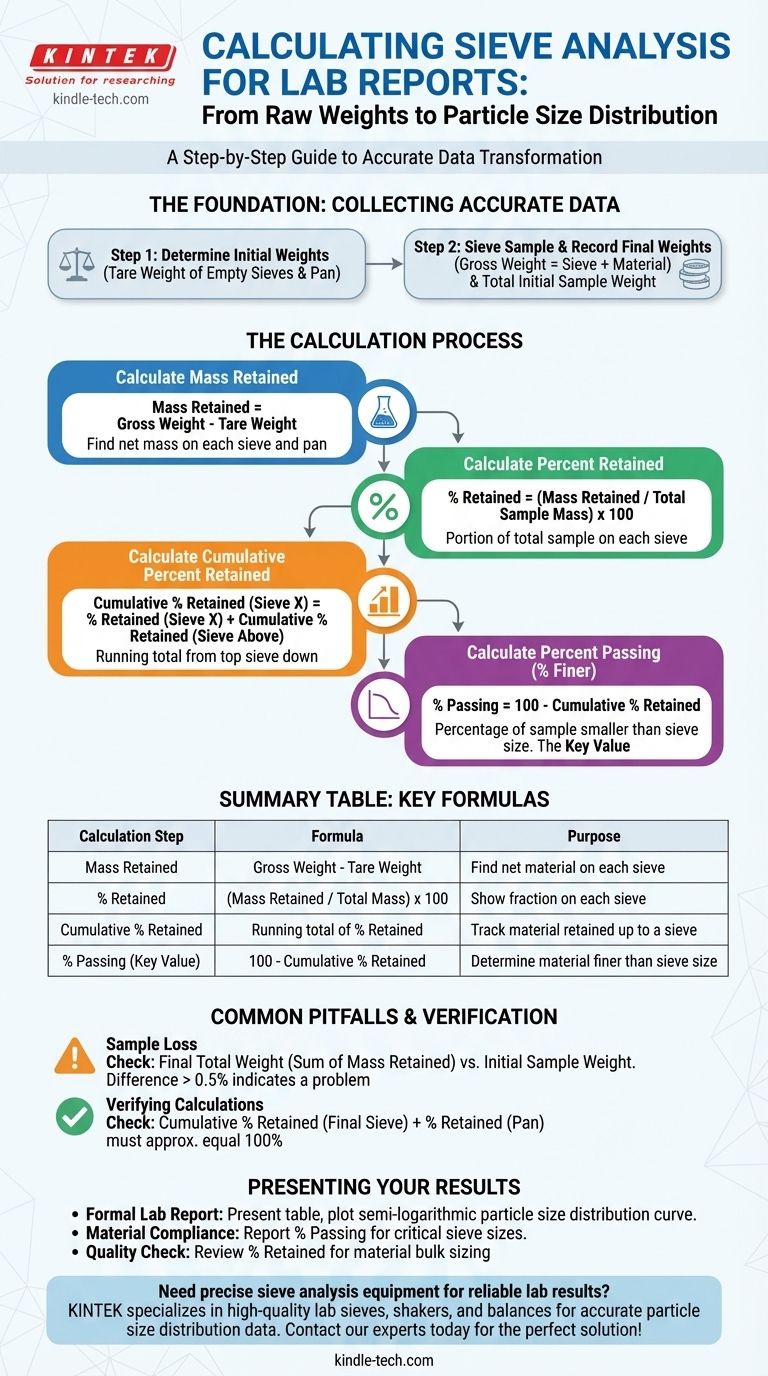
To calculate sieve analysis results for a lab report, you methodically convert the raw weight of material on each sieve into a series of percentages. This process involves finding the mass retained on each sieve, calculating its percentage relative to the total sample, and then determining the cumulative percentage of material that passes through each screen.

The core task of sieve analysis calculation is to transform raw mass measurements into a standardized format—the cumulative percent passing. This value is essential for creating a particle size distribution curve, which is the ultimate goal of the analysis.

How do you calculate sieve analysis in a lab report? A Step-by-Step Guide to Accurate Particle Size Distribution

The Foundation: Collecting Accurate Data

Before any calculation can begin, you must have precise measurements from the lab. The quality of your results is entirely dependent on the quality of this initial data.

Step 1: Determine Initial Weights

Before adding any sample material, you must weigh each individual sieve and the bottom pan. This is the tare weight.

Recording these empty weights accurately is critical for the calculations that follow.

Step 2: Sieve the Sample and Record Final Weights

After sieving your material for the specified time, you must weigh each sieve again, this time with the retained material inside. This is the gross weight.

You also need to know the total initial weight of the dry sample you started with before it was placed in the top sieve.

The Calculation Process: From Mass to Percentage

With your raw data collected, you can proceed with the calculations. This is typically organized in a data table with columns for each step.

Step 1: Calculate the Mass Retained

For each sieve, subtract the tare weight (empty sieve) from the gross weight (sieve + sample). This gives you the net mass of material retained on that specific sieve.

Mass Retained = Gross Weight - Tare Weight

The mass collected in the bottom pan should also be calculated this way.

Step 2: Calculate the Percent Retained

Next, divide the mass retained on each sieve by the total initial sample mass. Multiply the result by 100 to get the percentage.

% Retained = (Mass Retained / Total Sample Mass) x 100

This shows you what portion of the total sample was caught by each individual sieve.

Step 3: Calculate the Cumulative Percent Retained

This is a running total. Start with the percent retained on the largest sieve (the top one). Then, for each subsequent sieve, add its percent retained to the cumulative total of the sieves above it.

Cumulative % Retained (Sieve X) = % Retained (Sieve X) + Cumulative % Retained (Sieve above)

The final cumulative percent retained (which includes the pan) should be very close to 100%.

Step 4: Calculate the Percent Passing (% Finer)

This is the most important value for your final report and graph. It is the inverse of the cumulative percent retained.

% Passing = 100 - Cumulative % Retained

This value tells you what percentage of the entire sample is smaller than the opening size of that specific sieve. The % Passing for the pan should be 0, as no material can pass through it.

Common Pitfalls and Verification

A perfect analysis is rare. Understanding potential sources of error is key to producing a credible report.

The Problem of Sample Loss

It's common to lose a small amount of material (as dust, for instance) during the sieving process.

To check this, sum the individual masses retained on every sieve and the pan. Compare this final total weight to your initial sample weight. A difference of more than 0.5% may indicate a problem with the test procedure or data collection.

Verifying Your Calculations

The cumulative percent retained on your final sieve before the pan, plus the percent retained in the pan itself, must equal 100% (or be very close, accounting for minor sample loss).

If these numbers do not add up, there is an error in your calculation that must be found and corrected.

Presenting Your Results for a Report

The final step is to present your findings clearly. The goal is to make the particle size distribution immediately understandable.

  • If your primary focus is a formal lab report: Present your calculations in a clear table and use the "% Passing" column to plot a semi-logarithmic particle size distribution curve.
  • If your primary focus is material compliance: You may only need to report the "% Passing" for one or two critical sieve sizes specified by a project standard.
  • If your primary focus is a quick quality check: A simple review of the "% Retained" column can quickly tell you where the bulk of your material is sized.

Ultimately, these calculations turn a pile of aggregates into precise data that defines the material's character.

Summary Table:

Calculation Step Formula Purpose
Mass Retained Gross Weight - Tare Weight Find net material on each sieve
% Retained (Mass Retained / Total Mass) x 100 Show fraction on each sieve
Cumulative % Retained Running total of % Retained Track material retained up to a sieve
% Passing (Key Value) 100 - Cumulative % Retained Determine material finer than sieve size

Need precise sieve analysis equipment for reliable lab results? KINTEK specializes in high-quality lab sieves, shakers, and balances that ensure accurate particle size distribution data. Our equipment is trusted by laboratories for its durability and precision, helping you avoid calculation errors from sample loss or inconsistent sieving. Contact our experts today to find the perfect sieve analysis solution for your lab's needs!

Visual Guide
How do you calculate sieve analysis in a lab report? A Step-by-Step Guide to Accurate Particle Size Distribution Visual Guide

Related Products

People Also Ask

Related Products

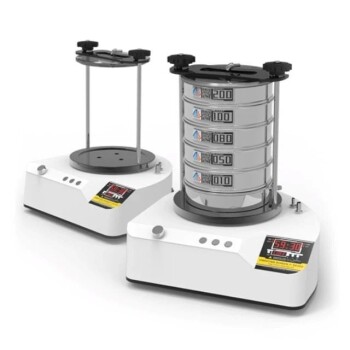
Laboratory Test Sieves and Vibratory Sieve Shaker Machine

Laboratory Test Sieves and Vibratory Sieve Shaker Machine

Efficiently process powders, granules, and small blocks with a high-frequency vibration sieve. Control vibration frequency, screen continuously or intermittently, and achieve accurate particle size determination, separation, and classification.

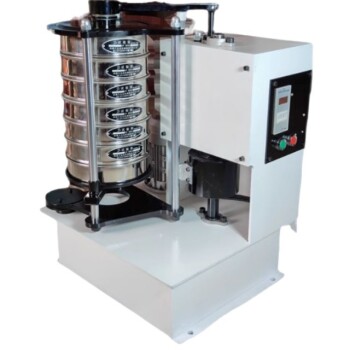
Three-dimensional electromagnetic sieving instrument

Three-dimensional electromagnetic sieving instrument

KT-VT150 is a desktop sample processing instrument for both sieving and grinding. Grinding and sieving can be used both dry and wet. The vibration amplitude is 5mm and the vibration frequency is 3000-3600 times/min.

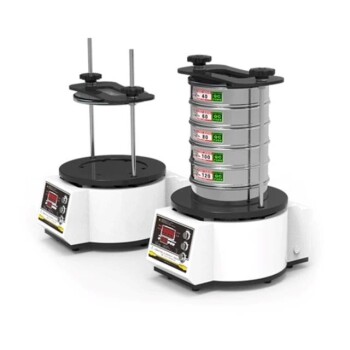
Laboratory Vibratory Sieve Shaker Machine for Dry and Wet Three-Dimensional Sieving

Laboratory Vibratory Sieve Shaker Machine for Dry and Wet Three-Dimensional Sieving

KT-VD200 can be used for sieving tasks of dry and wet samples in the laboratory. The screening quality is 20g-3kg. The product is designed with a unique mechanical structure and an electromagnetic vibrating body with a vibration frequency of 3000 times per minute.

Laboratory Vibratory Sieve Shaker Machine Slap Vibrating Sieve

Laboratory Vibratory Sieve Shaker Machine Slap Vibrating Sieve

KT-T200TAP is a slapping and oscillating sieving instrument for laboratory desktop use, with 300 rpm horizontal circular motion and 300 vertical slapping motions to simulate manual sieving to help sample particles pass through better.

Laboratory Wet Three-Dimensional Vibratory Sieve Shaker Machine

Laboratory Wet Three-Dimensional Vibratory Sieve Shaker Machine

The wet three-dimensional vibrating sieving instrument focuses on solving the sieving tasks of dry and wet samples in the laboratory. It is suitable for sieving 20g - 3kg dry, wet or liquid samples.

Custom PTFE Teflon Parts Manufacturer for PTFE Mesh F4 Sieve

Custom PTFE Teflon Parts Manufacturer for PTFE Mesh F4 Sieve

PTFE mesh sieve is a specialized test sieve designed for particle analysis in various industries, featuring a non-metallic mesh woven from PTFE filament. This synthetic mesh is ideal for applications where metal contamination is a concern . PTFE sieves are crucial for maintaining the integrity of samples in sensitive environments, ensuring accurate and reliable results in particle size distribution analysis.

Laboratory Vortex Mixer Orbital Shaker Multifunctional Rotation Oscillation Mixer

Laboratory Vortex Mixer Orbital Shaker Multifunctional Rotation Oscillation Mixer

The inching mixer is small in size, mixes quickly and thoroughly, and the liquid is in a vortex shape, which can mix all the test solutions attached to the tube wall.

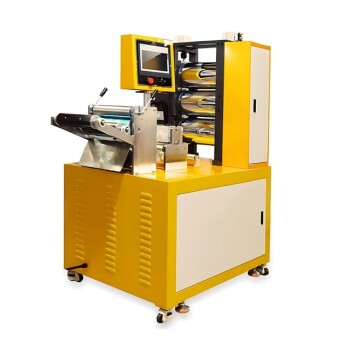
Small Lab Rubber Calendering Machine

Small Lab Rubber Calendering Machine

Small lab rubber calendering machine is used for producing thin, continuous sheets of plastic or rubber materials. It is commonly employed in laboratories, small-scale production facilities, and prototyping environments to create films, coatings, and laminates with precise thickness and surface finish.

Automatic Laboratory Heat Press Machine

Automatic Laboratory Heat Press Machine

Precision automatic heat press machines for labs—ideal for material testing, composites, and R&D. Customizable, safe, and efficient. Contact KINTEK today!

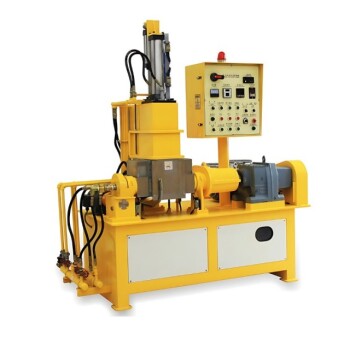
Lab Internal Rubber Mixer Rubber Kneader Machine for Mixing and Kneading

Lab Internal Rubber Mixer Rubber Kneader Machine for Mixing and Kneading

Lab internal rubber mixer is suitable for mixing, kneading and dispersing various chemical raw materials such as plastics, rubber, synthetic rubber, hot melt adhesive and various low-viscosity materials.

Double Plate Heating Press Mold for Lab

Double Plate Heating Press Mold for Lab

Discover precision in heating with our Double Plate Heating Mold, featuring high-quality steel and uniform temperature control for efficient lab processes. Ideal for various thermal applications.

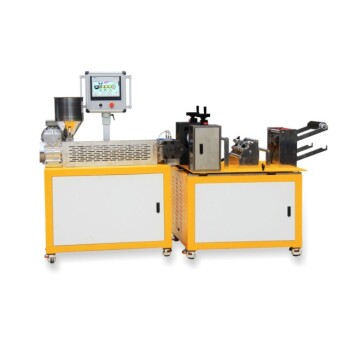
Lab Plastic PVC Calender Stretch Film Casting Machine for Film Testing

Lab Plastic PVC Calender Stretch Film Casting Machine for Film Testing

The cast film machine is designed for the molding of polymer cast film products and has multiple processing functions such as casting, extrusion, stretching, and compounding.

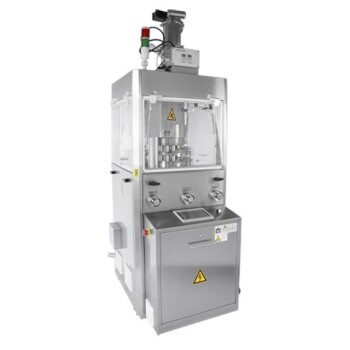
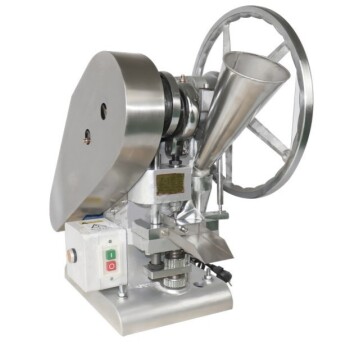
Single Punch Tablet Press Machine and Mass Production Rotary Tablet Punching Machine for TDP

Single Punch Tablet Press Machine and Mass Production Rotary Tablet Punching Machine for TDP

Rotary tablet punching machine is an automatic rotating and continuous tableting machine. It is mainly used for tablet manufacturing in the pharmaceutical industry, and is also suitable for industrial sectors such as food, chemicals, batteries, electronics, ceramics, etc. to compress granular raw materials into tablets.

Single Punch Electric Tablet Press Machine TDP Tablet Punching Machine

Single Punch Electric Tablet Press Machine TDP Tablet Punching Machine

The electric tablet punching machine is a laboratory equipment designed for pressing various granular and powdery raw materials into discs and other geometric shapes. It is commonly used in pharmaceutical, healthcare products, food, and other industries for small batch production and processing. The machine is compact, lightweight, and easy to operate, making it suitable for use in clinics, schools, laboratories, and research units.

Desktop Fast Laboratory Autoclave Sterilizer 35L 50L 90L for Lab Use

Desktop Fast Laboratory Autoclave Sterilizer 35L 50L 90L for Lab Use

The desktop fast steam sterilizer is a compact and reliable device used for rapid sterilization of medical, pharmaceutical, and research items. It efficiently sterilizes surgical instruments, glassware, medicines, and resistant materials, making it suitable for various applications.

Precision Wire Saw Laboratory Cutting Machine with 800mm x 800mm Workbench for Diamond Single Wire Circular Small Cutting

Precision Wire Saw Laboratory Cutting Machine with 800mm x 800mm Workbench for Diamond Single Wire Circular Small Cutting

Diamond wire cutting machines are mainly used for precision cutting of ceramics, crystals, glass, metals, rocks, thermoelectric materials, infrared optical materials, composite materials, biomedical materials and other material analysis samples. Especially suitable for precision cutting of ultra-thin plates with thickness up to 0.2mm.

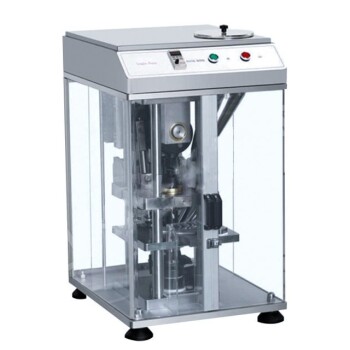
Single Punch Electric Tablet Press Machine Laboratory Powder Tablet Punching TDP Tablet Press

Single Punch Electric Tablet Press Machine Laboratory Powder Tablet Punching TDP Tablet Press

The single-punch electric tablet press is a laboratory-scale tablet press suitable for corporate laboratories in pharmaceutical, chemical, food, metallurgical and other industries.

Heated Hydraulic Press Machine with Integrated Manual Heated Plates for Lab Use

Heated Hydraulic Press Machine with Integrated Manual Heated Plates for Lab Use

Efficiently process heat-pressing samples with our Integrated Manual Heated Lab Press. With a heating range up to 500°C, it's perfect for various industries.

Metallographic Specimen Mounting Machine for Laboratory Materials and Analysis

Metallographic Specimen Mounting Machine for Laboratory Materials and Analysis

Precision metallographic mounting machines for labs—automated, versatile, and efficient. Ideal for sample prep in research and quality control. Contact KINTEK today!

High Energy Planetary Ball Mill Machine for Laboratory Horizontal Tank Type

High Energy Planetary Ball Mill Machine for Laboratory Horizontal Tank Type

The KT-P2000H uses a unique Y-axis planetary trajectory, and utilizes the collision, friction and gravity between the sample and the grinding ball.


Leave Your Message