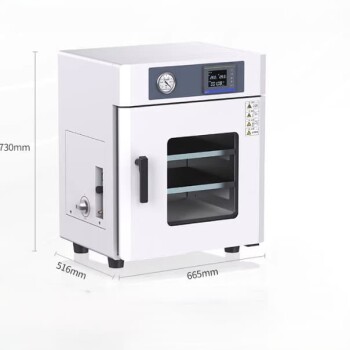
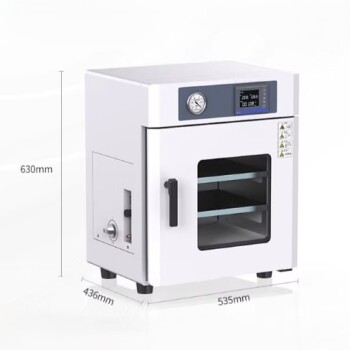
The drying oven serves as a critical stabilization step in the processing of Y3+:CaF2 nanopowders. It functions by baking centrifuged and washed precipitates at a constant temperature, typically around 80°C. This controlled thermal environment is strictly employed to thoroughly remove physically adsorbed water and any residual solvents left over from the washing phase.
By eliminating moisture prior to high-temperature processing, the drying oven acts as a safeguard against structural defects. It ensures the material is physically stable, preventing the catastrophic formation of pores or cracks that occur when trapped water vaporizes rapidly during sintering.
The Mechanics of Moisture Removal
Constant Thermal Environment
The drying oven maintains a stable temperature, generally set at 80°C for this specific material.
This moderate heat provides the energy necessary to drive off volatiles without inducing premature chemical reactions or phase changes in the nanopowder itself.
Eliminating Residual Solvents
During the washing process, nanopowders often retain traces of water or solvents.
The drying phase targets physically adsorbed water—moisture clinging to the surface of the particles—ensuring the powder reaches a completely dry state before moving forward.
Protecting Sintering Integrity
Preventing Internal Defects
The most critical role of the drying oven is preventing damage during the subsequent high-temperature sintering stage.
If moisture remains trapped within the powder, the intense heat of sintering causes rapid vaporization.
This expanding gas creates internal pressure, leading to the formation of internal pores or macroscopic cracking, which compromises the material's mechanical strength and optical quality.
Preserving Sintering Activity
Proper drying is essential for maintaining the sintering activity of the powder.
By ensuring the precursor is defect-free and chemically stable, the drying oven allows the particles to densify correctly during sintering, resulting in a high-quality final ceramic product.
Understanding the Trade-offs
The Risk of Incomplete Drying
Rushing this stage is a common pitfall. If the powder is not baked long enough to reach a fully dry state, gas pores will inevitably form during sintering.
These defects are often irreversible and will significantly degrade the final density and transparency of the Y3+:CaF2 material.
Temperature Sensitivity
While drying is necessary, the temperature must be controlled.
The target of 80°C is specific; it is high enough to evaporate water but low enough to avoid aggressive thermal shock or unwanted agglomeration that might occur at higher flash-drying temperatures.
Making the Right Choice for Your Goal
To maximize the quality of your Y3+:CaF2 nanopowders, align your drying protocol with your specific processing requirements:
- If your primary focus is Structural Integrity: Prioritize a complete drying cycle at 80°C to guarantee zero residual solvent, eliminating the risk of cracking during sintering.
- If your primary focus is Material Density: Ensure the removal of all physically adsorbed water to preserve sintering activity, allowing for maximum densification in the final heating stage.
A disciplined drying process is not merely about removing water; it is the foundational step that ensures the physical survival of your material during high-temperature densification.
Summary Table:
| Process Parameter | Role in Y3+:CaF2 Pretreatment | Benefit for Material Quality |
|---|---|---|
| Temperature (80°C) | Constant thermal energy to evaporate volatiles | Prevents premature chemical reactions or agglomeration |
| Moisture Removal | Targets physically adsorbed water and solvents | Eliminates internal gas pressure during sintering |
| Structural Stabilization | Prevents rapid vaporization of trapped liquids | Protects against macroscopic cracking and internal pores |
| Sintering Activity | Ensures defect-free precursor state | Promotes maximum material densification and transparency |
Elevate Your Material Research with KINTEK Precision
Don't let moisture compromise your sintering results. KINTEK specializes in advanced laboratory solutions, providing high-precision drying ovens and high-temperature furnace systems designed to ensure the integrity of your nanopowders and ceramics.
Whether you are processing Y3+:CaF2 or developing next-generation battery materials, our comprehensive portfolio—including vacuum and atmosphere furnaces, crushing and milling systems, and high-temperature high-pressure reactors—is engineered to meet the rigorous demands of material science.
Ready to achieve superior material density and structural integrity? Contact our laboratory specialists today to find the perfect equipment for your research goals.
Related Products
- Laboratory Scientific Electric Heating Blast Drying Oven
- 56L Vertical Laboratory Vacuum Drying Oven
- 23L Laboratory Vacuum Drying Oven
- High Temperature Muffle Oven Furnace for Laboratory Debinding and Pre Sintering
- Dental Porcelain Zirconia Sintering Ceramic Vacuum Press Furnace
People Also Ask
- How does a laboratory electric drying oven contribute to the formation of the initial coating? Expert Insights
- What role does a precision laboratory drying oven play in the synthesis of GO-PANI nanocomposites? Protect Material Integrity
- What role does a laboratory drying oven play in the preparation of zinc oxide nanoparticle precursors?
- What is the necessity of using a laboratory drying oven when processing MoO3/GO composite nanopowders? Find out here.
- What is the role of a laboratory drying oven in cellulose citrate production? Ensure Material Stability & Purity