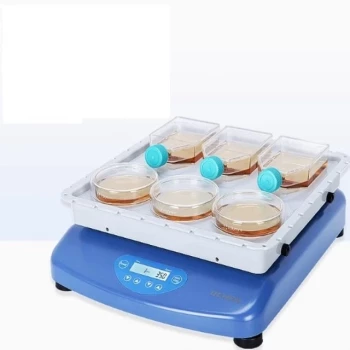
Precise mechanical preparation is the critical determinant of high-quality material synthesis. A high-efficiency mixer impacts tungsten disulfide (WS2) quality by applying intense mechanical force to thoroughly grind and blend tungsten oxide with sulfur and additives. This process creates a uniform distribution at a microscopic level, ensuring the precursors are physically primed for the chemical reactions that follow.
By establishing a tight contact interface between reactants, high-efficiency mixing eliminates heterogeneity in the precursor blend. This structural uniformity is the critical prerequisite for maximizing reaction conversion efficiency during the subsequent high-temperature sulfidation process.
The Mechanics of Homogeneity
Intense Mechanical Force
A high-efficiency mixer goes beyond simple stirring. It utilizes significant mechanical force to actively grind and blend the raw materials.
This action breaks down agglomerates in the tungsten oxide and sulfur powders. It ensures that the physical particle sizes are optimized for interaction.
Microscopic Distribution
The goal of this phase is not merely a visual blend, but uniformity at a microscopic level.
The mixer ensures that the sulfur source and additives, such as potassium carbonate, are evenly dispersed across the surface of the tungsten source particles. This prevents "hot spots" or dead zones where reagents are either too concentrated or entirely absent.
Optimizing the Reaction Interface
Creating a Tight Contact Interface
The primary chemical benefit of this mixing process is the creation of a tight contact interface.
By forcing the particles into close proximity, the mixer reduces the diffusion distance required for atoms to migrate during synthesis. This physical intimacy is what enables the chemical reaction to proceed smoothly.
Enhancing Conversion Efficiency
The quality of the final WS2 powder is directly tied to reaction conversion efficiency.
When the precursors are loosely packed or poorly mixed, the high-temperature sulfidation process becomes inefficient. The tight contact achieved by the mixer ensures that the maximum amount of tungsten oxide is successfully converted into tungsten disulfide.
Understanding the Risks of Inadequate Mixing
The Cost of Poor Contact
If the mixing stage lacks sufficient mechanical energy, the contact between the tungsten source and the sulfur source remains loose.
This results in incomplete reactions during the heating stage. You may end up with unreacted tungsten oxide impurities in your final product, significantly degrading its purity and performance.
Dependence on Additive Dispersion
The role of additives like potassium carbonate is contingent on their location within the mix.
If the mixer fails to distribute these additives uniformly, their catalytic or structural benefits are localized rather than systemic. This leads to inconsistent powder quality batch-to-batch.
Ensuring Process Integrity
To achieve the highest quality WS2 powder, you must view the mixing stage as a chemical enabler, not just a physical step.
- If your primary focus is maximizing reaction yield: Prioritize a mixer capable of delivering high mechanical shear to grind particles into a tight, cohesive interface.
- If your primary focus is product purity: Verify that your mixing protocol runs long enough to achieve microscopic homogeneity, ensuring no unreacted tungsten oxide remains due to poor contact.
Ultimately, the integrity of your final WS2 product is defined by the intimacy of the contact established during this critical preparation phase.
Summary Table:
| Mixing Factor | Impact on WS2 Quality | Key Benefit |
|---|---|---|
| Mechanical Force | Breaks down agglomerates & grinds precursors | Optimized particle size for reaction |
| Microscopic Distribution | Eliminates reagent "hot spots" or dead zones | Consistent batch-to-batch purity |
| Contact Interface | Minimizes atomic diffusion distances | Enhanced high-temperature conversion |
| Additive Dispersion | Uniformly distributes K2CO3 & catalysts | Systemic catalytic & structural integrity |
Elevate Your Material Synthesis with KINTEK Precision
Don't let inadequate mixing compromise your product purity. At KINTEK, we specialize in the high-performance laboratory equipment required for advanced material research. Whether you are synthesizing tungsten disulfide or developing next-gen battery tech, our high-efficiency crushing and milling systems, rotary and vacuum furnaces, and isostatic hydraulic presses provide the mechanical precision needed for perfect precursor preparation.
Our value to you:
- Maximized Yield: Engineering a tight contact interface for complete chemical conversion.
- Unmatched Purity: Eliminating unreacted impurities through microscopic homogeneity.
- Comprehensive Solutions: From crucibles and ceramics to high-pressure reactors, we supply everything your lab needs.
Ready to optimize your synthesis workflow? Contact KINTEK today for expert equipment solutions!
References
- Nataša Gajić, Marija Korać. Synthesis of Tribological WS2 Powder from WO3 Prepared by Ultrasonic Spray Pyrolysis (USP). DOI: 10.3390/met9030277
This article is also based on technical information from Kintek Solution Knowledge Base .
Related Products
- High Performance Lab Homogenizer for Pharma Cosmetics and Food R&D
- High Performance Laboratory Stirrers for Diverse Applications
- Laboratory Disc Rotary Mixer for Efficient Sample Mixing and Homogenization
- High Shear Homogenizer for Pharmaceutical and Cosmetic Applications
- Laboratory Vortex Mixer Orbital Shaker Multifunctional Rotation Oscillation Mixer
People Also Ask
- Why is a high-performance homogenizer essential for Fe3O4@C9 anode slurries? Boost Battery Performance & Stability.
- What is the primary function of high-performance homogenizers for SAPO-34 MMMs? Ensure Superior Gas Separation Efficiency
- How do lab stirrers & homogenizers ensure uniform distribution? Optimize Your Complex Multiphase Chemical Mixing
- What role does a laboratory homogenizer play in radioactive cesium detection? Ensure Accuracy in Wildlife Sampling
- How does a laboratory automatic masticator or homogenizer facilitate the processing of biofilm samples? Optimize Accuracy