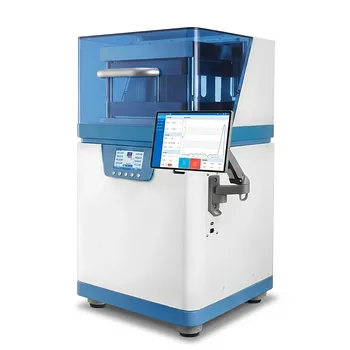
The high-pressure hydrothermal reactor serves as a precision-controlled thermodynamic chamber that enables the in-situ oxidation and structural transformation of MXene. By maintaining a sealed environment at elevated temperatures (typically 120°C to 150°C), the reactor generates autogenous pressure that facilitates the direct growth of anatase-phase titanium dioxide (TiO2) nanoparticles both on the surface and within the interlaminar spaces of the MXene sheets.
Core Takeaway: The hydrothermal reactor is the critical engine for creating a "pillar effect" in composites, where in-situ grown TiO2 nanoparticles act as structural supports that broaden interlaminar channels and prevent the restacking of MXene layers.
The Mechanisms of Hydrothermal Synthesis
Facilitating In-Situ Oxidation
The reactor provides the specific thermodynamic conditions required to trigger the in-situ oxidation of the MXene surface. Rather than simply depositing external particles, the high-pressure environment allows the titanium atoms already present in the MXene structure to react and transform into oxide nanoparticles.
Controlling Phase and Crystallinity
High-pressure reactors allow the aqueous solution to reach temperatures significantly higher than its boiling point. This subcritical environment is essential for the hydrolysis and crystallization of titanium precursors into the highly active anatase phase, which is preferred for its superior photocatalytic performance.
Creating the Pillar Effect
As TiO2 nanoparticles grow between the MXene layers, they function as structural "pillars." This pillar effect broadens the interlaminar channels of the material, significantly increasing the accessible surface area and improving the diffusion of ions or molecules within the composite.
Engineering the Composite Interface
Anisotropic Growth and Morphology
Under the high-pressure conditions of an autoclave, precursors can be driven to grow anisotropically along specific crystal directions. This can result in unique morphologies, such as nanoneedle structures, which provide an abundance of active sites for redox reactions compared to standard spherical particles.
Achieving Molecular-Scale Integration
The sealed system ensures that the components are integrated at a molecular scale rather than through simple physical mixing. The hydrothermal process facilitates chemical anchoring, where metal ions are captured by functional groups on the substrate and converted in situ, ensuring structural stability and efficient electron transfer.
Uniform Distribution in Interlaminar Spaces
Because the reaction occurs in a pressurized liquid phase, the precursors can penetrate deep into the interlaminar spaces of the MXene sheets. This results in a uniform distribution of TiO2 nanoparticles, which is nearly impossible to achieve through dry mixing or ambient-pressure methods.
Understanding the Trade-offs
The Risk of Over-Oxidation
While oxidation is necessary to form TiO2, excessive time or temperature in the reactor can lead to the complete consumption of the MXene core. If the reaction is not precisely timed, the metallic conductivity of the MXene may be lost as it converts entirely into a non-conductive oxide.
Structural Integrity vs. Surface Area
Increasing the pressure and temperature generally increases the size of the TiO2 "pillars," which can broaden channels. However, excessively large particles may cause mechanical strain on the MXene layers, potentially leading to the exfoliation or fragmentation of the composite structure.
Equipment and Safety Constraints
Hydrothermal synthesis requires specialized high-pressure autoclaves (often Teflon-lined) that can withstand corrosive precursors and high autogenous pressures. These systems require careful monitoring of "fill degrees" to prevent dangerous pressure spikes that could lead to equipment failure.
Applying These Insights to Your Material Goals
How to Apply This to Your Project
- If your primary focus is maximizing catalytic activity: Prioritize the hydrothermal parameters (120°C–150°C) that favor the anatase crystalline phase and nanoneedle morphology to increase active sites.
- If your primary focus is energy storage or ion transport: Focus on the pillar effect by adjusting precursor concentration to ensure TiO2 growth is concentrated between layers to keep channels open.
- If your primary focus is maintaining high conductivity: Limit the hydrothermal reaction time to ensure only partial surface oxidation occurs, preserving the conductive MXene core.
By mastering the thermodynamic environment of the high-pressure reactor, researchers can precisely tune the architecture of TiO2/MXene composites for specific industrial and electrochemical applications.
Summary Table:
| Synthesis Aspect | Role of High-Pressure Reactor | Key Benefit |
|---|---|---|
| In-Situ Oxidation | Provides thermodynamic control for Ti transformation | Enhanced structural stability and electron transfer |
| Phase Control | Maintains subcritical water conditions (120°C–150°C) | Formation of highly active anatase-phase TiO2 |
| Pillar Effect | Drives TiO2 growth within interlaminar spaces | Prevents MXene restacking and increases surface area |
| Morphology | Enables anisotropic growth along crystal directions | Creation of nanoneedles with abundant active sites |
| Integration | Facilitates chemical anchoring under pressure | Molecular-scale integration vs. simple physical mixing |
Elevate Your Material Synthesis with KINTEK Precision
Unlock the full potential of your TiO2/MXene research with KINTEK’s specialized high-temperature high-pressure reactors and autoclaves. Our equipment is engineered to provide the precise thermodynamic control necessary for in-situ oxidation, ensuring you achieve the perfect 'pillar effect' and phase crystallinity every time.
At KINTEK, we understand that advanced material science requires more than just standard tools. Our comprehensive portfolio includes:
- Reaction Systems: High-pressure autoclaves, CVD, PECVD, and atmosphere furnaces.
- Sample Prep: Crushing and milling systems, hydraulic pellet presses, and sieving equipment.
- Lab Essentials: ULT freezers, cooling solutions, and high-purity ceramics or crucibles.
Ready to optimize your composite morphology and conductivity? Contact our laboratory experts today to find the ideal high-pressure solution for your specific research goals.
References
- Shunkai Xu, Bin Liu. <i>In situ</i> oxidized TiO<sub>2</sub>/MXene ultrafiltration membrane with photocatalytic self-cleaning and antibacterial properties. DOI: 10.1039/d3ra02230g
This article is also based on technical information from Kintek Solution Knowledge Base .
Related Products
- Customizable Laboratory High Temperature High Pressure Reactors for Diverse Scientific Applications
- High Pressure Laboratory Autoclave Reactor for Hydrothermal Synthesis
- Customizable High Pressure Reactors for Advanced Scientific and Industrial Applications
- Stainless High Pressure Autoclave Reactor Laboratory Pressure Reactor
- Mini SS High Pressure Autoclave Reactor for Laboratory Use
People Also Ask
- How do high-pressure and high-temperature reactors ensure the effective treatment of lignocellulosic wastewater in WAO?
- What equipment is required for high-pressure high-temperature reactions? Master Extreme Chemistry Safely
- How do you control high pressure in a reactor? A Guide to Safe & Stable Operation
- Why is argon better than nitrogen for inert atmosphere? Ensure Absolute Reactivity & Stability
- How does initial oxygen pressure affect the wet oxidation of pharmaceutical sludge? Master Your Oxidation Depth