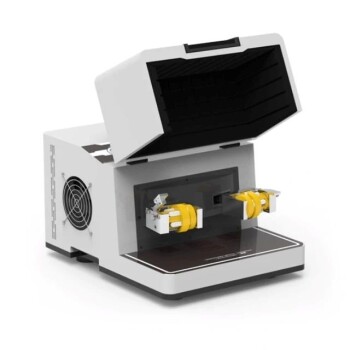
The laboratory ball mill serves as the critical bridge between raw synthesis and practical application. It functions by taking the transparent, brittle solid chunks of synthesized polysilane and subjecting them to mechanical impact to produce a fine powder. This refinement step is essential for converting the unwieldy reaction product into a usable state for coating.
The core value of the ball mill lies in its ability to drastically increase the specific surface area of the polysilane. By transforming large solid chunks into a uniform powder, the mill ensures the material can form even, consistent films during subsequent remelting and coating processes.
The Mechanics of Refinement
Fracture and Reduction
After the chemical reaction cools, polysilane typically exists as a large, brittle solid. This form is unsuitable for direct application.
The ball mill uses mechanical impact to physically crush these large chunks. The kinetic energy from the milling balls fractures the brittle material effectively.
Creating Consistency
The process does not simply break the material; it refines it. Through continuous impact, the mill reduces the polysilane into a uniform, fine powder.
This uniformity is vital. Without it, the final product would suffer from inconsistent particle sizes, leading to unpredictable results during application.
Optimizing for Coating Performance
Increasing Surface Area
The primary technical contribution of the ball mill is the increase of the material's specific surface area.
A higher surface area ensures better interaction during processing. It allows the material to behave predictably when subjected to heat or other application methods.
Ensuring Uniform Film Formation
For polysilanes used in coatings, the end goal is often a smooth, continuous layer.
The fine powder produced by the mill allows for uniform film formation when the material is remelted. This eliminates lumps or uneven thickness that would occur if larger, unrefined chunks were used.
Understanding the Operational Trade-offs
Managing Kinetic Energy
Ball milling utilizes high-energy impact and shear forces. While necessary for size reduction, this energy must be controlled to avoid altering the chemical structure of sensitive polymers.
Environmental Control
While the primary reference focuses on physical reduction, supplementary data on similar powder processing suggests that environmental control is a factor.
In high-energy milling scenarios, materials can become reactive. Using a protective atmosphere, such as argon, helps prevent oxidation during the mixing process, maintaining the high activity and quality of the precursor powder.
Making the Right Choice for Your Goal
To maximize the effectiveness of your polysilane processing, align your milling parameters with your specific end-use requirements:
- If your primary focus is Coating Uniformity: Prioritize a milling duration that guarantees a high specific surface area, as this directly correlates to smoother film formation during remelting.
- If your primary focus is Material Purity: Consider utilizing a protective atmosphere (like argon) within the mill to prevent oxidation induced by the heat and friction of high-energy impact.
The ball mill is not just a grinder; it is a precision tool that defines the consistency and quality of your final polysilane coating.
Summary Table:
| Process Stage | Action | Benefit for Coating |
|---|---|---|
| Fracture | Mechanical impact on brittle solids | Converts raw chunks into workable material |
| Refinement | Continuous grinding and shearing | Ensures uniform particle size distribution |
| Surface Optimization | Increasing specific surface area | Enhances reactivity and melting consistency |
| Film Formation | Processing into fine powder | Guarantees smooth, continuous coating layers |
| Atmosphere Control | Milling under Argon/Inert gas | Prevents oxidation of sensitive polymer precursors |
Elevate Your Material Research with KINTEK Precision
Transforming raw synthesized solids into high-performance coating powders requires more than just grinding—it requires precision. KINTEK specializes in advanced crushing and milling systems designed to give you total control over particle size, uniformity, and material purity.
Whether you are processing sensitive polysilanes or developing next-generation battery materials, our comprehensive portfolio—including laboratory ball mills, planetary mills, and protective atmosphere solutions—ensures your precursors meet the highest standards. Beyond milling, we support your entire workflow with high-temperature furnaces, hydraulic presses, and specialized consumables like ceramic crucibles and PTFE products.
Ready to optimize your coating performance? Contact our technical experts today to find the perfect equipment solution for your laboratory's unique requirements.
References
- Thomas Kisling, Klaus Bretterbauer. Real-Time Monitoring of a Sol–Gel Reaction for Polysilane Production Using Inline NIR Spectroscopy. DOI: 10.1021/acs.langmuir.3c00601
This article is also based on technical information from Kintek Solution Knowledge Base .
Related Products
- Stainless Steel Laboratory Ball Mill for Dry Powder and Liquid with Ceramic Polyurethane Lining
- Laboratory Planetary Ball Mill Rotating Ball Milling Machine
- Laboratory Ball Mill Jar Mill with Metal Alloy Grinding Jar and Balls
- Laboratory Planetary Ball Mill Cabinet Planetary Ball Milling Machine
- Laboratory Jar Ball Mill with Alumina Zirconia Grinding Jar and Balls
People Also Ask
- How do laboratory ball mills facilitate the mechanochemical synthesis of ZIF-8? Solvent-Free Synthesis Explained
- What is the primary function of a laboratory ball mill in the modification of sulfide-based solid electrolytes with LiPO2F2?
- How does a laboratory ball mill ensure the mixing quality of Mn3Zn0.8Sn0.2N and Ti? Achieve Perfect Homogeneity
- What is the function of a laboratory ball mill in the preparation of AMMCs? Optimize Dispersion & Grain Refinement
- In what way does a laboratory ball mill affect material properties when modifying PHBV/pulp fiber composites?