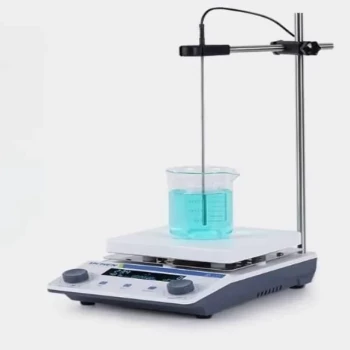
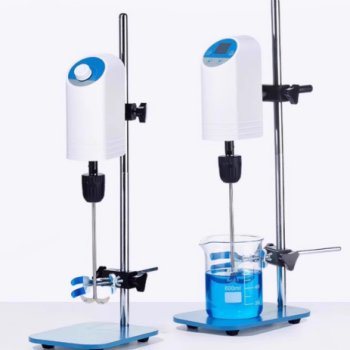
A magnetic stirrer serves as the kinetic driver of the photocatalytic process, ensuring the reaction environment remains dynamic and homogeneous. It provides continuous mechanical power to keep catalyst nanoparticles, such as Zinc Oxide (ZnO), in a constant state of suspension, which prevents settling and maximizes the physical contact required for chemical degradation.
Core Takeaway By maintaining a uniform slurry, a magnetic stirrer eliminates mass transfer limitations and ensures that catalyst particles are evenly exposed to both the target contaminants and the necessary light source. Without this constant agitation, the catalyst precipitates, drastically reducing the reaction surface area and stalling the degradation process.
The Mechanics of Suspension
Preventing Catalyst Precipitation
In a static solution, heavy catalyst powders naturally settle to the bottom of the container. This effectively removes them from the reaction, rendering them useless.
A magnetic stirrer counteracts gravity by applying constant rotational force. This maintains the nanoparticles in a "uniform state of suspension," keeping them active throughout the entire volume of the liquid.
Creating a Stable Slurry System
The goal is to create a stable, homogeneous mixture known as a slurry. This ensures that the ratio of catalyst to fluid is consistent everywhere in the reactor.
By achieving high-frequency rotation, the stirrer prevents the formation of localized gradients. This stability is the foundation for reliable, reproducible results.
Optimizing Reaction Kinetics
Maximizing Surface Contact
Photocatalysis relies on physical contact between the contaminant molecules and the active sites on the catalyst.
Stirring increases the effective "contact surface area." It forces pollutant molecules to collide more frequently with the suspended nanoparticles, accelerating the chemical breakdown.
Eliminating Mass Transfer Limitations
For a reaction to proceed efficiently, pollutant molecules must be able to diffuse to the catalyst surface.
Stirring removes diffusion barriers. It ensures that as soon as a contaminant molecule is degraded, a new one is immediately transported to the active site to take its place.
Enhancing Light Utilization
Ensuring Uniform Light Exposure
A catalyst can only work if it receives energy from ultraviolet (UV) radiation. If particles clump together or settle, they block light from reaching the center of the reaction mass.
Continuous mixing cycles the nanoparticles through the illuminated zones of the reactor. This guarantees that all particles receive uniform irradiation, preventing "dark zones" where no reaction occurs.
Preventing Light Scatter and Blockage
When catalysts precipitate, they form a dense layer that light cannot penetrate. This leads to decreased light utilization efficiency.
By maintaining a dispersed suspension, the stirrer ensures the optical path remains open. This allows the UV radiation to interact fully with the catalyst, driving the degradation rate to its maximum potential.
Understanding the Trade-offs
The Risk of Inconsistent Speed
The mechanical power applied must be constant. If the speed fluctuates, the suspension becomes unstable.
Inconsistent stirring leads to variable reaction rates. This introduces noise into kinetic data, making it impossible to accurately measure degradation efficiency.
Mass Transfer vs. Reaction Rate
It is critical to distinguish between the reaction speed and the mixing speed.
The stirrer ensures the process is limited by the chemical reaction itself, not by how fast fluids move (mass transfer). If you do not stir fast enough, your data reflects poor mixing, not the actual performance of your catalyst.
Making the Right Choice for Your Goal
- If your primary focus is Maximum Degradation Rate: Ensure your stirring speed is high enough to prevent any settling, maximizing the surface area available for UV interaction.
- If your primary focus is Accurate Data Collection: Maintain a strictly constant speed to establish a stable baseline, ensuring that any changes in concentration are due to chemistry, not physical settling.
The magnetic stirrer is not merely a mixing tool; it is a critical control variable that unifies the catalyst, the contaminant, and the light source into a single, efficient reactive system.
Summary Table:
| Feature | Impact on Photocatalytic Reaction | Benefit to Contaminant Removal |
|---|---|---|
| Catalyst Suspension | Prevents nanoparticles (e.g., ZnO) from settling | Maintains maximum active surface area |
| Homogenization | Eliminates localized concentration gradients | Ensures consistent degradation rates throughout the fluid |
| Mass Transfer | Reduces diffusion barriers between pollutants and catalyst | Accelerates chemical breakdown kinetics |
| Light Utilization | Cycles particles through illuminated UV zones | Prevents "dark zones" and ensures uniform irradiation |
| Speed Stability | Maintains a constant reaction baseline | Provides accurate, reproducible kinetic data |
Precision mixing is the heartbeat of efficient photocatalysis. At KINTEK, we understand that high-performance research requires reliable tools. Whether you are optimizing catalyst degradation or conducting complex chemical synthesis, our premium magnetic stirrers, crushing and milling systems, and high-temperature furnaces provide the stability your lab demands. From electrolytic cells to high-pressure reactors and specialized PTFE consumables, KINTEK specializes in laboratory equipment designed for accuracy and durability. Contact us today to equip your laboratory with the industry's most reliable research solutions!
References
- Mohammad Mehdi Baneshi, Hamed Biglari. Gentamicin Removal by Photocatalytic Process from Aqueous Solution. DOI: 10.15244/pjoes/78042
This article is also based on technical information from Kintek Solution Knowledge Base .
Related Products
- Laboratory Small Constant Temperature Heated Magnetic Stirrer Heater and Stirrer
- Custom PTFE Teflon Parts Manufacturer for Magnetic Stirring Bar
- High Performance Laboratory Stirrers for Diverse Applications
- Three-dimensional electromagnetic sieving instrument
- Custom PTFE Teflon Parts Manufacturer for PTFE Stirring Bar Recovery Rod
People Also Ask
- What role does a magnetic stirrer with heating play in ZnO nanoparticle synthesis? Precision Control for Quality Results
- What role does a constant temperature heating magnetic stirrer play in MFC-HAp synthesis? Achieve Material Homogeneity
- What is the function of a laboratory magnetic stirrer in Ni–Cr–P electrodeposition? Optimize Ion Transport & Coating
- Why is a laboratory magnetic stirrer required for benzoic acid esters? Boost Reaction Speed & Yield with High RPM
- What role does a laboratory magnetic stirrer play in TiO2 and TiO2-Ag sol preparation? Master Chemical Kinetics