An electrochemical testing system serves as the definitive diagnostic tool for validating the complex behavior of ordered mesoporous oxide battery electrodes. By integrating a specialized electrochemical workstation, researchers can go beyond simple capacity checks to quantify specific charge storage mechanisms, distinguishing between rapid surface-level reactions and deeper bulk diffusion processes.
Core Insight: The value of an electrochemical workstation lies in its ability to dissect the source of energy storage. It separates diffusion-controlled processes from surface pseudocapacitive behaviors, providing the critical data needed to determine if a material is suitable for high-power-density applications rather than just high energy storage.
Quantifying Charge Storage Dynamics
To evaluate ordered mesoporous oxides effectively, one must understand not just how much energy is stored, but how it is stored.
Distinguishing Storage Mechanisms
The primary function of the workstation is to utilize Cyclic Voltammetry (CV). This technique allows researchers to separate the total charge capabilities of the electrode into distinct components.
Isolation of Pseudocapacitance
Specifically, the system distinguishes between diffusion-controlled bulk intercalation (where ions penetrate deep into the material) and non-diffusion-controlled surface pseudocapacitive behaviors.
Identifying a high ratio of pseudocapacitance is often the goal with mesoporous materials, as it indicates the potential for rapid charging and discharging essential for high-power devices.
Evaluating Structural Efficiency and Kinetics
Ordered mesoporous oxides are engineered with specific pore structures to enhance performance. The testing system verifies if these physical structures are actually delivering electrochemical benefits.
Analyzing Impedance and Transfer
Using Electrochemical Impedance Spectroscopy (EIS), the workstation breaks down the resistance within the cell. It analyzes ohmic and interfacial impedance changes to accurately assess the kinetics of charge transfer.
Assessing Ion Diffusion and Wettability
The workstation reveals how the ordered pore structure contributes to electrolyte wettability. If the electrolyte cannot penetrate the pores, the surface area is wasted.
Furthermore, the system measures ion diffusion rates. It quantifies how effectively the mesoporous channels shorten the diffusion path for ions, a critical factor in reducing internal resistance.
Space-Charge Layer Effects
Advanced analysis allows for the evaluation of space-charge layer effects. This helps researchers understand the electrostatic interactions at the electrode-electrolyte interface that facilitate or hinder ion movement.
Verifying Long-Term Durability
While the workstation analyzes mechanisms, the broader high-precision testing system evaluates the material's endurance in practical scenarios.
Capacity Retention Verification
The system conducts long-term charge-discharge cycles. This stress-testing verifies the capacity retention of the modified electrodes over hundreds of cycles, ensuring the material is stable.
Rate Performance Evaluation
Testing systems perform rate performance evaluations to see how the electrode handles varying current loads. This connects the theoretical kinetic data derived from the workstation to actual performance under stress.
Understanding the Trade-offs
While electrochemical testing systems provide deep insights, they rely on complex data interpretation that carries inherent risks.
Model Dependency
Techniques like EIS rely heavily on equivalent circuit modeling. If the circuit model chosen by the researcher does not perfectly match the physical reality of the porous electrode, the calculated values for diffusion and resistance will be incorrect.
Half-Cell vs. Full-Cell Divergence
Workstations often utilize three-electrode half-cell setups to isolate the working electrode. While excellent for fundamental research, this environment does not always perfectly predict the interactions and cross-talk found in a commercial two-electrode full battery cell.
Making the Right Choice for Your Goal
When analyzing data from your electrochemical system, tailor your focus to your specific engineering objective.
- If your primary focus is High Power Density: Prioritize Cyclic Voltammetry (CV) data to maximize surface pseudocapacitive behaviors and ensure rapid ion availability.
- If your primary focus is Long Cycle Life: Focus on Electrochemical Impedance Spectroscopy (EIS) trends over time to monitor interfacial stability and minimize impedance growth during cycling.
By leveraging these specific analytical techniques, you transform raw data into a precise roadmap for optimizing electrode architecture.
Summary Table:
| Technique | Key Parameter Measured | Benefit for Mesoporous Oxide Analysis |
|---|---|---|
| Cyclic Voltammetry (CV) | Pseudocapacitance vs. Diffusion | Identifies high-power vs. high-energy storage ratios. |
| Impedance Spectroscopy (EIS) | Charge Transfer Resistance ($R_{ct}$) | Evaluates pore structure efficiency and electrolyte wettability. |
| Galvanostatic Cycling | Capacity Retention & Rate Performance | Verifies long-term durability and stability under high loads. |
| Kinetic Analysis | Ion Diffusion Rates ($D_{ion}$) | Quantifies the effectiveness of shortened diffusion paths. |
Elevate Your Battery Research with KINTEK Precision
Accelerate your material discovery with KINTEK’s specialized electrochemical testing systems and laboratory solutions. Whether you are developing ordered mesoporous oxides or next-generation energy storage, we provide the high-performance electrochemical workstations, electrolytic cells, and advanced electrodes required for precise diagnostic analysis.
Our comprehensive portfolio includes:
- Battery Research Tools: High-precision testing systems and specialized consumables.
- High-Temperature Equipment: Muffle, tube, and vacuum furnaces for electrode synthesis.
- Processing Solutions: Crushing, milling, and hydraulic pellet presses for sample preparation.
Maximize your lab's analytical depth and operational efficiency. Contact KINTEK today to find the perfect equipment for your battery research goals!
References
- Erdogan Celik, Matthias T. Elm. Ordered mesoporous metal oxides for electrochemical applications: correlation between structure, electrical properties and device performance. DOI: 10.1039/d1cp00834j
This article is also based on technical information from Kintek Solution Knowledge Base .
Related Products
- Lab Electrochemical Workstation Potentiostat for Laboratory Use
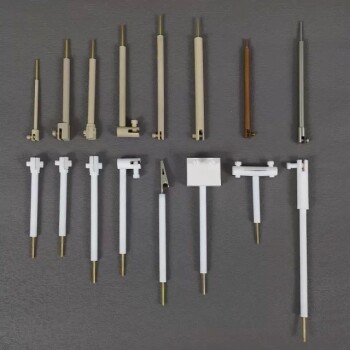
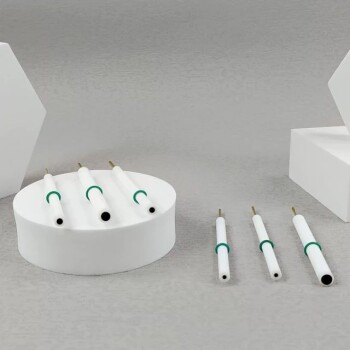
- Electrode Fixture for Electrochemical Experiments
- Glassy Carbon Electrochemical Electrode
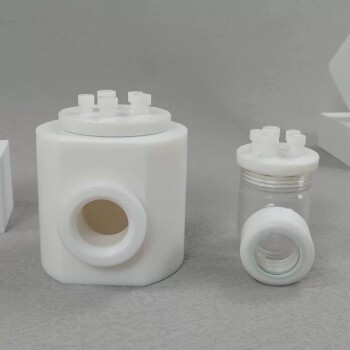
- Side Window Optical Electrolytic Electrochemical Cell
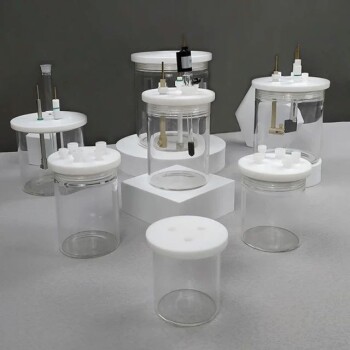
- Electrolytic Electrochemical Cell with Five-Port
People Also Ask
- How does an electrochemical workstation assist in assessing corrosion resistance? Quantify Laser-Remelted Steel Performance
- What are the primary functions of an electrochemical workstation (Potentiostat)? Expert Titanium Alloy Corrosion Analysis
- What is the primary function of a high-precision electrochemical workstation? Optimize Your Reactor Performance
- What role do electrochemical workstations play in researching the corrosion resistance of carbon coatings? Expert Guide
- What characteristics are analyzed using an electrochemical workstation during EIS testing of solid-state batteries?