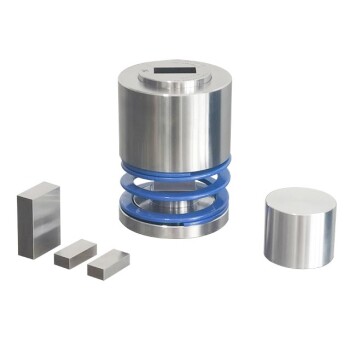
Ultra-high pressure equipment is the essential mechanism for forcing hydride anions into the nanocage structure of C12A7 and ensuring their stable encapsulation. By creating a controlled environment of 0.5 to 0.75 GPa at temperatures between 1200°C and 1300°C, these systems facilitate the solid-state reactions required to transition ions into the material's lattice. This high-pressure threshold is what allows the hydrogen ions to overcome physical resistance and remain securely trapped within the atomic cages.
The primary role of ultra-high pressure equipment is to provide the extreme physical force necessary to drive hydride ions into C12A7 nanocages while simultaneously acting as a seal to prevent the escape of active components and the entry of impurities.
The Mechanics of High-Pressure Encapsulation
Overcoming the Solid-State Reaction Barrier
At standard pressures, introducing hydride ions into the rigid C12A7 nanocage structure is energetically unfavorable. Ultra-high pressure equipment provides the 0.5 to 0.75 GPa of force required to drive these ions into the internal cavities of the material during synthesis.
Forcing Ion Migration at Temperature
The equipment maintains extreme pressure alongside temperatures of 1200°C to 1300°C, which mobilizes the ions. This combination ensures that the hydrogen ions do not simply rest on the surface but are forced into the framework to achieve a true encapsulated state.
Ensuring Lattice Stability
The high-pressure environment stabilizes the C12A7 lattice during the reaction phase, preventing the structure from collapsing under heat. This stability is vital for maintaining the geometric integrity of the cages so they can effectively "trap" the hydride anions as the material cools.
Environmental Control and Material Purity
Suppressing Active Component Loss
One of the critical functions of ultra-high pressure is the suppression of component evaporation. By exerting massive external force, the equipment prevents active components within the nanocages from escaping or "leaking" out during the high-temperature synthesis phase.
Blocking Impurity Infiltration
The high-pressure seal acts as a barrier against the external environment. This prevents the infiltration of impurity ions that would otherwise compete with hydride anions for space within the cages, thereby ensuring a higher concentration of the desired C12A7:H- material.
Enhancing Material Homogeneity
By maintaining a consistent pressure field, the equipment ensures that the solid-state reaction occurs uniformly throughout the sample. This results in a more homogenous distribution of hydride anions across the entire C12A7 structure, which is critical for consistent material performance.
Understanding the Trade-offs
Equipment Complexity and Cost
The primary drawback of using ultra-high pressure equipment is the significant capital investment required for the machinery. These systems require specialized materials to withstand the simultaneous stress of GPa-level pressure and 1300°C temperatures, leading to higher operational costs.
Throughput and Scalability Limitations
High-pressure synthesis is often a batch-oriented process rather than a continuous one. This can limit the volume of C12A7:H- produced at any one time compared to ambient-pressure chemical vapor deposition methods, making it more suitable for high-purity specialized applications than mass-market production.
Material Stress and Yield
While pressure is necessary for encapsulation, excessive or uneven pressure can lead to structural defects or cracking in the ceramic framework. Precision control is mandatory to balance the force needed for ion insertion with the physical limits of the C12A7 lattice.
Applying Ultra-High Pressure to Your Synthesis Goal
Achieving the correct balance of pressure and temperature is essential for producing high-quality C12A7:H- materials. Your specific synthesis parameters should be dictated by your requirements for purity and ion density.
- If your primary focus is maximum hydride concentration: Prioritize maintaining the upper limit of the pressure range (0.75 GPa) to ensure the highest possible force is applied to the ion migration process.
- If your primary focus is material purity: Focus on the airtight integrity of the high-pressure vessel to prevent any atmospheric impurities from entering the reaction chamber at high temperatures.
- If your primary focus is structural integrity: Carefully calibrate the cooling cycle while under pressure to prevent thermal shock and cracking within the nanocage framework.
The use of ultra-high pressure equipment remains the definitive method for creating stable, high-performance C12A7:H- materials through precise ionic encapsulation.
Summary Table:
| Synthesis Factor | Requirement/Range | Role in C12A7:H- Synthesis |
|---|---|---|
| Pressure | 0.5 to 0.75 GPa | Forces hydride ions into nanocages and prevents evaporation. |
| Temperature | 1200°C to 1300°C | Mobilizes ions to facilitate migration into the lattice. |
| Environment | Controlled High-Pressure | Suppresses impurity infiltration and ensures material purity. |
| Lattice Goal | Geometric Integrity | Stabilizes cages to securely trap anions during cooling. |
Elevate Your Material Synthesis with KINTEK Precision
Achieving the extreme conditions required for C12A7:H- synthesis demands equipment that never compromises on performance. KINTEK specializes in high-performance laboratory solutions, providing the isostatic presses, high-temperature furnaces, and high-pressure reactors essential for stable ionic encapsulation.
From advanced vacuum and atmosphere furnaces to precision hydraulic pellet presses and crucibles, our portfolio is designed to help researchers overcome solid-state reaction barriers and ensure material homogeneity. Whether you are focusing on battery research tools or specialized ceramic synthesis, KINTEK offers the reliability, technical expertise, and OEM/ODM support you need to drive innovation.
Ready to optimize your high-pressure research? Contact KINTEK today to find the perfect equipment for your laboratory!
References
- Xiangyu Zhang, Tian‐Nan Ye. Recent progress and prospects in active anion-bearing C12A7-mediated chemical reactions. DOI: 10.1039/d3ta02422a
This article is also based on technical information from Kintek Solution Knowledge Base .
Related Products
- Customizable Laboratory High Temperature High Pressure Reactors for Diverse Scientific Applications
- Customizable High Pressure Reactors for Advanced Scientific and Industrial Applications
- Mini SS High Pressure Autoclave Reactor for Laboratory Use
- High Pressure Laboratory Autoclave Reactor for Hydrothermal Synthesis
- Stainless High Pressure Autoclave Reactor Laboratory Pressure Reactor
People Also Ask
- How do high-pressure and high-temperature reactors ensure the effective treatment of lignocellulosic wastewater in WAO?
- What equipment is required for high-pressure high-temperature reactions? Master Extreme Chemistry Safely
- How do you control high pressure in a reactor? A Guide to Safe & Stable Operation
- How does initial oxygen pressure affect the wet oxidation of pharmaceutical sludge? Master Your Oxidation Depth
- Why is argon better than nitrogen for inert atmosphere? Ensure Absolute Reactivity & Stability