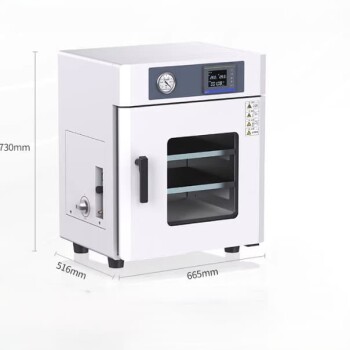
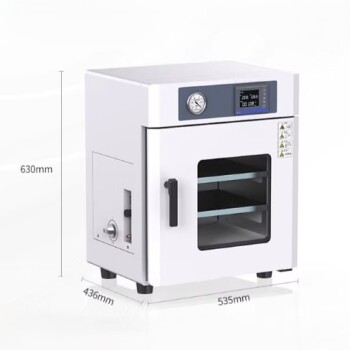
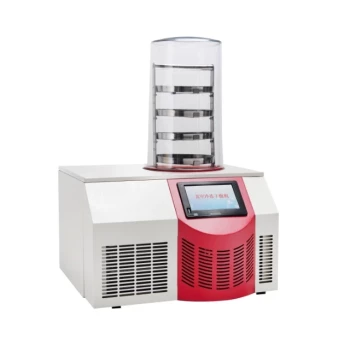
In the preparation of polymer-inorganic composite solid electrolytes, the vacuum drying oven serves as the critical purification stage. It functions by creating a heated, low-pressure environment that forces the deep evaporation of residual organic solvents and trace moisture from polymer matrices like PEO or PVDF.
Core Takeaway Achieving a stable solid-state battery depends entirely on the purity of the electrolyte layer. The vacuum drying process eliminates contaminants that cause side reactions and lithium anode corrosion, thereby securing the low interface impedance and high electrochemical stability required for performance.
The Mechanics of Solvent and Moisture Removal
Facilitating the Solution Casting Process
Polymer-inorganic composites are frequently produced via solution casting, where polymers are dissolved in organic solvents such as Dimethylformamide (DMF) or Dimethylacetamide (DMAc).
Once the membrane is cast, the vacuum drying oven is utilized to remove these solvents.
Because these solvents can be trapped deep within the polymer chains, standard air drying is often insufficient. The vacuum environment lowers the vapor pressure, pulling these stubborn solvents out of the composite structure.
Lowering Boiling Points for Gentle Drying
High temperatures can degrade sensitive polymer chains or alter the crystalline structure of the composite.
By operating under vacuum, the oven lowers the effective boiling point of solvents and water.
This allows researchers to remove liquids at moderate temperatures (often 50°C to 100°C), preventing thermal degradation while ensuring the material is thoroughly dried.
Ensuring Electrochemical Stability
Preventing Anode Corrosion
The most critical deep need addressed by vacuum drying is the protection of the metallic lithium anode.
Residual moisture or solvents left in the electrolyte membrane will react chemically with lithium metal.
This reaction leads to corrosion and the formation of a high-impedance layer at the interface, which severely degrades battery cycling performance.
Pre-treatment of Hygroscopic Raw Materials
Vacuum drying is not only used for the final membrane but also for the pre-treatment of raw materials.
Components like PEO polymers and lithium salts (e.g., LiTFSI) are highly hygroscopic, meaning they absorb moisture from the air.
Thorough dehydration of these precursors in a vacuum oven before processing is a vital step to prevent introducing water into the system from the very beginning.
Understanding the Trade-offs
Temperature vs. Structural Integrity
While heat speeds up drying, excessive temperatures can damage the polymer matrix or cause inorganic fillers to aggregate.
You must balance the thermal limit of your polymer (e.g., PEO melts at relatively low temperatures) against the boiling point of the solvent you are trying to remove.
Rapid Evaporation Risks
Applying a high vacuum too quickly can cause solvents to boil violently within the membrane.
This can result in micro-cracks or pinholes in the solid electrolyte.
These structural defects can compromise the mechanical strength of the membrane and lead to short circuits during battery operation.
Making the Right Choice for Your Goal
To maximize the effectiveness of your vacuum drying process, tailor your approach to your specific performance metrics:
- If your primary focus is Cycle Life: Prioritize longer drying times at moderate temperatures to ensure absolute removal of moisture, which is the primary driver of continuous anode corrosion.
- If your primary focus is Ionic Conductivity: Ensure the drying temperature does not exceed the polymer's melting point to maintain the optimal amorphous/crystalline ratio necessary for ion transport.
- If your primary focus is Manufacturing Speed: Utilize a staged vacuum protocol to ramp pressure down gradually, preventing structural defects while accelerating solvent removal.
The vacuum drying oven acts as the final gatekeeper, ensuring that chemically active precursors are transformed into a stable, high-performance solid electrolyte.
Summary Table:
| Stage | Function | Impact on Performance |
|---|---|---|
| Pre-treatment | Dehydration of hygroscopic salts & polymers | Prevents moisture-induced side reactions |
| Solvent Removal | Evaporation of DMF/DMAc at low pressure | Ensures membrane purity and structural integrity |
| Low-Temp Drying | Prevents polymer thermal degradation | Maintains optimal amorphous/crystalline ratio |
| Final Purification | Eliminates trace impurities | Protects lithium anode and reduces interface impedance |
Elevate Your Solid-State Battery Research with KINTEK
Precise control over moisture and solvent removal is non-negotiable for high-performance electrolytes. KINTEK specializes in advanced laboratory equipment, providing the specialized vacuum drying ovens and crushing and milling systems necessary to produce defect-free polymer-inorganic composites.
From high-temperature furnaces and hydraulic presses for material synthesis to ULT freezers and PTFE consumables for specialized storage, we offer a comprehensive portfolio tailored to battery research and material science.
Ready to optimize your electrolyte stability? Contact our technical experts today to find the perfect equipment solution for your lab.
Related Products
- 56L Vertical Laboratory Vacuum Drying Oven
- 23L Laboratory Vacuum Drying Oven
- Laboratory Scientific Electric Heating Blast Drying Oven
- Benchtop Laboratory Vacuum Freeze Dryer
- Vacuum Heat Treat Sintering Brazing Furnace
People Also Ask
- Why is a laboratory vacuum drying oven recommended for rice straw residues? Protect Your Biomass Integrity
- What role does a laboratory vacuum drying oven play in the preparation of modified multi-walled carbon nanotubes?
- What is the importance of using a laboratory vacuum drying oven? Preserving Slow-Release Microcapsule Integrity
- Why is a Laboratory Vacuum Drying Oven recommended for PBAT microspheres? Protect Sensitive Polymer Integrity
- What role does a laboratory vacuum drying oven play in processing nanoparticle powder samples? Protect Sample Integrity