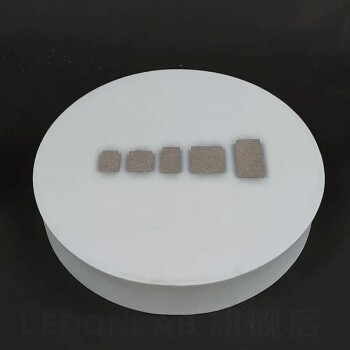
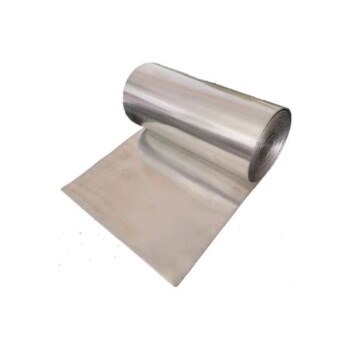
In the assembly of solid-state coin cells, nickel foam serves a dual purpose as both a structural spacer and an electrical current collector. Its porous, three-dimensional architecture allows it to facilitate electron flow while simultaneously acting as a mechanical buffer within the cell casing.
Core Insight: Beyond simple conductivity, nickel foam solves the critical mechanical challenge of interface stability in solid-state batteries. By acting as an elastic spring, it accommodates volume expansion during cycling to ensure continuous contact between the electrode and the solid electrolyte.
The Mechanical Role: Solving Interface Stability
In solid-state batteries, maintaining physical connection between layers is far more difficult than in liquid-based systems. Nickel foam addresses this through its physical properties.
Acting as an Elastic Buffer
The foam functions as a compressible layer inside the rigid coin cell casing. Because of its porous structure, it acts as a buffer that can absorb mechanical variance within the cell stack.
Maintaining Electrode Contact
Solid electrolytes require consistent pressure to interface effectively with electrodes. The nickel foam ensures this consistent physical contact remains intact, bridging the gap between the cell casing and the active materials.
Accommodating Volume Changes
Battery materials naturally expand and contract during charge and discharge cycles. The foam’s elasticity allows it to compress and rebound, accommodating these volume changes without breaking the electrical or ionic connection.
The Electrical Role: Enhancing Conductivity
While its mechanical properties are vital for assembly, nickel foam remains a highly effective electrical component.
Three-Dimensional Conduction
Unlike flat metal foils, nickel foam provides a three-dimensional structure. This creates a vast network of efficient electron conduction paths throughout the interface area.
Functioning as a Current Collector
The foam actively collects electrons generated during the chemical reaction. Its structure ensures that this current is efficiently gathered and channeled out of the cell, minimizing resistance.
Critical Considerations and Trade-offs
While nickel foam is beneficial, it introduces specific constraints that must be factored into the cell design.
Volumetric Efficiency
By functioning as a spacer, the foam occupies internal volume within the coin cell. This space is taken up by inactive structural material rather than active energy-storing chemistry, potentially impacting total energy density.
Dependence on Mechanical Pressure
The system relies heavily on the foam's ability to maintain elasticity over time. If the foam permanently deforms or loses its "spring" effect, the critical contact with the solid electrolyte may degrade.
Making the Right Choice for Your Goal
When designing solid-state coin cells, the use of nickel foam should be driven by your specific mechanical and electrical requirements.
- If your primary focus is Interface Stability: Prioritize nickel foam to maintain stack pressure and ensure constant contact between the electrode and the solid electrolyte.
- If your primary focus is Cycle Life: Utilize the foam’s buffering capacity to accommodate material expansion and contraction, preventing delamination during repeated charging.
Nickel foam transforms the passive role of a spacer into an active component that secures both the mechanical integrity and electrical efficiency of the cell.
Summary Table:
| Function | Key Benefit | Impact on Battery Performance |
|---|---|---|
| Mechanical Buffer | Acts as an elastic spring | Accommodates volume expansion and prevents delamination. |
| Current Collector | 3D porous architecture | Provides efficient electron conduction paths and lowers resistance. |
| Interface Support | Maintains constant pressure | Ensures continuous physical contact between electrode and solid electrolyte. |
| Spacer Role | Structural integration | Simplifies internal cell stack assembly within rigid casings. |
Elevate Your Battery Research with KINTEK Precision
Ready to optimize your solid-state battery assembly? KINTEK specializes in high-performance laboratory equipment and specialized consumables designed for cutting-edge energy research.
Whether you need precision hydraulic pellet presses for solid electrolyte preparation, advanced vacuum furnaces, or specialized battery research tools and nickel foam consumables, our comprehensive portfolio ensures your lab achieves superior interface stability and electrical efficiency.
Contact us today to find the perfect equipment for your research goals!
Related Products
- Nickel Foam for Industrial and Laboratory Applications
- Copper Nickel Foam Metal Sheet
- Copper Foam
- High Purity Zinc Foil for Battery Lab Applications
- Nickel Aluminum Tabs for Soft Pack Lithium Batteries
People Also Ask
- What procedures should be followed after using nickel or copper foam? A Guide to Reliable Reuse and Performance
- What is nickel foam used for? A Guide to Its Electrochemical Applications
- In which fields is nickel foam widely used? A Key Material for Advanced Engineering
- What procedures should be followed before using nickel or copper foam? Ensure Optimal Performance and Reliability
- What are the advantages of using high-porosity Nickel Foam or Nickel Mesh? Boost Your MEC Performance