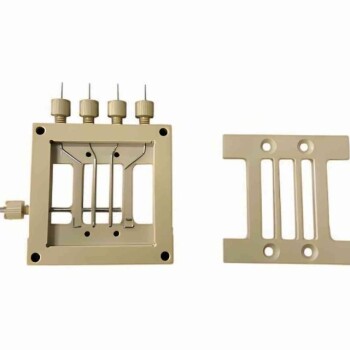
Electrolytic polishing represents the definitive method for preparing FeCrAl alloy samples for high-fidelity microstructural analysis. By utilizing an electrolytic cell with a specific perchloric acid-alcohol solution, this process electrochemically dissolves the surface to eliminate microscopic scratches and the mechanically disturbed layer left by initial grinding.
While mechanical polishing creates a reflective surface, it often masks the true microstructure under a layer of deformation. Electrolytic polishing removes this stress-induced artifact, revealing the authentic, stress-free grain structure necessary for accurate optical observation.
The Mechanics of Surface Preparation
Controlled Anodic Dissolution
The electrolytic cell functions by creating a controlled electrochemical environment. By applying a specific voltage, the FeCrAl sample acts as the anode, allowing the surface material to dissolve into the electrolyte.
The Electrolyte Solution
The process typically utilizes a mixture of perchloric acid and alcohol (often ethanol). This specific chemical environment is calibrated to smooth the alloy surface at a microscopic level, far beyond what abrasive pads can achieve.
Elimination of Mechanical Artifacts
Standard mechanical grinding inevitably leaves a "disturbed layer" of deformed material on the sample surface. The electrolytic cell removes this layer entirely, ensuring that the features observed are inherent to the material, not the preparation process.
Why FeCrAl Alloys Demand Electrolytic Polishing
Revealing True Grain Boundaries
For FeCrAl alloys, obtaining a stress-free surface is critical for defining grain boundaries. This clarity is essential for distinguishing between original grain structures and deformed grain characteristics under an optical microscope.
Analyzing Complex Welding Zones
This method is particularly decisive when analyzing samples subjected to Friction Stir Welding (FSW), such as MA956 steel. Mechanical polishing often obscures the ultra-fine features found in the Thermomechanically Affected Zone (TMAZ) and the Stir Zone (SZ).
Removing Work-Hardened Layers
The electrochemical process effectively strips away the work-hardened layer created during sectioning and grinding. This reveals the "true" structure of the alloy, allowing for precise evaluation of microstructural evolution.
Understanding the Trade-offs
Chemical Safety Risks
The use of perchloric acid electrolytes presents significant safety challenges compared to mechanical abrasives. These solutions are reactive and require careful handling within the electrolytic cell to prevent hazardous situations.
Sensitivity to Voltage Settings
Success is highly dependent on applying the correct voltage. Incorrect settings can lead to pitting or etching rather than polishing, failing to produce the required flat, stress-free surface.
Making the Right Choice for Your Goal
To ensure your microstructural analysis yields valid data, align your preparation method with your specific analytical needs:
- If your primary focus is general surface flatness: Electrolytic polishing is superior to mechanical methods for removing the final microscopic scratches that obscure visibility.
- If your primary focus is analyzing deformation zones (like FSW): This method is non-negotiable, as it is the only way to reveal the ultrafine grain structures in the TMAZ and SZ without mechanical distortion.
Electrolytic polishing transforms a prepared sample from a merely shiny object into an accurate scientific specimen.
Summary Table:
| Feature | Mechanical Polishing | Electrolytic Polishing (Electrolytic Cell) |
|---|---|---|
| Surface Effect | Creates reflective surface but masks artifacts | Removes disturbed layers and microscopic scratches |
| Structure Clarity | Deforms surface grains and grain boundaries | Reveals true grain boundaries and authentic structure |
| Welding Zones | Often obscures fine features in TMAZ/SZ | Essential for visualizing ultra-fine stir zone features |
| Process Type | Physical abrasion with pads/compounds | Controlled electrochemical anodic dissolution |
| Material Stress | Leaves a work-hardened, disturbed layer | Eliminates stress-induced layers completely |
Precision Sample Preparation Starts Here
To achieve high-fidelity microstructural analysis, you need equipment that ensures absolute surface integrity. KINTEK specializes in advanced laboratory solutions, providing the high-performance electrolytic cells and electrodes necessary for precise electrochemical polishing of FeCrAl alloys and other specialized materials.
Our extensive portfolio supports every stage of your research, including:
- Material Processing: High-temperature furnaces (muffle, vacuum, CVD) and crushing systems.
- Sample Preparation: Hydraulic pellet presses, isostatic presses, and premium ceramic crucibles.
- Advanced Research: Battery research tools, high-pressure reactors, and precise cooling solutions.
Don't let mechanical artifacts compromise your data. Contact KINTEK today to discuss how our specialized electrolytic cells and laboratory consumables can enhance your microstructural observation and research outcomes.
References
- Huan Sheng Lai, Wenzhong Zhou. Effect of Rolling Deformation on Creep Properties of FeCrAl Alloys. DOI: 10.3389/fenrg.2021.663578
This article is also based on technical information from Kintek Solution Knowledge Base .
Related Products
- PTFE Electrolytic Cell Electrochemical Cell Corrosion-Resistant Sealed and Non-Sealed
- Super Sealed Electrolytic Electrochemical Cell
- Electrolytic Electrochemical Cell with Five-Port
- H Type Electrolytic Cell Triple Electrochemical Cell
- Electrolytic Electrochemical Cell Gas Diffusion Liquid Flow Reaction Cell
People Also Ask
- What is the necessity of selecting a PTFE electrolytic cell? Ensure Precise Graphene Corrosion Testing Accuracy
- What is the proper method for cleaning the surface of an all-PTFE electrolytic cell? Ensure Accurate Results with a Pristine Surface
- How should an all-PTFE electrolytic cell be stored after use? Expert Maintenance Tips for Long-Lasting Performance
- What is the proper cleaning method for an all-PTFE electrolytic cell? Essential Tips for Surface Integrity
- What are the standard opening specifications for all-PTFE electrolytic cells? A Guide to Sealed vs. Non-Sealed Ports