Knowledge What is the recommended polishing sequence for a disk electrode that has scratches? Restore Your Surface to a Mirror Finish
Author avatar

Tech Team · Kintek Solution

Updated 1 day ago

What is the recommended polishing sequence for a disk electrode that has scratches? Restore Your Surface to a Mirror Finish


To restore a scratched disk electrode, you must employ a sequential polishing process using descending alumina powder sizes. You should begin with coarse 1.0 µm powder to remove the physical damage, then progress through 0.5 µm and 0.3 µm steps, concluding with a final 0.05 µm mirror finish.

The presence of physical scratches requires a coarse-to-fine restoration workflow rather than the standard single-step polish. Success depends not just on the particle sequence, but on rigorous inspection and cleaning between each step to ensure the surface remains flat and uncontaminated.

The Correct Polishing Sequence

Step 1: Coarse Polishing

If scratches are visible, standard fine polishing will not suffice. You must start with 1.0 µm alumina powder.

This coarser grit is designed to grind down the surface layer, effectively removing the depth of the scratch.

Step 2: Intermediate Smoothing

Once the deep scratches are removed, you must smooth the surface texture. Proceed to polish with 0.5 µm alumina powder.

Follow this immediately with 0.3 µm alumina powder. These intermediate steps bridge the gap between the coarse grind and the final finish.

Step 3: The Final Mirror Finish

The last step is the standard maintenance polish used for daily cleaning. Use 0.05 µm alumina powder to achieve a mirror-like surface.

This step ensures the electrode is electrochemically active and free of micro-abrasions.

Execution and Technique

Preparing the Surface

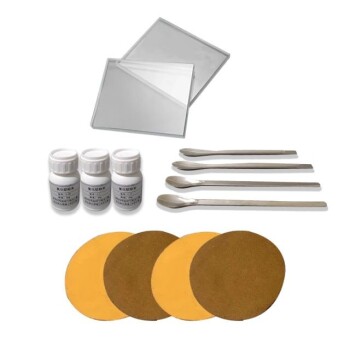
Adhere a suede polishing cloth to your polishing plate. Apply the specific alumina powder grit for your current step and moisten it with distilled water to form a paste.

Proper Motion and Orientation

Hold the electrode strictly perpendicular to the polishing pad. This vertical orientation is critical to maintaining the geometric integrity of the disk.

Polish the electrode using a figure-eight, circular, or linear motion.

Cleaning Between Steps

After completing a specific grit size (e.g., moving from 1.0 µm to 0.5 µm), you must thoroughly clean the electrode. Use ethanol or deionized water to remove all residual polishing paste.

Common Pitfalls to Avoid

Risk of Cross-Contamination

Never use a fine-grit cloth with coarse-grit residue. If you carry 1.0 µm particles onto a cloth designated for 0.05 µm, you will introduce new scratches rather than removing them.

Compromising Electrode Geometry

The most common error is failing to hold the electrode perpendicular to the pad. If you polish at an angle, you will round the edges of the disk.

This alters the active surface area, which leads to inaccurate experimental data.

Making the Right Choice for Your Goal

  • If your primary focus is repairing scratches: Execute the full sequence (1.0 µm $\rightarrow$ 0.5 µm $\rightarrow$ 0.3 µm $\rightarrow$ 0.05 µm) to resurface the material.
  • If your primary focus is routine maintenance: Skip the coarser grits and use only the 0.05 µm alumina powder to clean the surface.

Treat the polishing process as a precision restoration, where patience and cleanliness are just as important as the materials you use.

Summary Table:

Polishing Phase Alumina Grit Size Purpose Key Technique
Coarse 1.0 µm Remove physical scratches and damage Hold electrode strictly perpendicular
Intermediate 0.5 µm & 0.3 µm Smooth surface texture and bridge grit gap Thoroughly clean with ethanol between steps
Final 0.05 µm Achieve a mirror-like, active surface Use designated fine-grit suede cloth
Maintenance 0.05 µm Only Routine cleaning of unscratched electrodes Ensure no cross-contamination from coarse grit

Enhance Your Electrochemical Precision with KINTEK

Don't let surface imperfections compromise your research data. KINTEK specializes in high-performance laboratory equipment and consumables designed for the most demanding scientific applications. Whether you are maintaining electrolytic cells and electrodes, conducting battery research, or utilizing our advanced high-temperature furnaces and reactors, we provide the precision tools you need for success.

From premium polishing powders to essential laboratory ceramics and PTFE products, KINTEK is your partner in achieving consistent, reliable results. Contact us today to explore our comprehensive range of consumables and equipment tailored for your laboratory's needs.

Related Products

People Also Ask

Related Products

Electrode Polishing Material for Electrochemical Experiments

Electrode Polishing Material for Electrochemical Experiments

Looking for a way to polish your electrodes for electrochemical experiments? Our polishing materials are here to help! Follow our easy instructions for best results.

Cylindrical Press Mold with Scale for Lab

Cylindrical Press Mold with Scale for Lab

Discover precision with our Cylindrical Press Mold. Ideal for high-pressure applications, it molds various shapes and sizes, ensuring stability and uniformity. Perfect for lab use.

Isostatic Molding Pressing Molds for Lab

Isostatic Molding Pressing Molds for Lab

Explore high-performance isostatic pressing molds for advanced material processing. Ideal for achieving uniform density and strength in manufacturing.

Vacuum Hot Press Furnace Machine for Lamination and Heating

Vacuum Hot Press Furnace Machine for Lamination and Heating

Experience clean and precise lamination with Vacuum Lamination Press. Perfect for wafer bonding, thin-film transformations, and LCP lamination. Order now!

Custom PTFE Wafer Holders for Lab and Semiconductor Processing

Custom PTFE Wafer Holders for Lab and Semiconductor Processing

This is a high-purity, custom-machined PTFE (Teflon) holder, expertly designed for the secure handling and processing of delicate substrates like conductive glass, wafers, and optical components.

Warm Isostatic Press WIP Workstation 300Mpa for High Pressure Applications

Warm Isostatic Press WIP Workstation 300Mpa for High Pressure Applications

Discover Warm Isostatic Pressing (WIP) - A cutting-edge technology that enables uniform pressure to shape and press powdered products at a precise temperature. Ideal for complex parts and components in manufacturing.

Automatic Lab Cold Isostatic Press CIP Machine Cold Isostatic Pressing

Automatic Lab Cold Isostatic Press CIP Machine Cold Isostatic Pressing

Efficiently prepare samples with our Automatic Lab Cold Isostatic Press. Widely used in material research, pharmacy, and electronic industries. Provides greater flexibility and control compared to electric CIPs.

Cold Isostatic Pressing Machine CIP for Small Workpiece Production 400Mpa

Cold Isostatic Pressing Machine CIP for Small Workpiece Production 400Mpa

Produce uniformly high-density materials with our Cold Isostatic Press. Ideal for compacting small workpieces in production settings. Widely used in powder metallurgy, ceramics, and biopharmaceutical fields for high-pressure sterilization and protein activation.

Laboratory Manual Hydraulic Pellet Press for Lab Use

Laboratory Manual Hydraulic Pellet Press for Lab Use

Efficient sample preparation with small footprint Manual Lab Hydraulic Press. Ideal for material researching labs, pharmacy, catalytic reaction, and ceramics.

Automatic Laboratory Hydraulic Pellet Press Machine for Lab Use

Automatic Laboratory Hydraulic Pellet Press Machine for Lab Use

Experience efficient sample preparation with our Automatic Lab Press Machine. Ideal for material research, pharmacy, ceramics, and more. Features a compact size and hydraulic press functionality with heating plates. Available in various sizes.

Vacuum Cold Trap Direct Cold Trap Chiller

Vacuum Cold Trap Direct Cold Trap Chiller

Improve vacuum system efficiency and extend pump life with our Direct Cold Trap. No chilling fluid required, compact design with swivel casters. Stainless steel and glass options available.

Vacuum Cold Trap Chiller Indirect Cold Trap Chiller

Vacuum Cold Trap Chiller Indirect Cold Trap Chiller

Boost vacuum system efficiency and prolong pump life with our Indirect Cold Trap. Built-in chilling system with no need for fluid or dry ice. Compact design and easy to use.

Custom PTFE Teflon Parts Manufacturer for Non-Standard Insulator Customization

Custom PTFE Teflon Parts Manufacturer for Non-Standard Insulator Customization

PTFE insulator PTFE has excellent electrical insulation properties in a wide temperature and frequency range.

Zirconia Ceramic Gasket Insulating Engineering Advanced Fine Ceramics

Zirconia Ceramic Gasket Insulating Engineering Advanced Fine Ceramics

Zirconia insulating ceramic gasket has high melting point, high resistivity, low thermal expansion coefficient and other properties, making it an important high temperature resistant material, ceramic insulating material and ceramic sunscreen material.

Manual High Temperature Heated Hydraulic Press Machine with Heated Plates for Lab

Manual High Temperature Heated Hydraulic Press Machine with Heated Plates for Lab

The High Temperature Hot Press is a machine specifically designed for pressing, sintering and processing materials in a high temperature environment. It is capable of operating in the range of hundreds of degrees Celsius to thousands of degrees Celsius for a variety of high temperature process requirements.

Iridium Dioxide IrO2 for Water Electrolysis

Iridium Dioxide IrO2 for Water Electrolysis

Iridium dioxide, whose crystal lattice is rutile structure. Iridium dioxide and other rare metal oxides can be used in anode electrodes for industrial electrolysis and microelectrodes for electrophysiological research.

Laboratory manual slicer

Laboratory manual slicer

Manual microtome is a high-precision cutting device designed for laboratories, industry and medical fields. It is suitable for the preparation of thin slices of various materials such as paraffin samples, biological tissues, battery materials, food, etc.

KF ISO Stainless Steel Vacuum Flange Blind Plate for High Vacuum Systems

KF ISO Stainless Steel Vacuum Flange Blind Plate for High Vacuum Systems

Discover KF/ISO stainless steel vacuum flange blind plates, ideal for high vacuum systems in semiconductor, photovoltaic, and research labs. High-quality materials, efficient sealing, and easy installation.<|end▁of▁sentence|>

Custom PTFE Teflon Parts Manufacturer Laboratory High Temperature Mixing Paddle Mixer

Custom PTFE Teflon Parts Manufacturer Laboratory High Temperature Mixing Paddle Mixer

The PTFE mixing paddle mixer is a versatile and robust tool designed for laboratory use, particularly in environments requiring high resistance to chemicals and extreme temperatures. Crafted from high-quality PTFE, this mixer boasts several key features that enhance its functionality and durability.


Leave Your Message