While your question is about torch brazing, the most significant advantages in modern manufacturing come from controlled-atmosphere methods like furnace and vacuum brazing. These processes offer superior control, cleanliness, and strength, making them ideal for high-precision or complex assemblies where manual torch methods would introduce inconsistencies and contamination.
The core advantage of modern furnace and vacuum brazing is the ability to create exceptionally clean, strong, and distortion-free joints in a highly repeatable process. This is achieved by precisely controlling the heating and cooling of the entire assembly within a protective atmosphere, eliminating the need for corrosive fluxes.
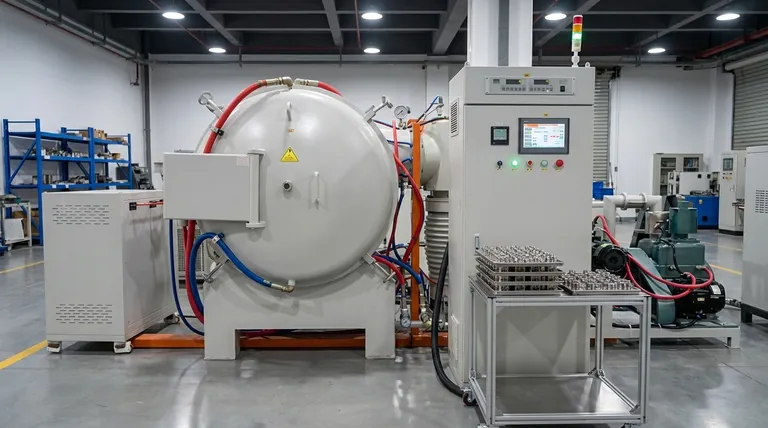
Understanding Furnace and Vacuum Brazing
Torch brazing involves a localized, manually applied flame. In contrast, furnace and vacuum brazing heat the entire component assembly inside a sealed chamber. This fundamental difference is the source of their primary advantages.
Exceptional Joint Quality and Strength
The controlled environment is key to quality. By removing oxygen and other contaminants, these methods produce superior joints.
This results in a contaminant-free joint, as impurities like oxides are prevented from forming or are removed by the vacuum. This process eliminates the risk of flux inclusions or corrosion that can compromise the joint over time.
The final joint is often stronger than the base materials themselves. The filler metal forms a thin, uniform film that provides high integrity and strength without fusing or damaging the parent metals.
Minimal Distortion and Residual Stress
Uniform heating and cooling are critical for maintaining the dimensional accuracy of components.
Furnace and vacuum brazing provide excellent temperature uniformity across the entire part. This slow, even heating and cooling cycle drastically reduces the internal stresses that cause warping and distortion.
This precision makes the process ideal for complex and delicate assemblies where maintaining tight tolerances is non-negotiable.
Versatility in Materials and Design
These methods are not limited to joining simple, identical metals.
They excel at joining dissimilar metals and parts with different thicknesses, which can be very difficult with other methods.
The process allows for the creation of multiple joints at once. An entire complex assembly with dozens of connection points can be brazed in a single cycle, ensuring consistency.
It's also highly effective for long or inaccessible joints, as the filler metal is drawn into the gaps uniformly by capillary action.
Process Efficiency and Integration
Beyond just joining parts, furnace brazing can be combined with other essential manufacturing steps.
The process can integrate heat treatments like hardening, annealing, or age hardening into a single furnace cycle. This saves significant time and cost by eliminating separate manufacturing steps.
Because the process is so clean, it eliminates the need for post-braze cleaning to remove flux, streamlining production.
Understanding the Trade-offs
While powerful, these methods are not universally applicable. Their primary limitations are cost and scale.
The required equipment—a specialized vacuum or atmosphere furnace—represents a significant capital investment compared to a simple brazing torch.
This makes furnace and vacuum brazing best suited for high-volume production runs or applications where the absolute highest joint integrity is required, such as in the aerospace or medical industries. They are less practical for one-off repairs or fieldwork.
Making the Right Choice for Your Goal
Selecting the right brazing method depends entirely on your project's specific requirements for precision, scale, and cost.
- If your primary focus is high-volume production of complex, high-precision parts: Furnace or vacuum brazing is the superior choice for its repeatability, strength, and integrated heat-treating capabilities.
- If your primary focus is portability, low initial cost, or simple one-off repairs: A manual method like torch brazing is more practical and cost-effective, despite requiring more operator skill and offering less process control.
Ultimately, understanding the distinct advantages of controlled-atmosphere brazing empowers you to choose the process that delivers the necessary quality and efficiency for your application.
Summary Table:
| Advantage | Benefit |
|---|---|
| Exceptional Joint Quality | Contaminant-free, strong joints without flux or corrosion risk. |
| Minimal Distortion | Uniform heating/cooling reduces warping for tight tolerances. |
| Material & Design Versatility | Joins dissimilar metals and complex assemblies in one cycle. |
| Process Efficiency | Integrates heat treatments and eliminates post-braze cleaning. |
Ready to achieve superior joint integrity and streamline your production process?
For high-volume manufacturing of complex or high-precision components, the controlled environment of furnace or vacuum brazing is unmatched. It ensures consistent, clean, and strong results batch after batch.
At KINTEK, we specialize in providing the advanced lab equipment and consumables needed for reliable brazing processes. Our expertise helps laboratories and manufacturers optimize their joining operations for maximum efficiency and quality.
Contact our experts today to discuss how our solutions can enhance your brazing capabilities and meet your specific application needs.
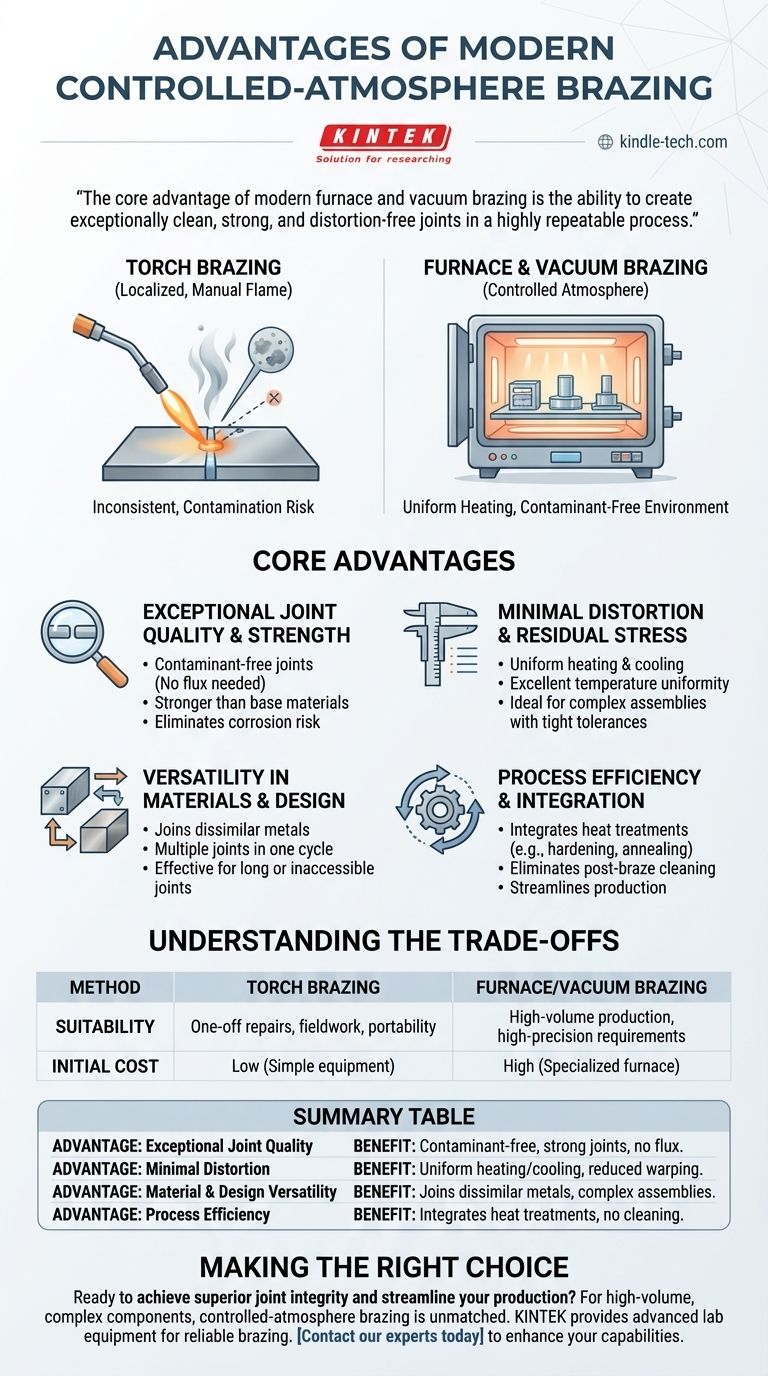
Visual Guide
Related Products
- Vacuum Heat Treat Sintering Brazing Furnace
- Ultra-High Temperature Graphite Vacuum Graphitization Furnace
- Vacuum Dental Porcelain Sintering Furnace
- Vertical High Temperature Graphite Vacuum Graphitization Furnace
- High Temperature Muffle Oven Furnace for Laboratory Debinding and Pre Sintering
People Also Ask
- What are the specific functions of introducing reducing atmospheres or inert gas environments in vacuum brazing?
- How does a vacuum brazing furnace work? Achieve Superior, Flux-Free Metal Joining
- Can brazing be used for ferrous metals? Yes, and here's how to ensure a strong joint.
- What is the cost of a vacuum brazing furnace? A guide to key factors and investment strategy
- What is vacuum heat treatment process? Achieve Superior Control, Cleanliness, and Quality