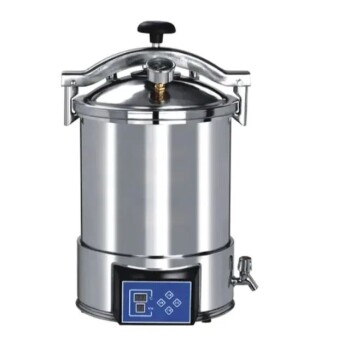
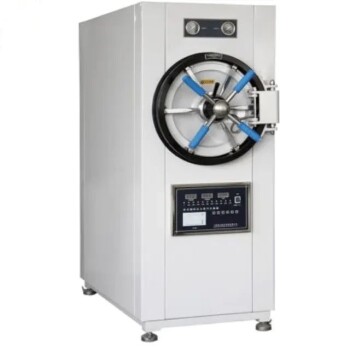
The use of a high-pressure hydrothermal autoclave represents a significant leap in precision over traditional chemical precipitation. By utilizing subcritical water conditions, this method enables the synthesis of Mn-Ce oxide nanoparticles with smaller grain sizes, superior crystallinity, and more uniform distribution. These factors directly translate to enhanced low-temperature denitration activity and stronger bonding when integrated with carriers like graphene.
Utilizing a high-pressure hydrothermal autoclave transforms the synthesis process from a simple chemical reaction into a controlled thermodynamic event. This environment allows for precise manipulation of crystal growth and interfacial bonding that traditional atmospheric methods cannot achieve.
The Mechanics of Enhanced Nanoparticle Synthesis
Accelerated Reaction Kinetics
A high-pressure autoclave creates a sealed environment where temperatures can exceed the atmospheric boiling point of solvents, often reaching 160°C to 180°C. These subcritical conditions significantly increase the reaction activity of the precursor solution, accelerating the chemical reaction rate far beyond what is possible in open-air precipitation.
Superior Morphological and Size Control
Unlike traditional precipitation, which often results in irregular particle clusters, the hydrothermal method guides controlled crystal growth. The high-pressure environment induces uniform nucleation, resulting in nanoparticles with narrower size distributions and specific crystal morphologies that optimize catalytic surface area.
Enhanced Crystallinity and Purity
The thermodynamic conditions within the reactor facilitate the formation of particles with high crystallinity. By increasing the reactivity of water molecules and changing their dielectric constant, the process ensures a more complete and ordered crystal structure, which is essential for stable electrochemical and catalytic performance.
Optimizing Catalyst Integration and Stability
Stronger Interfacial Bonding
One of the most critical advantages is the ability to create strong chemical bonds between the Mn-Ce oxides and their supporting carriers, such as graphene or carbon fibers. The high internal pressure promotes the penetration of precursors into the carrier structure, forming coupled heterojunctions that are difficult to achieve at atmospheric pressure.
Increased Specific Surface Area
Hydrothermal synthesis typically produces materials with wider interlayer spacing and larger specific surface areas. In the context of Mn-Ce oxides, this structure provides more active sites for gas adsorption, directly improving the efficiency of low-temperature denitration.
Uniform Loading on Substrates
The controlled hydrolysis facilitated by the autoclave allows for the slow and steady precipitation of oxides onto a substrate. This prevents the "clumping" often seen in rapid chemical precipitation, ensuring that the active catalyst material is distributed evenly across the entire surface of the support material.
Understanding the Trade-offs
Equipment Complexity and Safety
While traditional precipitation can be performed in simple glass beakers, hydrothermal synthesis requires specialized high-pressure reactors. These systems demand rigorous safety protocols and maintenance to handle the extreme pressure and temperature combinations.
Batch Processing and Scalability
Hydrothermal synthesis is typically a batch process, which can limit throughput compared to continuous chemical precipitation methods. Additionally, the time required for heating and cooling the autoclave adds to the overall production cycle, potentially increasing energy costs.
How to Apply This to Your Project
Making the Right Choice for Your Goal
- If your primary focus is maximum catalytic activity: Utilize the high-pressure hydrothermal method to ensure the smallest possible grain size and the highest density of active surface sites.
- If your primary focus is catalyst longevity and durability: Prioritize the hydrothermal autoclave to achieve the strong interfacial bonding required to prevent active material from detaching from its carrier.
- If your primary focus is rapid, low-cost screening of materials: Consider traditional chemical precipitation for initial proof-of-concept tests before moving to hydrothermal synthesis for final optimization.
Choosing the high-pressure hydrothermal route ensures that your Mn-Ce oxide nanoparticles possess the structural integrity and surface chemistry required for high-performance industrial applications.
Summary Table:
| Feature | Hydrothermal Autoclave Synthesis | Traditional Chemical Precipitation |
|---|---|---|
| Particle Size | Small, uniform grain size | Larger, irregular clusters |
| Crystallinity | High; ordered crystal structure | Lower; often amorphous or less ordered |
| Reaction Rate | Accelerated (subcritical conditions) | Standard atmospheric rate |
| Carrier Bonding | Strong interfacial chemical bonds | Weak physical adsorption |
| Surface Area | High specific surface area | Lower specific surface area |
| Equipment | Specialized high-pressure reactors | Standard laboratory glassware |
Elevate Your Nanoparticle Research with KINTEK Precision
Maximize your catalyst performance and material integrity with KINTEK’s advanced laboratory solutions. Whether you are synthesizing Mn-Ce oxide nanoparticles or developing next-generation energy materials, our high-temperature high-pressure reactors and autoclaves provide the precise thermodynamic control necessary for superior crystallinity and uniform particle distribution.
At KINTEK, we specialize in high-performance equipment, including:
- High-Pressure Reactors & Autoclaves for precision synthesis.
- Muffle, Tube, and Vacuum Furnaces for expert heat treatment.
- Hydraulic Presses & Milling Systems for sample preparation.
- Electrolytic Cells & Battery Research Tools for electrochemical testing.
Ready to optimize your synthesis process? Contact us today to discover how KINTEK’s specialized equipment and technical expertise can enhance your lab's efficiency and research outcomes.
References
- Shangrong Tan, Xuyuan Wang. Mn-Ce Oxide Nanoparticles Supported on Nitrogen-Doped Graphene for Low-Temperature Catalytic Reduction of NOx: De-Nitration Characteristics and Kinetics. DOI: 10.3390/cryst13020313
This article is also based on technical information from Kintek Solution Knowledge Base .
Related Products
- High Pressure Laboratory Autoclave Reactor for Hydrothermal Synthesis
- Mini SS High Pressure Autoclave Reactor for Laboratory Use
- Stainless High Pressure Autoclave Reactor Laboratory Pressure Reactor
- Customizable High Pressure Reactors for Advanced Scientific and Industrial Applications
- Laboratory High Pressure Horizontal Autoclave Steam Sterilizer for Lab Use
People Also Ask
- What role does a high-pressure reactor (autoclave) play in the synthesis of NiCuFe-LDH? Master Hydrothermal Growth
- What Role Does a High-Pressure Reactor or Autoclave Play in HA Catalyst Synthesis? Achieve High Surface Area Materials
- What equipment is required for hydrothermal synthesis of Ga0.25Zn4.67S5.08? Optimize Your Semiconductor Production
- What is the function of a high-pressure reactor in the hydrothermal synthesis of boehmite? Expert Process Insights
- What role does an autoclave play in the synthesis of MnO2 nanofibers? Mastering Hydrothermal Growth