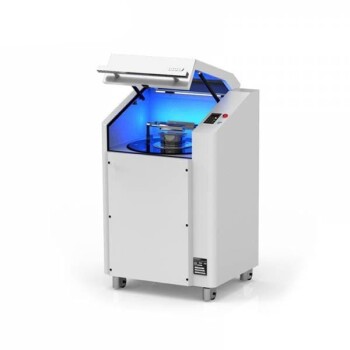
The use of planetary ball mills with tungsten carbide grinding sets is the gold standard for fayalite slag preparation due to their ability to achieve extreme particle fineness with minimal contamination. This combination leverages high-energy centrifugal forces and the superior density of tungsten carbide to reduce hard, abrasive slag to micron-level dimensions. By utilizing these tools, researchers ensure high sample reactivity, uniform particle distribution, and the preservation of chemical purity required for precise downstream analytical work.
Core Takeaway: The combination of planetary motion and tungsten carbide media provides the necessary mechanical energy and material hardness to efficiently pulverize hard fayalite slag while maintaining high chemical purity and structural uniformity.
High-Energy Grinding Dynamics
Centrifugal Force and Impact Energy
A planetary ball mill operates through the simultaneous rotation and revolution of the grinding jars, generating massive centrifugal forces. These forces create high-speed collisions and shear actions between the grinding balls and the slag particles.
For a hard material like fayalite slag, this high-energy impact is essential to overcome the lattice energy of the mineral. This process ensures the material is not just crushed, but pulverized into a highly reactive state.
Achieving Micron-Level Fineness
Traditional crushing methods often fail to reach the ultrafine micron-level required for modern analysis. Planetary mills can refine slag fragments to sizes smaller than 0.075 mm (200 mesh) or even into the nanometer range.
This extreme fineness ensures 100 percent monomer dissociation, which is critical for analytical leaching. It also increases the specific surface area, facilitating faster and more complete solid-state reactions during subsequent thermal processing.
The Role of Tungsten Carbide (WC) Media
Superior Density and Hardness
Tungsten carbide (WC) is selected for its extreme hardness and high density. These physical properties allow the grinding media to transfer more kinetic energy to the slag particles during every collision.
Because fayalite slag is naturally abrasive, softer grinding media would wear down rapidly. WC's resistance to deformation ensures that the grinding efficiency remains constant throughout the entire processing cycle.
Minimizing Sample Contamination
One of the most significant advantages of WC is its superior wear resistance. In high-purity applications, preventing the introduction of metallic impurities from the grinding jar itself is vital.
Using tungsten carbide prevents common contaminants like iron or chrome from entering the sample. This allows researchers to maintain chemical purity levels exceeding 99.95%, ensuring that analytical results reflect the slag's true composition.
Enhancing Sample Quality and Reactivity
Achieving Uniform Particle Distribution
Unlike manual grinding, which results in randomized and inconsistent particle sizes, a planetary ball mill provides a standardized distribution. This uniformity is crucial for achieving high density in solid electrodes or sintered ceramics.
Consistent particle sizing leads to predictable electrocatalytic activity and uniform physical properties in the final product. It eliminates the variability that often plagues laboratory-scale material synthesis.
Promoting Atomic-Level Mixing
The high-energy mechanical action does more than just reduce size; it facilitates atomic-level forced mixing. This is particularly important when fayalite slag is being mixed with other precursors or reagents.
The process effectively breaks down surface oxide layers on the particles. This creates a high-activity precursor foundation, allowing for more complete reactions during high-temperature annealing or microwave synthesis.
Understanding the Trade-offs
Thermal Management Challenges
The high-energy rotation required to grind hard slag generates significant internal heat. If the temperature is not managed, it can lead to unwanted phase changes or the oxidation of the slag sample.
To mitigate this, users must often implement intervallic cooling cycles. This prevents the tungsten carbide jars from overheating and protects the structural integrity of the powder.
Equipment Costs and Material Brittleness
Tungsten carbide grinding sets represent a significant capital investment compared to stainless steel or alumina. While they are more durable in terms of wear, they are also more brittle.
Users must exercise caution to avoid mechanical shock or dropping the jars, which can lead to cracking. Additionally, the high density of WC requires the mill to be properly balanced to prevent excessive vibration and mechanical wear on the motor.
How to Apply This to Your Project
Making the Right Choice for Your Goal
To maximize the benefits of this technology, your approach should be tailored to your specific research or production requirements.
- If your primary focus is High Chemical Purity: Utilize tungsten carbide jars to ensure metallic impurities remain below 0.05%, which is critical for fundamental material science studies.
- If your primary focus is Rapid Throughput: Leverage the high density of WC media to reduce grinding times by up to 50% compared to lighter materials like zirconia.
- If your primary focus is Downstream Reactivity: Aim for sub-micron particle sizes to maximize surface area, ensuring complete monomer dissociation for leaching or titration.
By strategically combining high-energy planetary motion with the unparalleled hardness of tungsten carbide, you can transform abrasive fayalite slag into a highly consistent, high-purity powder ready for advanced technical applications.
Summary Table:
| Key Feature | Benefit for Fayalite Slag | Technical Outcome |
|---|---|---|
| Tungsten Carbide Media | Extreme hardness and density | Minimal wear; <0.05% contamination |
| Planetary Motion | High-energy centrifugal forces | Faster pulverization to micron/nano size |
| Uniform Distribution | Consistent particle sizing | 100% monomer dissociation for leaching |
| High Wear Resistance | Durable grinding jar integrity | Preserves 99.95%+ chemical purity |
Elevate Your Material Research with KINTEK
Precision in sample preparation is the foundation of reliable analysis. KINTEK specializes in high-performance laboratory equipment designed to handle the most abrasive materials like fayalite slag.
Our comprehensive range includes:
- Crushing and Milling Systems: High-energy planetary ball mills with premium tungsten carbide, zirconia, and ceramic grinding sets.
- High-Temperature Solutions: Muffle, tube, and vacuum furnaces for precise thermal processing.
- Advanced Reactivity Tools: High-pressure reactors, autoclaves, and hydraulic pellet presses for material synthesis.
Ensure your lab achieves micron-level fineness and unmatched chemical purity with our durable, high-efficiency systems. Contact KINTEK today to find the perfect milling solution for your project!
References
- Anton Andersson, Fredrik Engström. A Method for Synthesizing Iron Silicate Slags to Evaluate Their Performance as Supplementary Cementitious Materials. DOI: 10.3390/app13148357
This article is also based on technical information from Kintek Solution Knowledge Base .
Related Products
- High Energy Planetary Ball Mill for Laboratory Horizontal Tank Type Milling Machine
- Laboratory Planetary Ball Mill Rotating Ball Milling Machine
- High-Energy Omnidirectional Planetary Ball Mill Milling Machine for Laboratory
- High Energy Planetary Ball Mill Milling Machine for Laboratory
- Laboratory Horizontal Planetary Ball Mill Milling Machine
People Also Ask
- What is the role of a planetary ball mill in sulfide-based solid-state batteries? Engineer High-Performance Cathodes
- What are the parameters of a planetary ball mill? Master Speed, Time, and Media for Perfect Grinding
- What is the function of a planetary ball mill for nanostructured eutectic steel? Essential Prep for High-Strength Alloys
- What role does a planetary ball mill play in the preparation of NASICON-type solid electrolytes like LATP and LAGP?
- What is the function of a planetary ball mill in solid-state electrolyte prep? Milling vs. SDS Methods Explained