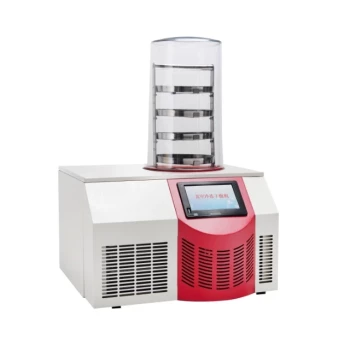
The primary advantage of using a vacuum drying oven for green-synthesized iron nanoparticles is its ability to preserve the material's chemical stability and physical structure. By creating a low-pressure environment, a vacuum oven allows for the evaporation of washing solvents, such as ethanol, at significantly reduced temperatures (e.g., 25°C).
Core Takeaway Standard thermal drying exposes highly reactive nanoparticles to heat and atmospheric oxygen, frequently causing immediate oxidation and performance loss. Vacuum drying mitigates this by lowering the boiling point of solvents, allowing for rapid dehydration in an oxygen-deprived environment that protects the zero-valent iron core and prevents particle clumping.
Preserving Chemical Reactivity
Preventing Oxidation of the Iron Core
The most critical challenge with green-synthesized iron nanoparticles, particularly zero-valent iron (α-Fe0), is their tendency to oxidize rapidly when exposed to air. Standard ovens circulate hot, oxygen-rich air, which degrades the metallic iron into iron oxides.
A vacuum oven operates in a low-oxygen environment, which drastically minimizes the risk of oxidation. This preservation of the metallic state is essential for maintaining the material's catalytic degradation activity and its inherent antibacterial properties.
Protecting Surface Functional Groups
Green synthesis often relies on organic phytochemicals to cap and stabilize the nanoparticles. High temperatures in a standard oven can cause thermal degradation or cross-linking of these surface molecules.
Vacuum drying reduces the thermal stress placed on the material. By keeping the processing temperature low, you ensure that the active sites and functional groups on the nanoparticle surface remain intact and available for future reactions.
Maintaining Physical Morphology
Minimizing Agglomeration and Sintering
High temperatures induce thermal motion, causing nanoparticles to migrate, collide, and fuse together (sinter). This leads to larger particle sizes and a significant loss of surface area.
By facilitating drying at temperatures as low as 25°C to 60°C, vacuum drying prevents this thermal growth. This is vital for maintaining a high dispersion and a small average particle size (often in the low nanometer range).
Preserving Porous Structures
If your synthesis aims to create complex structures, such as flower-like formations or porous microspheres, standard drying can cause these delicate architectures to collapse.
The gentle dehydration process of a vacuum oven preserves the material's "looseness." This ensures the final product retains a high surface-to-volume ratio, which is directly correlated to high adsorption activity and catalytic efficiency.
Understanding the Trade-offs
Operational Complexity vs. Product Quality
While vacuum drying offers superior product quality, it introduces slight operational complexity compared to standard ovens. It requires a vacuum pump, which demands maintenance (such as oil changes) and careful monitoring of pressure levels.
Batch Size Limitations
Vacuum ovens typically have smaller effective chamber capacities than standard convection ovens. If you are scaling up to industrial mass production, you may face bottlenecks that require larger, more expensive vacuum equipment to match the throughput of standard thermal drying.
Making the Right Choice for Your Goal
To maximize the efficacy of your green-synthesized iron nanoparticles, align your drying method with your specific performance metrics:
- If your primary focus is catalytic or antibacterial power: Use a vacuum oven to ensure the zero-valent iron core (α-Fe0) does not oxidize into rust before you can use it.
- If your primary focus is particle size and surface area: Use a vacuum oven to lower the drying temperature, preventing the particles from sintering into larger, less effective clumps.
Summary: For reactive iron nanomaterials, vacuum drying is not just an alternative; it is a critical processing step required to lock in the chemical and physical properties achieved during synthesis.
Summary Table:
| Feature | Vacuum Drying Oven | Standard Convection Oven |
|---|---|---|
| Environment | Low-oxygen / Oxygen-deprived | Oxygen-rich (circulating air) |
| Drying Temperature | Low (as low as 25°C) | High (typically >60°C) |
| Oxidation Risk | Minimal (Protects Fe0 core) | High (Formation of iron oxides) |
| Particle Morphology | Prevents sintering/agglomeration | High risk of particle fusion |
| Active Surface | Preserves capping agents/groups | Potential thermal degradation |
| Key Application | Catalytic & antibacterial NPs | Non-reactive stable materials |
Elevate Your Nanomaterial Precision with KINTEK
Don't let oxidation and sintering compromise your research. KINTEK specializes in high-performance laboratory equipment designed for the most sensitive synthesis workflows. From advanced vacuum ovens and cooling solutions to our comprehensive range of high-temperature furnaces, crushing systems, and hydraulic presses, we provide the tools needed to lock in the chemical and physical properties of your nanoparticles.
Whether you are focusing on green synthesis, battery research, or advanced ceramics, our team is ready to help you select the ideal equipment to maximize your catalytic and adsorption efficiency. Contact us today to find the perfect drying solution for your lab!
References
- K. A. P. Gaminda, R. Senthilnithy. Degradation of Malachite Green using Green Synthesized Iron Nanoparticles by <em>Coffea arabica</em> Leaf Extracts and its Antibacterial Activity. DOI: 10.4038/kjms.v5i2.76
This article is also based on technical information from Kintek Solution Knowledge Base .
Related Products
- 56L Vertical Laboratory Vacuum Drying Oven
- 23L Laboratory Vacuum Drying Oven
- Laboratory Scientific Electric Heating Blast Drying Oven
- Benchtop Laboratory Vacuum Freeze Dryer
- Vacuum Heat Treat Sintering Brazing Furnace
People Also Ask
- Why is a laboratory vacuum drying oven recommended for rice straw residues? Protect Your Biomass Integrity
- What role does a laboratory vacuum drying oven play in the preparation of modified multi-walled carbon nanotubes?
- What is the importance of using a laboratory vacuum drying oven? Preserving Slow-Release Microcapsule Integrity
- Why is a Laboratory Vacuum Drying Oven recommended for PBAT microspheres? Protect Sensitive Polymer Integrity
- What role does a laboratory vacuum drying oven play in processing nanoparticle powder samples? Protect Sample Integrity