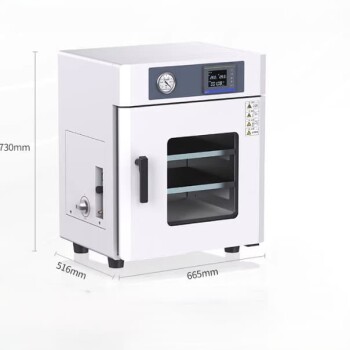
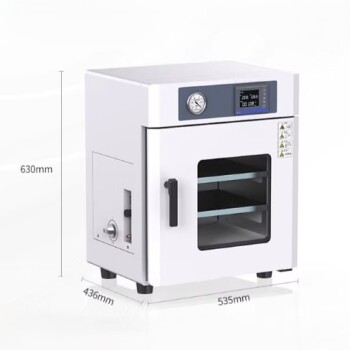
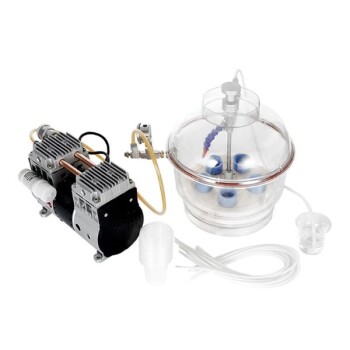
The primary advantage of using a vacuum drying oven for combustible cartridge cases is the ability to remove moisture and solvents at significantly reduced temperatures. By lowering the system pressure, you eliminate the need for high heat, thereby preventing the chemical decomposition or spontaneous combustion of heat-sensitive energetic materials like nitrocellulose.
Core Takeaway: Vacuum drying replaces thermal intensity with pressure reduction. This ensures that volatile components are dried thoroughly without ever reaching their critical instability temperatures, simultaneously preventing oxidation and preserving the material's internal structure.
Enhancing Process Safety
The Critical Role of Pressure Reduction
The fundamental mechanism of a vacuum oven is the reduction of system pressure. This physical change lowers the boiling point of water and residual solvents.
Consequently, rapid evaporation occurs at much lower temperatures (e.g., 50°C to 70°C) compared to conventional atmospheric drying.
Mitigating Explosion Risks
Combustible cartridge cases often contain nitrocellulose, a highly heat-sensitive energetic material.
Conventional drying methods require heat levels that can push these materials dangerously close to their auto-ignition points. Vacuum drying operates well below these thresholds, effectively eliminating the risk of spontaneous combustion during the manufacturing process.
Preserving Material Integrity and Performance
Preventing Thermal Degradation
Beyond safety, high heat can degrade the chemical structure of the cartridge components before they are even used.
Vacuum drying prevents thermal oxidative degradation and discoloration. This ensures that the biomass components (such as cellulose derivatives) retain their natural structure and functional characteristics.
Maintaining Structural Morphology
Combustible cases rely on specific internal structures to burn cleanly and completely.
High-temperature drying can cause structural collapse, carbonization, or the "sintering" (clumping) of particles. A vacuum environment preserves the internal microporous structure and prevents particle agglomeration, ensuring the cartridge performs consistently during firing.
Eliminating Oxidation
Conventional ovens expose materials to heated atmospheric oxygen, which can degrade active ingredients over time.
Because the vacuum oven operates in an oxygen-depleted environment, it significantly reduces the risk of oxidation on material surfaces. This preserves the chemical stability of the cartridge components, ensuring a longer shelf life and reliable ignition.
Understanding the Operational Trade-offs
System Complexity vs. Simplicity
While vacuum drying offers superior safety and quality, it introduces greater mechanical complexity than standard convection ovens.
Operators must maintain vacuum pumps and ensure seal integrity to sustain the low-pressure environment. A failure in the vacuum seal can lead to a rise in pressure and temperature, potentially reintroducing the risks the system is designed to avoid.
Throughput Considerations
Vacuum drying is predominantly a batch process.
Unlike continuous conveyor-belt dryers used in some non-explosive industries, vacuum ovens require loading, sealing, depressurizing, and re-pressurizing. This can limit total throughput speed, though the trade-off is often necessary for the safety of energetic materials.
Making the Right Choice for Your Goal
To maximize the efficiency and safety of your production line, consider your primary constraints:
- If your primary focus is Safety Compliance: Prioritize vacuum drying to maintain process temperatures well below the decomposition threshold of nitrocellulose.
- If your primary focus is Product Consistency: Use vacuum drying to prevent oxidation and maintain the precise microporous structure required for clean combustion.
- If your primary focus is Solvent Recovery: Leverage the vacuum's ability to evaporate solvents at low temperatures for efficient capture and recycling without thermal breakdown.
Ultimately, for combustible ordnance, vacuum drying is not just an alternative; it is a critical safety control that decouples drying efficiency from thermal risk.
Summary Table:
| Feature | Conventional Drying | Vacuum Drying |
|---|---|---|
| Drying Mechanism | High Thermal Intensity | Pressure Reduction |
| Process Temperature | High (Risk of Auto-ignition) | Low (50°C - 70°C) |
| Safety Level | High risk for energetic materials | Maximum safety for nitrocellulose |
| Material Integrity | Risk of oxidation/degradation | Preserves structure and color |
| Oxidation Risk | High (Oxygen-rich environment) | Minimal (Oxygen-depleted) |
| Atmosphere | Ambient Air | Vacuum / Inert Gas |
Secure Your Energetic Material Processing with KINTEK
Don't compromise on safety or performance when handling sensitive materials. KINTEK specializes in precision laboratory equipment designed for the most demanding applications. Whether you are processing combustible cartridge cases or sensitive biomass, our high-performance vacuum ovens and high-temperature high-pressure reactors ensure absolute control over your thermal processes.
From muffle and vacuum furnaces to specialized PTFE and ceramic consumables, KINTEK provides the comprehensive tools needed for advanced material research and production.
Ready to elevate your lab's safety and efficiency?
Contact our technical experts today to find the perfect drying or heating solution tailored to your specific requirements.
References
- Mengde Wu, Zhenggang Xiao. Advances in the development and characterization of combustible cartridge cases and propellants: Preparation, performance, and future prospects. DOI: 10.1515/rams-2025-0119
This article is also based on technical information from Kintek Solution Knowledge Base .
Related Products
- 56L Vertical Laboratory Vacuum Drying Oven
- 23L Laboratory Vacuum Drying Oven
- Laboratory Scientific Electric Heating Blast Drying Oven
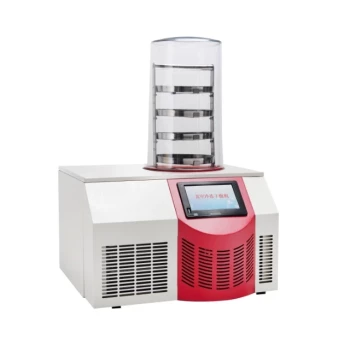
- Benchtop Laboratory Vacuum Freeze Dryer
- Dental Porcelain Zirconia Sintering Ceramic Vacuum Press Furnace
People Also Ask
- Why is a laboratory vacuum drying oven recommended for rice straw residues? Protect Your Biomass Integrity
- What role does a laboratory vacuum drying oven play in the preparation of modified multi-walled carbon nanotubes?
- What is the importance of using a laboratory vacuum drying oven? Preserving Slow-Release Microcapsule Integrity
- Why is a Laboratory Vacuum Drying Oven recommended for PBAT microspheres? Protect Sensitive Polymer Integrity
- What role does a laboratory vacuum drying oven play in processing nanoparticle powder samples? Protect Sample Integrity