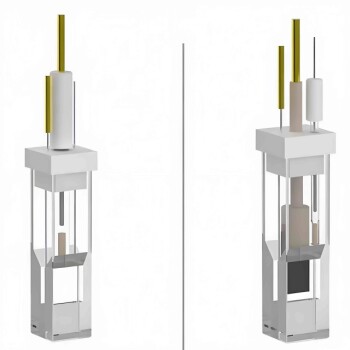
The definitive advantage of using a customized three-electrode electrolytic cell is the isolation of the working electrode's potential. By incorporating a reference electrode, this system effectively decouples the performance of your LTO/LPSC or Nb2O5/LPSC composite electrode from the counter electrode (typically lithium metal). This separation eliminates data artifacts caused by counter-electrode polarization, allowing for an accurate assessment of the composite material's intrinsic behavior.
Core Takeaway In traditional two-electrode systems, the instability of the counter electrode can be mistakenly interpreted as failure in your test material. A three-electrode setup introduces a stable voltage reference, allowing you to "subtract" the counter electrode's noise and precisely pinpoint degradation mechanisms specific to the cathode composite itself.
The Limitation of Two-Electrode Systems
To understand the value of the three-electrode cell, one must first recognize the inherent flaw in traditional two-electrode testing for these specific composites.
The Ambiguity of Voltage Shifts
In a standard two-electrode cell, the counter electrode (often lithium metal) serves a dual purpose: it completes the circuit and acts as the reference point for voltage measurement.
If the lithium counter electrode becomes unstable or undergoes polarization during cycling, the overall cell voltage shifts.
False Negatives in Stability Data
When analyzing complex composites like LTO/LPSC or Nb2O5/LPSC, this creates a critical blind spot.
You cannot definitively determine if a performance drop is due to the degradation of your composite material or simply the counter electrode struggling to maintain stability.
The Precision of Three-Electrode Isolation
Customized three-electrode cells solve this by introducing a dedicated reference probe that carries no current, providing an unwavering "truth" point for potential measurements.
Decoupling Electrode Performance
The primary reference indicates that this design separates the potential of the working electrode from the counter electrode.
This means the voltage you record is the true potential difference between your composite electrode and the reference, completely ignoring the overpotential or polarization occurring at the lithium counter electrode.
Accurate Degradation Analysis
With the noise of the counter electrode removed, researchers can observe the true electrochemical stability of the LTO or Nb2O5 materials.
This allows for the precise identification of degradation mechanisms within the cathode itself, such as interfacial side reactions between the active material and the LPSC solid electrolyte, without external interference.
Understanding the Trade-offs
While the three-electrode system offers superior data fidelity, it introduces specific challenges that must be managed to ensure valid results.
Design and Assembly Complexity
"Customized" implies that these cells are not off-the-shelf standard components.
Designing a cell that maintains good contact between a solid electrolyte (LPSC) and a reference probe, while also maintaining pressure on the working and counter electrodes, requires significant mechanical precision and assembly skill.
Geometric Sensitivity
The placement of the reference electrode is critical.
If placed incorrectly within the customized cell, it can introduce uncompensated resistance (iR drop) or sensing errors, potentially skewing the very data you are trying to refine.
Making the Right Choice for Your Goal
When deciding between these cell configurations for your LTO/LPSC or Nb2O5/LPSC research, consider your primary objective.
- If your primary focus is fundamental mechanism analysis: You must use a three-electrode system to isolate the cathode's intrinsic stability and rule out counter-electrode interference.
- If your primary focus is rapid, high-throughput screening: A two-electrode system may suffice for rough capacity checks, provided you acknowledge the potential for data masking by the counter electrode.
True insight into electrochemical behavior requires measuring the material, not the limitations of the test equipment.
Summary Table:
| Feature | Two-Electrode System | Three-Electrode System |
|---|---|---|
| Voltage Accuracy | Includes counter electrode polarization | Isolates working electrode potential |
| Reference Point | Dual-purpose counter electrode | Dedicated, current-free reference probe |
| Data Clarity | High noise; masks degradation | High fidelity; pinpoint material failure |
| Primary Use Case | Rapid screening/capacity checks | Fundamental mechanism & stability analysis |
| Complexity | Simple assembly | Higher; requires precise geometric placement |
Precision in electrochemical research starts with the right equipment. KINTEK specializes in advanced laboratory solutions, offering customized electrolytic cells and electrodes designed to eliminate artifacts and deliver the 'truth' in your battery research. From high-temperature furnaces to specialized hydraulic presses and high-pressure reactors, we provide the tools necessary to analyze LTO, Nb2O5, and LPSC composites with absolute confidence. Enhance your lab's diagnostic capabilities today—contact KINTEK's technical experts now to discuss your custom cell requirements!
Related Products
- H Type Electrolytic Cell Triple Electrochemical Cell
- Electrolytic Electrochemical Cell Gas Diffusion Liquid Flow Reaction Cell
- Electrolytic Electrochemical Cell with Five-Port
- PTFE Electrolytic Cell Electrochemical Cell Corrosion-Resistant Sealed and Non-Sealed
- Super Sealed Electrolytic Electrochemical Cell
People Also Ask
- What is a H type cell? A Guide to Divided Electrochemical Cells for Accurate Experiments
- How should the electrolyte be prepared and added to the H-type electrolytic cell? Best Practices for Purity and Safety
- What is the technical necessity of using an H-type electrolytic cell for NO3RR tests? Protect Your Ammonia Yields
- How does the design of an H-type electrolytic cell benefit the neutral water electrolysis process for metal recovery?
- What is the primary function of an H-type electrolytic cell in NitRR? Ensure Accurate Product Yields