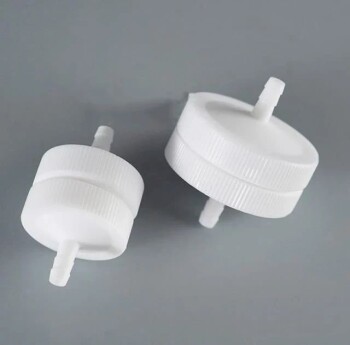
The primary advantage of Polytetrafluoroethylene (PTFE) filters lies in their exceptional chemical inertness. When analyzing suspended particulate matter, specifically for ionic components, PTFE ensures data integrity by preventing the introduction of external contaminants during the extraction process.
By combining high chemical stability with low surface adsorption, PTFE filters eliminate the risk of filter-based contamination. This guarantees that detected ions—such as potassium, chloride, and sulfate—originate exclusively from the sample source rather than the filtration medium itself.
The Science of Contamination Control
To accurately quantify ionic components, the collection medium must be effectively invisible to the analysis. PTFE achieves this through two specific physical properties.
Exceptional Chemical Inertness
The core benefit of PTFE is its resistance to chemical reaction. It provides a stable background that does not interact chemically with the particulate matter collected on its surface.
Low Surface Adsorption
Beyond stability, PTFE features very low surface adsorption. This ensures that target analytes are not irreversibly bound to the filter fibers, allowing for complete recovery during the extraction phase.
Integrity During Extraction
The choice of filter is critical during the sample preparation phase, particularly when using aggressive techniques like ultrasonic extraction with ultrapure water.
Preventing Material Degradation
During ultrasonic extraction, less robust filter materials can degrade or leach compounds. PTFE withstands this process without breaking down, maintaining physical and chemical integrity.
Eliminating Background Noise
Crucially, the PTFE material does not introduce metal or acid radical ion contamination into the solution. This silence in the background signal is essential for high-sensitivity analysis.
Ensuring Analytical Accuracy
The ultimate goal of using PTFE is to validate the source of the detected components.
Isolating Sample Emissions
By removing the filter as a potential source of ions, analysts can be certain that the results reflect the actual sample.
Specific Ion Detection
This allows for the precise attribution of ions like potassium, chloride, and sulfate directly to combustion emissions, rather than artifacts leached from the filter matrix.
Understanding the Trade-offs
While PTFE is superior for ionic analysis, it is important to understand the implications of using alternative materials in this specific context.
The Risk of Positive Bias
Using non-inert filters during ultrasonic extraction creates a significant risk of positive bias. This occurs when the filter contributes ions to the extract, artificially inflating the concentration of the target analytes.
False Attribution
Without the inertness of PTFE, it becomes impossible to confirm if ions detected by chromatography are from the suspended particulate matter or the filter itself. This compromises the ability to trace emissions back to sources like combustion.
Making the Right Choice for Your Goal
Selecting the correct filter is a strategic decision based on the specific analytes you intend to measure.
- If your primary focus is Ionic Quantitation: Use PTFE filters to prevent the leaching of metal and acid radical ions during ultrasonic extraction.
- If your primary focus is Source Apportionment: Rely on PTFE to ensure that specific markers like potassium and sulfate are attributed solely to combustion emissions.
Using PTFE filters converts the filtration step from a potential variable into a controlled constant, ensuring your analytical data remains pure and defensible.
Summary Table:
| Feature | Advantage of PTFE Filters | Impact on Analysis |
|---|---|---|
| Chemical Stability | Exceptional inertness | Prevents background leaching and chemical interference. |
| Surface Adsorption | Very low adsorption | Ensures full recovery of target analytes during extraction. |
| Physical Integrity | High durability | Withstands ultrasonic extraction without material degradation. |
| Background Signal | Minimal ion contribution | Guarantees detected ions (K, Cl, SO4) are from the sample. |
| Data Accuracy | Eliminates positive bias | Ensures reliable source apportionment for combustion emissions. |
Elevate Your Analytical Precision with KINTEK Laboratory Solutions
Don't let filter-based contamination compromise your research integrity. KINTEK specializes in high-performance laboratory equipment and consumables, providing the essential tools for high-sensitivity analysis. Whether you are conducting source apportionment studies or complex chemical quantification, our premium PTFE products and ceramics ensure your data remains pure and defensible.
Our extensive portfolio supports every stage of your workflow, from crushing and milling systems to high-temperature furnaces and precision hydraulic presses. We serve researchers and industrial labs globally with high-quality consumables, cooling solutions like ULT freezers, and specialized battery research tools.
Take the uncertainty out of your analysis. Contact KINTEK today to source the high-purity consumables and lab equipment your project demands!
References
- Qingyue Wang, Norio Yamaguchi. Basic study on combustion characteristics of waste rice husk and emission behavior from a new-type air vortex current combustor. DOI: 10.2495/chem110191
This article is also based on technical information from Kintek Solution Knowledge Base .
Related Products
- Custom PTFE Teflon Parts Manufacturer for Sampling Filters
- Custom PTFE Teflon Parts Manufacturer for Air Valve Applications
- Shortpass Filters for Optical Applications
- Custom PTFE Teflon Parts Manufacturer F4 Conical Flask Triangular Flask 50 100 250ml
- Custom PTFE Teflon Parts Manufacturer for Non-Standard Insulator Customization
People Also Ask
- What is the primary function of porous PTFE sheets in Zinc-Air Fuel Cells? Optimize Your Air Cathode Performance
- Why use 0.25 μm PTFE filters after centrifugation? Master Clarification for High-Turbidity Samples
- How does a 0.45 µm PTFE syringe filter protect analytical equipment? Shield Your HPLC from Biomass Contaminants
- Why are 0.45 μm PTFE syringe filters necessary? Protect Your LC-MS Data Integrity & Hardware
- What is the purpose of using PTFE syringe filters in photocatalytic reactions? Ensure Precise Data & Protect Equipment