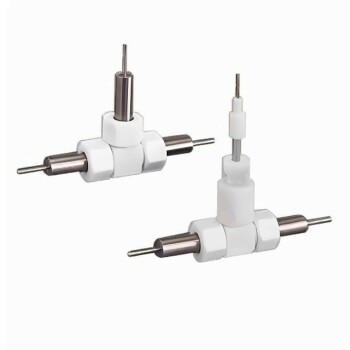
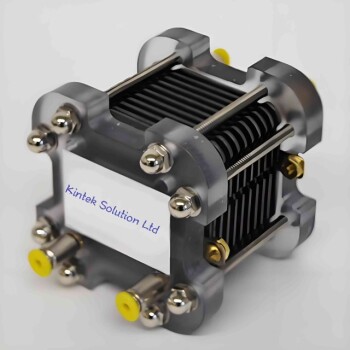
Specialized photoelectrochemical electrolytic cells function as the critical interface for accurately evaluating hydrogen evolution reaction (HER) performance. They utilize a three-electrode system and a quartz window to create a stable, high-fidelity environment where light-driven reactions can be measured without optical interference or loss.
These cells are not just containers; they are precision instruments designed to ensure loss-free light transmission, enabling the quantitative analysis of how internal electric fields drive carrier migration and reaction kinetics.
Optimizing the Reaction Environment
The Function of the Quartz Window
The inclusion of a quartz window is the defining feature of these specialized cells.
Its primary function is to ensure that incident light reaches the photoelectrode surface without absorption or loss.
This unobstructed transmission is essential to fully excite electron-hole pairs, which are the fundamental drivers of the hydrogen evolution reaction.
Establishing Stability
These cells provide a mechanically and chemically stable environment for the reaction.
This stability is required to support the three-electrode system, ensuring that external variables do not skew sensitive electrochemical measurements.
Quantifying Performance Metrics
Measuring Photocurrent Density
The cell design facilitates the precise measurement of photocurrent density-potential curves.
This allows researchers to map the direct relationship between the potential applied to the system and the current generated by light excitation.
Analyzing Impedance and Kinetics
Beyond simple current measurements, these cells enable the analysis of electrochemical impedance.
This data is crucial for quantifying interfacial reaction kinetics, providing insight into how quickly and efficiently charge transfer occurs at the electrode surface.
Understanding Carrier Dynamics
Evaluating Built-in Electric Fields
A core function of the cell is to allow for the quantitative analysis of internal electrical properties.
Specifically, the apparatus helps researchers understand how built-in electric fields enhance the rate at which charge carriers migrate through the material.
Real-World Condition Testing
The data derived from these cells reflects actual working conditions.
This ensures that the analysis of carrier migration and reaction kinetics applies to practical scenarios, rather than theoretical models.
Critical Considerations for Accuracy
The Necessity of Quartz vs. Glass
It is critical to understand the trade-off regarding the window material.
Standard glass often absorbs specific wavelengths of light, particularly in the UV spectrum.
Using anything other than a quartz window will result in optical loss, leading to an underestimation of electron-hole pair excitation and inaccurate performance data.
Making the Right Choice for Your Goal
To maximize the utility of a specialized photoelectrochemical cell, align your experimental approach with your specific analytical needs.
- If your primary focus is total efficiency: Prioritize the cleanliness and quality of the quartz window to ensure maximum light saturation and electron-hole excitation.
- If your primary focus is mechanistic understanding: Leverage the three-electrode system to capture impedance data, isolating the effects of built-in electric fields on carrier migration.
These cells bridge the gap between theoretical photophysics and tangible electrochemical performance, providing the clear optical path necessary to validate hydrogen evolution strategies.
Summary Table:
| Core Function | Key Feature | Impact on HER Evaluation |
|---|---|---|
| Optical Transmission | High-quality Quartz Window | Ensures loss-free light transmission for full electron-hole pair excitation. |
| Kinetics Analysis | Three-Electrode System | Enables precise measurement of photocurrent density and electrochemical impedance. |
| Carrier Dynamics | Optimized Cell Geometry | Facilitates quantitative analysis of built-in electric fields and migration rates. |
| System Stability | Chemical-Resistant Housing | Provides a stable environment for reproducible, high-fidelity electrochemical data. |
Elevate Your Hydrogen Research with KINTEK Precision
Unlock higher accuracy in your photoelectrochemical studies with KINTEK’s specialized electrolytic cells. Whether you are analyzing reaction kinetics or optimizing electron-hole pair excitation, our premium laboratory solutions—including high-performance electrolytic cells, electrodes, and quartz-window systems—are engineered for precision.
KINTEK offers a comprehensive range of laboratory equipment tailored for energy research, from high-temperature furnaces and reactors to specialized battery research tools.
Contact us today to find the perfect equipment for your lab!
References
- Fengxiang Qiao, Bo Li. Engineering internal electric fields in photoelectrochemical systems for enhanced hydrogen evolution: mechanisms, characterization and design strategies. DOI: 10.1039/d5im00112a
This article is also based on technical information from Kintek Solution Knowledge Base .
Related Products
- Quartz Electrolytic Electrochemical Cell for Electrochemical Experiments
- Side Window Optical Electrolytic Electrochemical Cell
- Electrolytic Electrochemical Cell with Five-Port
- Optical Water Bath Electrolytic Electrochemical Cell
- H-Type Double-Layer Optical Electrolytic Electrochemical Cell with Water Bath
People Also Ask
- Why is a quartz electrolytic cell used for acrylic acid wastewater? Ensure Chemical Stability & Data Integrity
- How does the design of an electrochemical electrolytic cell influence the coating uniformity? Optimize Your Catalysts
- What are the key features of quartz that make it suitable for electrolytic cells? Discover the 4 Pillars of Superior Performance
- What is the correct shutdown and disassembly procedure after an experiment? Ensure Safety and Protect Your Equipment
- How do the electrochemical cell and three-electrode testing system collaborate? Optimize Zinc Anode Deposition Control