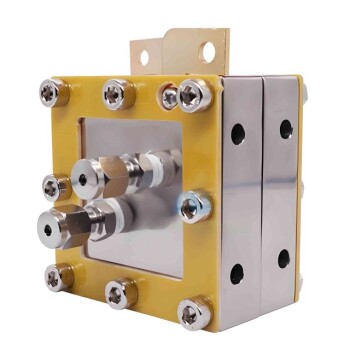
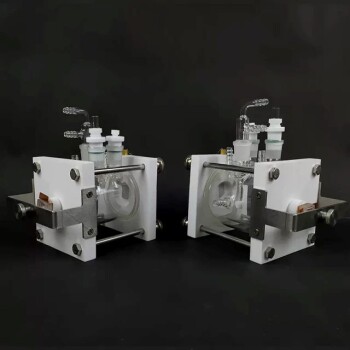
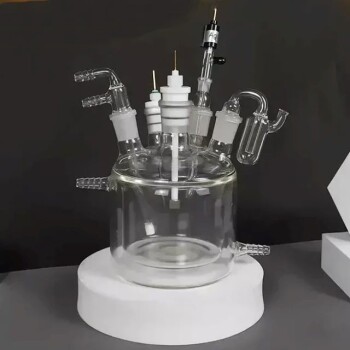
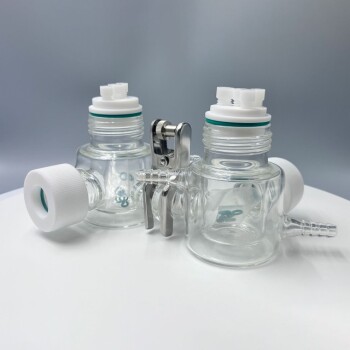
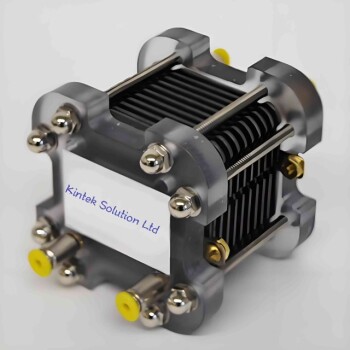
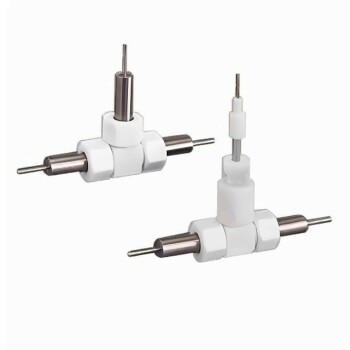
The definitive design advantage of a three-electrode electrolytic cell lies in its ability to decouple potential control from current transmission, enabling rigorous maintenance of the working electrode's potential. By integrating a working electrode, a counter electrode, and a reference electrode into a single vessel, this system provides the stability required to capture accurate oxidation kinetics and ensure highly reproducible experimental data.
In photoelectrolysis, precise control is paramount. The three-electrode configuration isolates the measurement of potential from the flow of current, ensuring that the electrochemical conditions at the working electrode remain stable regardless of reaction intensity.
The Mechanics of Precision
The Three-Component Architecture
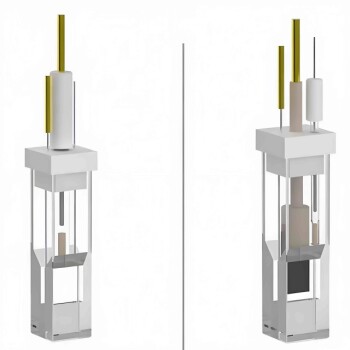
To achieve high-fidelity results, this design integrates three specific components into a single reaction vessel. This typically includes a titanium dioxide/titanium ($\text{TiO}_2$/Ti) working electrode and a stainless steel wire counter electrode. Crucially, a silver/silver chloride (Ag/AgCl) reference electrode is added to complete the circuit logic.
Decoupling Potential and Current
The primary functional benefit of this setup is the separation of duties. In simpler systems, the same electrode often manages both potential measurement and current carrying, leading to interference.
Managing Light-Driven Reactions
In a batch photoelectrolysis system, this decoupling is vital. It allows the system to manage light-driven reactions without the fluctuating currents distorting the voltage reading at the working surface.
Impact on Research Outcomes
Achieving Potential Stability
For researchers, the ability to maintain a stable working electrode potential is non-negotiable. This design ensures that the applied potential stays constant under controlled electrochemical conditions, eliminating drift that could skew data.
Accurate Kinetic Studies
This stability is specifically required for studying complex reaction mechanisms, such as the oxidation kinetics of Sulfamethazine. Without a stable reference point, determining the rate and mechanism of such oxidations becomes unreliable.
Ensuring Reproducibility
Scientific rigor depends on the ability to repeat results. By standardizing the electrical environment within the cell, the three-electrode design yields highly reproducible experimental data, reducing the variance between batch runs.
Understanding the Trade-offs
Increased System Complexity
While superior for precision, this configuration introduces physical complexity to the reactor design. Integrating three distinct electrodes into a single vessel requires careful spatial arrangement to prevent short circuits and ensure uniform electrolyte distribution.
Instrumentation Requirements
Utilizing a three-electrode cell generally necessitates a potentiostat capable of managing the reference loop. This contrasts with simpler two-electrode setups that might only require a basic DC power supply, potentially increasing the cost and technical barrier for the experiment.
Making the Right Choice for Your Research
To determine if this configuration serves your specific project needs, consider your primary data requirements:
- If your primary focus is kinetic accuracy: Adopt the three-electrode system to precisely study reaction rates, such as Sulfamethazine oxidation, without voltage interference.
- If your primary focus is data reliability: Use this configuration to ensure that your potential measurements are stable, yielding reproducible results across multiple batch runs.
The three-electrode cell is not just a vessel; it is a precision instrument that transforms variable chemical reactions into quantifiable, consistent data.
Summary Table:
| Feature | Advantage | Impact on Research |
|---|---|---|
| Reference Electrode | Decouples potential from current | Ensures stable, drift-free voltage measurements |
| Tri-Component Setup | Isolates working electrode conditions | Enables high-fidelity capture of oxidation kinetics |
| Circuit Logic | Eliminates current interference | Provides highly reproducible experimental data |
| Standardized Environment | Controlled electrochemical conditions | Accurate study of complex reactions like Sulfamethazine oxidation |
Elevate Your Electrochemical Research with KINTEK
Precision is the foundation of breakthrough science. At KINTEK, we specialize in providing high-performance electrolytic cells and electrodes specifically designed to meet the rigorous demands of batch photoelectrolysis and kinetic studies. Whether you are researching battery technologies, exploring light-driven oxidation, or scaling up laboratory processes, our comprehensive portfolio offers the tools you need for success.
Our Value to Your Laboratory:
- Precision Engineering: High-quality three-electrode cells and specialized electrodes (Ag/AgCl, Platinum, Titanium) for stable potential control.
- Versatile Solutions: A full range of lab equipment, from high-temperature furnaces and vacuum reactors to crushing systems and isostatic hydraulic presses.
- Reliability: Durable materials like PTFE and high-purity ceramics to ensure chemical compatibility and longevity.
Ready to achieve superior data reproducibility? Contact us today to find the perfect electrochemical configuration for your lab!
References
- Nikolaos Philippidis, Ioannis Poulios. Photoelectrocatalytic Oxidation of Sulfamethazine on TiO2 Electrodes. DOI: 10.3390/catal13081189
This article is also based on technical information from Kintek Solution Knowledge Base .
Related Products
- H Type Electrolytic Cell Triple Electrochemical Cell
- Electrolytic Electrochemical Cell Gas Diffusion Liquid Flow Reaction Cell
- Electrolytic Electrochemical Cell with Five-Port
- PTFE Electrolytic Cell Electrochemical Cell Corrosion-Resistant Sealed and Non-Sealed
- Super Sealed Electrolytic Electrochemical Cell
People Also Ask
- What is a H type cell? A Guide to Divided Electrochemical Cells for Accurate Experiments
- How should the electrolyte be prepared and added to the H-type electrolytic cell? Best Practices for Purity and Safety
- What is the technical necessity of using an H-type electrolytic cell for NO3RR tests? Protect Your Ammonia Yields
- How does the design of an H-type electrolytic cell benefit the neutral water electrolysis process for metal recovery?
- What is the primary function of an H-type electrolytic cell in NitRR? Ensure Accurate Product Yields