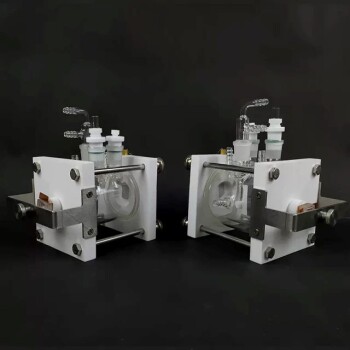
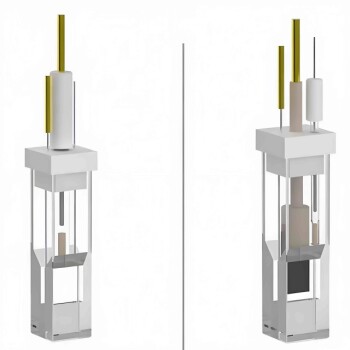
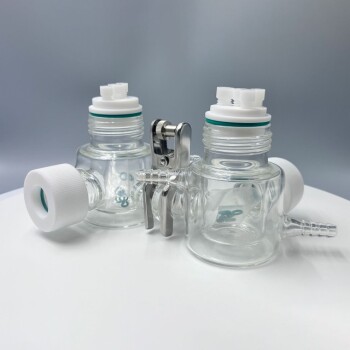
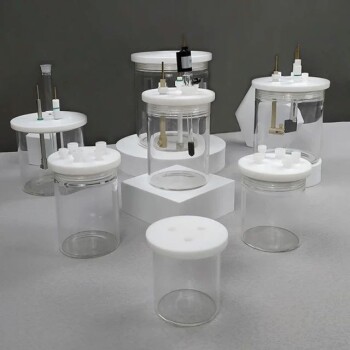
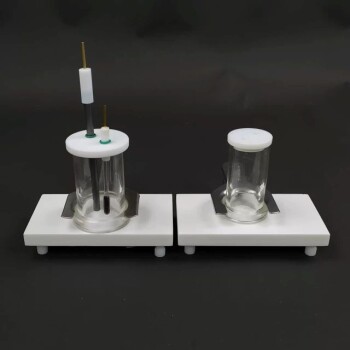
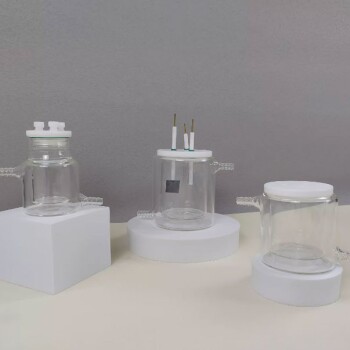
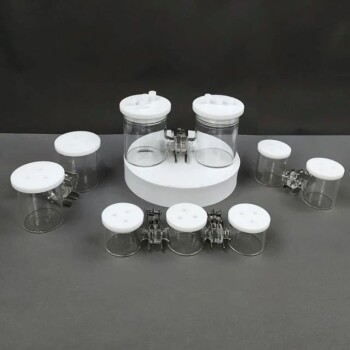
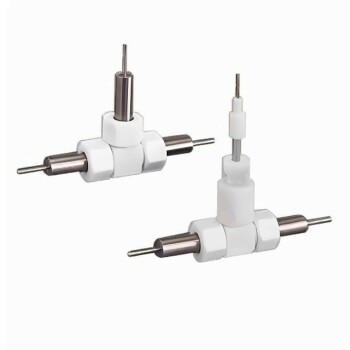
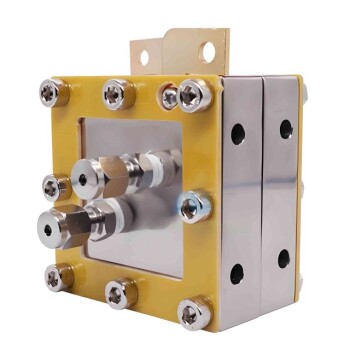
The primary design advantage of a flat electrochemical cell is its ability to isolate a specific, uniform region of the nitrided surface using a sealing ring. By defining a precise exposure area (such as 0.5027 cm²), this setup strictly confines the corrosion test to the treated layer, eliminating the influence of the sample edges and ensuring highly accurate current density calculations.
Core Takeaway The flat electrochemical cell is critical for testing surface-treated materials because it mechanically isolates the test surface from the sample edges. By strictly defining the exposure area, it ensures that electrochemical data—specifically pitting potential and repassivation behavior—reflects the true performance of the nitrided layer rather than artifacts caused by edge geometry or electrolyte leakage.
Precision in Exposure Area
Defining the Test Surface
The most critical function of the flat cell design is the use of a sealing ring or O-ring. This component mechanically defines the exact boundary of the test area.
Impact on Calculations
Accurate corrosion data relies on knowing the exact surface area reacting with the electrolyte. By locking this variable to a precise figure (e.g., 0.5027 cm²), the design ensures that current density calculations are mathematically rigorous.
Preventing Leakage
The specialized design creates a barrier that prevents the electrolyte from leaking into non-test regions. This isolation ensures that the measured current originates solely from the intended nitrided surface, preventing data skewing.
Elimination of Geometric Artifacts
Avoiding Edge Effects
Standard immersion testing often exposes the edges of a sample to the solution. Edges typically exhibit different corrosion kinetics than flat surfaces, potentially leading to premature failure.
Focusing on the Nitrided Layer
For nitrided stainless steel (such as UNS S32205), the goal is to assess the surface treatment, not the sample geometry. The flat cell configuration effectively avoids edge effects, ensuring the test strictly evaluates the planar, treated surface.
High-Fidelity Data Collection
Accurate Polarization Curves
By controlling the area and eliminating edge interference, the cell allows a potentiostat to generate reliable cyclic polarization curves.
Capturing Critical Potentials
This setup enables the precise determination of the pitting potential and repassivation behavior. Because the current is not "leaking" to untreated areas or edges, the breakdown of the passive film can be attributed definitively to the nitrided material's limitations.
Understanding the Trade-offs
Reliance on Seal Integrity
The accuracy of a flat cell is entirely dependent on the quality of the seal. If the O-ring or sealing ring is compromised, crevice corrosion may occur under the seal itself, introducing a new type of artifact that mimics the edge effects you are trying to avoid.
Complexity of Setup
Compared to simple beaker immersion, a flat cell requires precise mechanical assembly. The sample must be securely held to prevent liquid leakage, particularly if the setup involves friction (as with tribometer integration) or long-term exposure.
Making the Right Choice for Your Goal
To maximize the value of your corrosion testing, apply the flat cell design based on your specific objectives:
- If your primary focus is Material Characterization: Use the flat cell to strictly define the surface area, ensuring that calculated values for breakdown potential and polarization resistance are normalized and accurate.
- If your primary focus is Mechanism Analysis: Rely on the cell's isolation capabilities to study localized corrosion initiation on the nitrided layer without interference from edge-induced failures.
Ultimately, the flat cell transforms corrosion testing from a general observation of a part into a precise quantitative analysis of a surface treatment.
Summary Table:
| Feature | Design Advantage | Benefit for Nitrided Steel |
|---|---|---|
| Sealing Ring | Defines precise exposure area (e.g., 0.5027 cm²) | Ensures accurate current density calculations |
| Edge Isolation | Eliminates contact with sample boundaries | Prevents geometric artifacts and premature edge failure |
| Controlled Interface | Prevents electrolyte leakage | Guarantees data reflects only the treated surface |
| Cyclic Polarization | High-fidelity data collection | Precise determination of pitting and repassivation potentials |
Elevate Your Material Research with KINTEK
Precision in electrochemical analysis starts with the right equipment. KINTEK specializes in high-performance laboratory solutions, providing researchers with advanced electrolytic cells and electrodes, as well as specialized high-temperature high-pressure reactors for demanding corrosion studies. Whether you are analyzing nitrided layers or developing next-generation battery technologies, our comprehensive range of tools—from crushing and milling systems to precision hydraulic presses—ensures your data is accurate and reproducible.
Ready to optimize your lab’s testing capabilities? Contact KINTEK today to find the perfect electrochemical solution and experience the value of industry-leading precision.
References
- Yamid E. Núñez de la Rosa, Vladimir Ballesteros Ballesteros. Effect of Low-Temperature Plasma Nitriding on Corrosion and Surface Properties of Duplex Stainless Steel UNS S32205. DOI: 10.1007/s11665-020-04753-6
This article is also based on technical information from Kintek Solution Knowledge Base .
Related Products
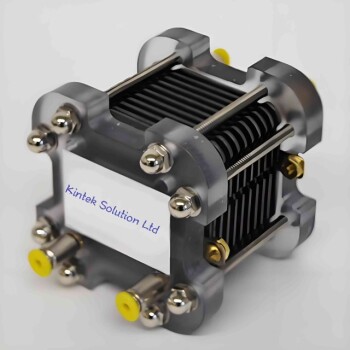
- Flat Corrosion Electrolytic Electrochemical Cell
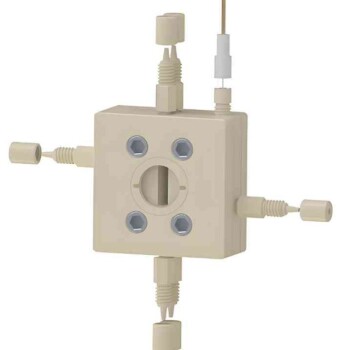
- Thin-Layer Spectral Electrolysis Electrochemical Cell
- H-Type Double-Layer Optical Electrolytic Electrochemical Cell with Water Bath
- Electrolytic Electrochemical Cell with Five-Port
- Electrolytic Electrochemical Cell for Coating Evaluation
People Also Ask
- What is the difference between electrolytic corrosion cell and electrochemical corrosion cell? Understand the Driving Force Behind Corrosion
- Why is a constant temperature control system required for electrochemical corrosion testing in SBF? Key to Lab Accuracy
- How does the design of an electrochemical electrolytic cell influence the coating uniformity? Optimize Your Catalysts
- What procedures and observations are necessary during an experiment with a flat plate corrosion electrolytic cell? Master the 3-Phase Method
- What is the operating principle of a flat plate corrosion electrolytic cell? A Guide to Controlled Materials Testing