Continuous flow and plug flow reactors are the superior choice for industrial supercritical water waste treatment because they enable the integration of critical subsystems like heat recovery and high-efficiency mixing. Unlike batch reactors, these systems provide the stability and control necessary to manage salt deposition and ensure consistent waste destruction at a large scale.
The transition from batch to continuous processing is essential for industrial viability. Continuous flow systems solve the critical issue of reproducibility and solids management, ensuring that high destruction efficiencies can be maintained safely over long operational periods.
Enhancing Industrial Scalability
Integration of Heat Recovery Systems
For supercritical water treatment to be economically viable, energy efficiency is paramount. Continuous flow reactors allow for the seamless integration of heat recovery systems.
This capability allows operators to capture and reuse the significant thermal energy generated during the process. Batch reactors generally lack the continuous throughput required to make such recovery systems effective or feasible.
Suitability for Large-Scale Operations
Batch reactors are inherently limited by their cycle times—filling, heating, reacting, cooling, and emptying.
Continuous flow and plug flow reactors are specifically designed for large-scale industrial waste treatment. They operate in a steady state, allowing for the processing of massive volumes of waste without the downtime associated with batch cycling.
High-Efficiency Fluid Mixing
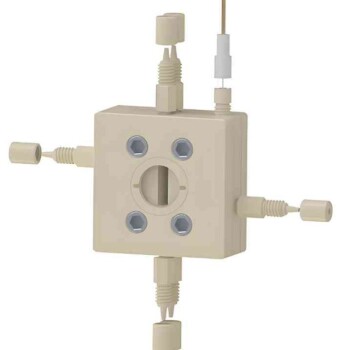
Industrial waste streams are rarely uniform. Continuous systems allow for the integration of high-efficiency fluid mixers directly into the flow path.
This ensures uniform contact between the oxidant and the organic waste. Proper mixing is the foundation of the reaction rate and overall system performance, a factor often compromised in static batch vessels.
Improving Process Control and Reliability
Superior Destruction Efficiency
The primary goal of any waste treatment facility is the complete neutralization of hazardous materials. Continuous flow reactors demonstrate better waste destruction efficiency compared to their batch counterparts.
By maintaining constant temperature, pressure, and residence time, these reactors eliminate the "cold spots" or inconsistent reaction conditions that can occur in batch processing.
Reproducibility of Results
Industrial compliance requires that the output of a process be predictable and consistent every single time.
Continuous flow systems offer superior reproducibility. Once the steady state is achieved, the output remains constant, eliminating the batch-to-batch variance that plagues non-continuous operations.
Solving the Solids Challenge
Managing Salt Deposition and Blockage
The most significant technical hurdle in supercritical water oxidation is the precipitation of salts, which can clog the reactor.
Continuous flow reactors are more effective at managing blockage issues. The continuous movement of fluid, combined with the integrated mixers mentioned earlier, prevents the static accumulation of salts that typically leads to plugging in batch systems.
Understanding the Trade-offs
Complexity of Design
While continuous flow reactors offer superior performance, they require a higher level of engineering complexity.
The integration of mixers and heat exchangers introduces more mechanical parts into a high-pressure, high-temperature environment. This requires robust maintenance protocols to ensure these integrated components do not become points of failure.
Dependency on Steady State
Continuous systems rely on maintaining a steady state for optimal efficiency.
Unlike batch reactors, which can be easily stopped and started, continuous systems are less flexible regarding frequent shutdowns. They are best utilized in scenarios where the waste stream is constant and reliable.
Making the Right Choice for Your Goal
Selecting the correct reactor type depends on your specific operational constraints and volume requirements.
- If your primary focus is industrial throughput: Adopt continuous flow reactors to leverage integrated heat recovery and handle large volumes without downtime.
- If your primary focus is process reliability: Choose continuous flow systems to minimize salt deposition blockages and ensure reproducible destruction efficiency.
- If your primary focus is energy efficiency: Prioritize continuous reactors that allow for the direct recycling of thermal energy back into the feed stream.
Continuous flow reactors transform supercritical water treatment from a batch experiment into a viable, efficient industrial process.
Summary Table:
| Feature | Continuous/Plug Flow Reactors | Batch Reactors |
|---|---|---|
| Scalability | High; ideal for large-scale steady-state waste processing | Low; limited by cycle times (filling/cooling) |
| Energy Efficiency | Excellent; seamless integration of heat recovery systems | Poor; recovery is difficult in static cycles |
| Process Stability | High; constant temperature, pressure, and residence time | Variable; prone to inconsistent reaction conditions |
| Solids Management | Effective; flow/mixing prevents salt deposition | Difficult; high risk of blockage and plugging |
| Reproducibility | Consistent; output is predictable once steady state is reached | Moderate; suffers from batch-to-batch variance |
Optimize Your Industrial Waste Treatment with KINTEK
Ready to scale your supercritical water oxidation or high-pressure processes? KINTEK specializes in advanced laboratory and industrial equipment, including high-temperature high-pressure reactors and autoclaves, tailored for demanding waste destruction and research applications.
Our expertise in high-pressure engineering ensures you achieve superior destruction efficiency and reliable solids management. Whether you need custom reactor systems, cooling solutions, or essential consumables like ceramics and crucibles, our team is here to support your success.
Contact KINTEK today to discuss your project requirements and enhance your facility's performance.
References
- Florentina Maxim, Speranţa Tănăsescu. Functional Materials for Waste-to-Energy Processes in Supercritical Water. DOI: 10.3390/en14217399
This article is also based on technical information from Kintek Solution Knowledge Base .
Related Products
- Customer Made Versatile CVD Tube Furnace Chemical Vapor Deposition Chamber System Equipment
- Customizable Laboratory High Temperature High Pressure Reactors for Diverse Scientific Applications
- Electric Rotary Kiln Continuous Working Small Rotary Furnace Heating Pyrolysis Plant
- Vacuum Sealed Continuous Working Rotary Tube Furnace Rotating Tube Furnace
- Customizable High Pressure Reactors for Advanced Scientific and Industrial Applications
People Also Ask
- What is a CVD tube furnace? A Complete Guide to Thin-Film Deposition
- What is the function of a high-temperature CVD tube furnace in 3D graphene foam prep? Master 3D Nanomaterial Growth
- How does a CVD tube furnace inhibit the sintering of silver supports? Boost Membrane Durability and Performance
- What is the function of a tube furnace in CVD SiC synthesis? Achieving Ultra-Pure Silicon Carbide Powders
- What is the difference between hot wall CVD and cold wall CVD? Choose the Right System for Your Process