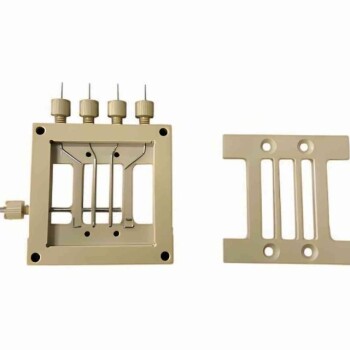
Successfully operating an in-situ Raman electrolytic cell requires strict adherence to electrical, chemical, and physical safeguards. You must ensure correct electrode polarity to avoid reverse connections, select electrolytes that prevent unwanted side reactions, and strictly limit voltage to avoid damaging electrodes or decomposing the electrolyte.
Success relies on protecting three distinct elements simultaneously: the integrity of the electrochemical data, the physical safety of the fragile quartz or glass components, and the personal safety of the operator against corrosive chemicals and gases.
Preserving Electrochemical Integrity
Managing Electrical Parameters
You must strictly maintain the correct polarity for the anode and cathode. A reverse connection can ruin your experimental data and permanently damage the electrode surfaces.
Avoid applying excessively high voltage. High voltage can lead to rapid electrolyte decomposition or structural damage to the electrodes, compromising the cell's optical window.
Optimizing the Chemical Environment
Select an electrolyte that is chemically compatible with your target reaction. An improper choice can trigger side reactions that obscure the Raman signal or degrade the cell materials.
Maintain strict control over the electrolyte’s concentration and temperature. Variations in these parameters can alter both the electrochemical reaction rate and the optical properties of the solution, skewing your results.
Ensuring a Proper Seal
Verify that the cell is tightly sealed before starting the experiment. A compromised seal leads to electrolyte leakage, which not only introduces environmental pollutants but also destabilizes the reaction environment.
Physical Handling and Maintenance
Handling Fragile Components
Whether made of glass or quartz, the cell body is inherently brittle and fragile. Handle the cell gently at all times to avoid impacts with hard objects or surfaces.
While quartz is heat-resistant, you must still avoid excessively high temperatures. Rapid thermal changes or extreme heat can cause cracking due to thermal stress.
Cleaning Protocols
Never use metal brushes to clean the cell. Metal implements can scratch the optical surfaces, permanently ruining the cell's ability to transmit clear Raman signals.
For thorough cleaning, scrub the inner wall with acetone, followed by a rinse with ethanol. Finish by rinsing with ultrapure water (resistivity ≥ 18.2 MΩ·cm) to ensure no residue remains.
Preventing Chemical Conflicts
During cleaning or operation, never mix incompatible acids and bases, such as HNO₃ (nitric acid) and NaOH (sodium hydroxide). These combinations can cause violent exothermic reactions that may shatter the cell or injure the operator.
Operational Safety and Hazards
Personal Protective Equipment (PPE)
Always wear protective gloves and safety glasses. This is non-negotiable when working with corrosive electrolytes that can cause burns or blindness upon contact.
Ventilation and Gas Management
Conduct experiments inside a fume hood. Electrolysis often generates harmful gases or vapors that must be vented away from the operator.
Electrical Safety
Avoid direct contact with the electrolyte and electrodes while the workstation is active. This prevents the risk of electric shock, thermal burns, and chemical poisoning.
Common Pitfalls to Avoid
Overlooking Contamination
A common error is failing to protect the cell surface from external contaminants. Impurities entering the cell will introduce noise to your Raman spectrum and may catalyze unwanted reactions.
Ignoring Thermal Stress
Users often assume quartz is invincible regarding heat. Ignoring the thermal limits of your specific cell design can lead to catastrophic structural failure during high-current experiments.
Making the Right Choice for Your Goal
To maximize the lifespan of your equipment and the quality of your data, prioritize your actions based on your specific focus:
- If your primary focus is Data Accuracy: Prioritize sealing and electrolyte purity, as leakage or contamination will immediately invalidate your spectral data.
- If your primary focus is Equipment Longevity: Focus on gentle handling and proper cleaning protocols, specifically avoiding metal tools and thermal shock.
- If your primary focus is Operator Safety: strict adherence to PPE and fume hood usage is the critical factor to prevent chemical and electrical injuries.
Treat the cell as a precision optical instrument first and a chemical vessel second.
Summary Table:
| Category | Key Precaution | Why It Matters |
|---|---|---|
| Electrical | Correct Polarity & Voltage Limits | Prevents electrode damage and electrolyte decomposition. |
| Chemical | Seal Integrity & Electrolyte Choice | Avoids leaks, side reactions, and optical signal noise. |
| Physical | No Metal Brushes & Gentle Handling | Protects fragile quartz/glass and optical clarity. |
| Safety | PPE & Fume Hood Usage | Protects operator from corrosive chemicals and harmful gases. |
| Cleaning | Acetone/Ethanol + Ultrapure Water | Ensures no residue remains to skew spectroscopic results. |
Maximize the precision of your spectroscopic research with KINTEK. As specialists in advanced laboratory equipment, we provide high-performance electrolytic cells and electrodes specifically designed for sensitive in-situ Raman applications. Beyond electrochemical tools, KINTEK offers a comprehensive range of high-temperature furnaces, hydraulic presses, and cooling solutions to support your entire lab workflow. Contact our technical experts today to find the perfect precision tools for your battery research and material science goals.
Related Products
- Thin-Layer Spectral Electrolysis Electrochemical Cell
- Electrolytic Electrochemical Cell for Coating Evaluation
- Electrolytic Electrochemical Cell with Five-Port
- Electrolytic Electrochemical Cell Gas Diffusion Liquid Flow Reaction Cell
- Flat Corrosion Electrolytic Electrochemical Cell
People Also Ask
- What are the recommended post-experiment procedures for cleaning and storing the thin-layer spectroelectrochemical cell?
- What preparation steps are required before initiating an experiment with the thin-layer spectroelectrochemical cell?
- What operational environments and sealing options are available for the thin-layer spectroelectrochemical cell?
- For what types of systems, temperature ranges, and sealing configurations is the thin-layer spectroelectrochemical cell designed? Ideal for Aqueous and Non-Aqueous Analysis
- What are the necessary preparation steps before using a thin-layer spectroelectrochemical cell? A Guide to Reliable Results