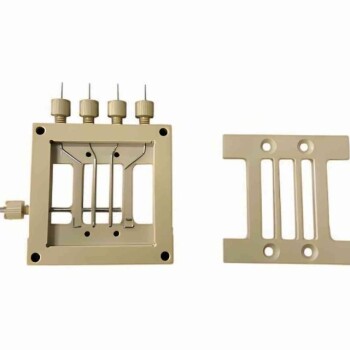
The in-situ Raman electrolytic cell features a body and lid constructed primarily from PEEK (Polyether ether ketone), a robust polymer chosen for its chemical stability. The design integrates a quartz window on top of the cell body to allow for optical measurements, while the lid is precision-engineered with three specific holes to house the working, counter, and reference electrodes.
Core Takeaway By combining a chemically resistant PEEK chassis with an optically transparent quartz window, this cell is optimized for real-time spectroscopic monitoring of the working electrode surface during electrochemical reactions.
Detailed Component Breakdown
The Cell Body Construction
The main structural component of the cell is fabricated from PEEK. This material is selected for its high mechanical strength and excellent resistance to chemical corrosion, ensuring the cell remains stable even when exposed to various electrolytes during experimentation.
The Optical Window
Positioned on top of the PEEK body is a quartz window. This is the critical feature for Raman spectroscopy, as quartz offers superior light transmittance across a broad spectrum (from ultraviolet to infrared) compared to standard glass. This window provides a clear optical path for the laser to observe the working electrode sample located directly beneath it.
The Lid Configuration
Like the body, the cell lid is manufactured from PEEK to maintain uniform chemical resistance. The lid is functionally designed with three distinct electrode holes. These openings are arranged to securely hold the standard three-electrode system: the working electrode (WE), the counter electrode (CE), and the reference electrode (RE).
Understanding the Trade-offs
Chemical Compatibility of Quartz
While quartz is highly resistant to strong acids and weak bases, it has a specific vulnerability. You must strictly avoid using Hydrofluoric acid (HF), as it is one of the few substances that reacts destructively with quartz, which would ruin the optical window.
Cleaning and Maintenance
Despite the durability of PEEK, the surfaces of the cell—and especially the quartz window—require careful handling. Never use metal brushes or abrasive materials during cleaning, as scratches on the quartz will scatter the laser light and degrade the quality of your Raman spectra.
Making the Right Choice for Your Experiment
To ensure successful data collection, match your operational protocols to the cell's material limits:
- If your primary focus is optical signal quality: Ensure the quartz window is kept pristine and free of scratches, as this is the only interface between your spectrometer and the sample.
- If your primary focus is electrolyte selection: Verify that your chosen electrolyte does not contain Hydrofluoric acid (HF), ensuring the longevity of the quartz component.
Success in in-situ Raman spectroscopy relies on maintaining the clarity of the quartz window while leveraging the chemical inertness of the PEEK body.
Summary Table:
| Component | Material | Primary Function |
|---|---|---|
| Cell Body & Lid | PEEK (Polyether ether ketone) | Provides mechanical strength and high chemical resistance |
| Optical Window | Quartz | Enables broad-spectrum light transmittance for laser monitoring |
| Electrode Ports | Precision-machined PEEK | Securely houses Working, Counter, and Reference electrodes |
| Compatible Media | Strong acids/weak bases | Ensures stability during diverse electrochemical reactions |
Elevate Your Electrochemical Spectroscopy with KINTEK
Precision in material science starts with the right equipment. At KINTEK, we specialize in high-performance laboratory solutions, from in-situ Raman electrolytic cells and electrodes to battery research tools and high-temperature furnaces. Our PEEK-based cells are designed to withstand rigorous chemical environments while delivering the optical clarity your research demands.
Whether you need advanced electrolytic cells, platinum/glassy carbon electrodes, or PTFE consumables, our team is ready to provide the technical expertise and high-quality hardware your lab requires.
Ready to upgrade your research capabilities? Contact us today to find the perfect fit for your application!
Related Products
- Thin-Layer Spectral Electrolysis Electrochemical Cell
- Electrolytic Electrochemical Cell for Coating Evaluation
- Electrolytic Electrochemical Cell with Five-Port
- Electrolytic Electrochemical Cell Gas Diffusion Liquid Flow Reaction Cell
- Flat Corrosion Electrolytic Electrochemical Cell
People Also Ask
- What are the recommended post-experiment procedures for cleaning and storing the thin-layer spectroelectrochemical cell?
- What preparation steps are required before initiating an experiment with the thin-layer spectroelectrochemical cell?
- What operational environments and sealing options are available for the thin-layer spectroelectrochemical cell?
- For what types of systems, temperature ranges, and sealing configurations is the thin-layer spectroelectrochemical cell designed? Ideal for Aqueous and Non-Aqueous Analysis
- What are the necessary preparation steps before using a thin-layer spectroelectrochemical cell? A Guide to Reliable Results