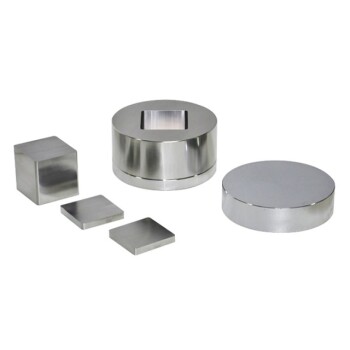
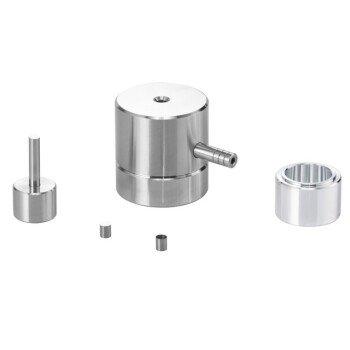
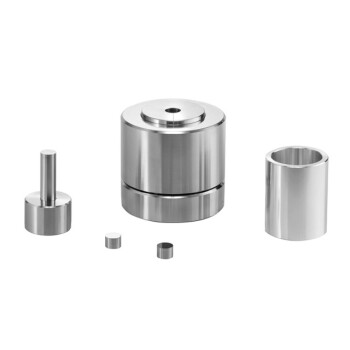
High-strength graphite molds serve as the critical interface between the processing equipment and the composite material. They primarily function as a physical containment vessel to define sample geometry and as a transmission medium to transfer high mechanical pressure (typically around 30 MPa) directly to the Ti/Al2O3 assembly. Additionally, they leverage graphite's inherent thermal properties to ensure a uniform temperature field throughout the sintering zone.
The graphite mold is not merely a container; it is an active processing tool that converts hydraulic force into material density while regulating the thermal environment to prevent structural defects.
Mechanical Functions in Synthesis
Defining Geometry and Alignment
The most immediate function of the graphite mold is to act as a positioning container. It constrains the loose powder or stacked metal foils to a specific macroscopic shape (such as a circular disk).
For laminated composites like Ti/Al2O3, the mold is essential for maintaining the alignment of the multi-layer stacks. This containment prevents lateral shifting during the process, ensuring the final component meets precise dimensional specifications.
The Pressure Transmission Medium
Beyond simple containment, the mold acts as a pressure transmission medium. It vertically transmits the force from the hydraulic cylinders directly to the sample surface.
In this role, the mold must withstand significant axial pressures (often 25–50 MPa) without deforming. This transmission is vital for facilitating plastic deformation and closing pores within the material, which drives the densification of the composite.
Thermal Roles and Sintering Quality
Ensuring Uniform Heating
Graphite possesses excellent thermal conductivity, which is exploited to regulate the sintering environment. The mold absorbs heat from the furnace elements and redistributes it evenly around the specimen.
This uniformity is critical for Ti/Al2O3 composites. It prevents local hot spots or thermal gradients that could lead to uneven sintering, residual stresses, or cracking within the ceramic layers.
Enabling Diffusion Bonding
The combination of pressure transmission and thermal uniformity facilitates diffusion bonding. By maintaining consistent heat and pressure, the mold allows atoms to migrate across the Ti and Al2O3 interfaces.
This process transforms the separate layers or powders into a cohesive structural unit. Without the mold's ability to maintain these conditions simultaneously, the material would suffer from local non-bonding or delamination.
Understanding the Trade-offs
Managing Chemical Reactivity
While graphite is excellent for heat and pressure, it presents a chemical challenge when working with Titanium. Titanium is highly reactive and can form Titanium Carbide (TiC) upon direct contact with carbon at high temperatures.
To mitigate this, isolation layers (such as alumina powder or foil) are often used between the mold and the sample. This facilitates demolding and preserves the chemical purity of the composite surface.
Mechanical Limitations at Extremes
Graphite maintains high strength at elevated temperatures (up to 1450°C), but it is brittle. While it handles compressive loads well, it has low tensile strength.
Operators must ensure the alignment is perfect to avoid shear forces. Misalignment during the high-pressure phase can lead to catastrophic mold failure, destroying both the consumable mold and the sample inside.
Making the Right Choice for Your Goal
Understanding the dual mechanical and thermal roles of the mold allows you to optimize the hot-pressing process.
- If your primary focus is Dimensional Precision: Prioritize high-density, high-strength graphite grades to minimize mold deformation under the 30+ MPa load.
- If your primary focus is Surface Purity: Ensure the use of an inert isolation layer (like alumina) to prevent Ti-C reactions while relying on the mold strictly for pressure transmission.
- If your primary focus is Homogeneity: Utilize a mold design with thicker walls to maximize thermal mass, ensuring the most uniform temperature distribution possible.
The success of your Ti/Al2O3 composite relies on treating the graphite mold not as a passive bucket, but as the primary instrument for delivering force and heat.
Summary Table:
| Function Category | Primary Role | Benefit to Ti/Al2O3 Composite |
|---|---|---|
| Mechanical | Geometry & Alignment | Maintains multi-layer stack precision and dimensional accuracy. |
| Pressure | Force Transmission | Transfers axial pressure (30+ MPa) to drive material densification. |
| Thermal | Heat Redistribution | Ensures a uniform temperature field to prevent cracking and residual stress. |
| Interfacial | Diffusion Bonding | Facilitates atomic migration across Ti and Al2O3 layers for cohesive strength. |
Elevate Your Advanced Material Synthesis with KINTEK
Precise control over heat and pressure is the foundation of high-performance Ti/Al2O3 composites. KINTEK specializes in high-tier laboratory equipment designed for the most demanding sintering environments. From high-strength graphite molds and crucibles to advanced vacuum hot-pressing furnaces and hydraulic presses, we provide the tools you need to achieve maximum densification and structural integrity.
Whether you are focusing on battery research, aerospace ceramics, or metallurgy, our comprehensive range of high-temperature furnaces, crushing systems, and specialized consumables (including PTFE and ceramic products) ensures your lab operates at the cutting edge of technology.
Ready to optimize your composite processing? Contact KINTEK experts today to find the perfect equipment solution for your research and production goals!
Related Products
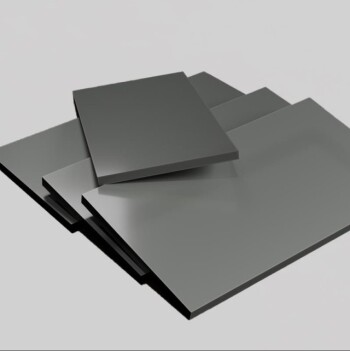
- Carbon Graphite Plate Manufactured by Isostatic Pressing Method
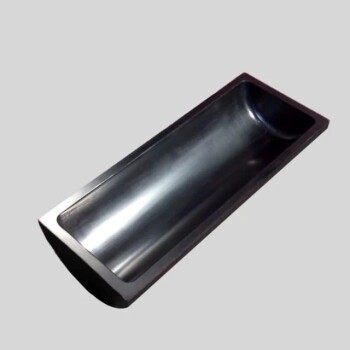
- High Purity Pure Graphite Crucible for Evaporation
- High Purity Pure Graphite Crucible for Electron Beam Evaporation
- Carbon Graphite Boat -Laboratory Tube Furnace with Cover
- Vertical High Temperature Graphite Vacuum Graphitization Furnace
People Also Ask
- What is the process of isostatic graphite manufacturing? Achieve Unmatched Material Uniformity and Performance
- What is isostatic graphite? The Ultimate Material for High-Tech and High-Temperature Applications
- What is the density of isostatic graphite? Unlock Superior Performance for Demanding Applications
- How big is the isostatic pressing market? A Deep Dive into the $1.2B+ Advanced Manufacturing Enabler
- Why Use an Isostatic or High-Precision Hydraulic Press for Li/LLZO/Li Batteries? Master Solid-State Interfaces