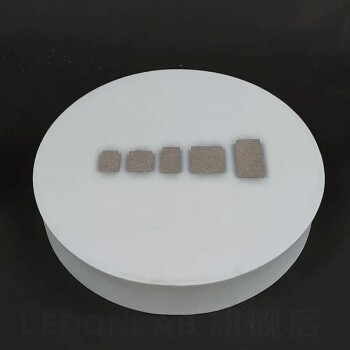
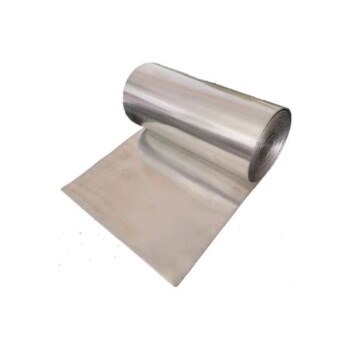
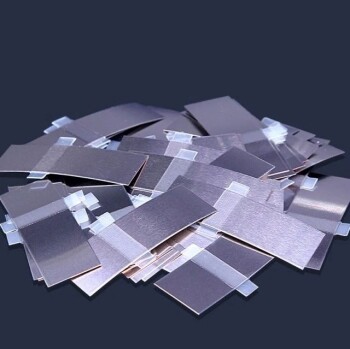
Industrial-grade Nickel Foam functions primarily as a highly porous, conductive three-dimensional scaffold. Its main role is to maximize the effective surface area available for loading powder catalysts while simultaneously ensuring that electrolytes can fully penetrate the electrode structure. This capability is critical for testing oxygen evolution performance under rigorous conditions that mimic real-world applications.
The core value of Nickel Foam lies in its ability to bridge the gap between laboratory testing and industrial reality. By combining high surface area with excellent electrical conductivity, it allows researchers to evaluate catalytic performance at high current densities (300–500 mA/cm²), effectively simulating the operating environment of industrial water electrolyzers.
The Structural Role of Nickel Foam
To understand why Nickel Foam is the industry standard for these tests, one must look at how its physical architecture solves the problems inherent in gas-evolving reactions.
Maximizing Effective Surface Area
The foam acts as a massive three-dimensional framework. Unlike flat electrodes, this porous structure provides a significantly larger surface area relative to its geometric footprint.
This allows for a much higher loading of powder catalysts. The foam anchors the catalyst material securely, exposing more active sites to the reaction.
Ensuring Electrolyte Penetration
Surface area is useless if the chemical reactants cannot reach it. Nickel Foam possesses a highly porous, open-cell structure.
This design ensures that the electrolyte solution can deeply penetrate the electrode. It guarantees that the inner layers of the loaded catalyst remain chemically accessible during the reaction.
Electrical Performance Functions
Beyond its physical structure, the material’s electrical properties are fundamental to its function as a catalyst carrier.
Facilitating Rapid Electron Transport
Nickel is an excellent electrical conductor. In an electrocatalytic setup, efficient movement of electrons is the "fuel" for the reaction.
The foam facilitates rapid electron transport throughout the entire three-dimensional electrode. It minimizes resistance, ensuring that energy is efficiently delivered to the catalyst powder dispersed within the scaffold.
Enabling High Current Density Testing
The combination of conductivity and surface area allows the electrode to handle significant electrical loads.
The reference specifically notes that this setup enables evaluations at current densities between 300 and 500 mA/cm².
This capability is vital for validity. It ensures that performance data reflects the harsh conditions of industrial water electrolyzers, rather than just idealized, low-current laboratory conditions.
Understanding the Operational Trade-offs
While Nickel Foam is a powerful tool for industrial simulation, users must understand the specific context of its utility to avoid misinterpreting data.
Macro-Performance vs. Intrinsic Kinetics
The primary function of this material is to simulate a "system-level" environment.
It is designed to test how a catalyst performs under high-throughput conditions (high current). It is less suited for isolating single-site intrinsic kinetics compared to perfectly flat, inert electrodes, as the 3D structure introduces complex mass transport variables.
The Necessity of High Loading
To utilize the foam effectively, researchers must take advantage of its porosity.
Using this material implies a requirement for substantial catalyst loading. If the catalyst loading is too low, the benefits of the 3D conductive framework are not fully realized, and the bare nickel substrate may interfere with the data.
Making the Right Choice for Your Goal
When designing your experimental setup for oxygen evolution, your choice of substrate should align with your end goals.
- If your primary focus is Industrial Simulation: Choose Nickel Foam to test stability and efficiency at high current densities (300–500 mA/cm²).
- If your primary focus is Catalyst Loading: Use Nickel Foam to maximize the amount of active powder you can test within a fixed geometric area.
Ultimately, Nickel Foam is the definitive choice when you need to prove that a catalyst can survive and perform in the high-energy reality of commercial water electrolysis.
Summary Table:
| Key Feature | Functional Benefit | Industrial Impact |
|---|---|---|
| 3D Porous Structure | Maximizes catalyst loading and electrolyte penetration | Bridges the gap between lab tests and industrial scale |
| High Conductivity | Facilitates rapid electron transport across the scaffold | Minimizes resistance for efficient energy delivery |
| High Current Density | Supports testing at 300–500 mA/cm² | Simulates the rigorous environment of commercial electrolyzers |
| Structural Integrity | Anchors powder catalysts securely | Ensures stability during high-throughput oxygen evolution reactions |
Elevate Your Electrocatalysis Research with KINTEK
Ready to simulate real-world industrial performance in your lab? KINTEK specializes in high-performance materials and laboratory equipment designed for the most demanding research environments. Our premium industrial-grade Nickel Foam, alongside our extensive range of electrolytic cells, electrodes, and battery research tools, provides the 3D conductive architecture needed to push your catalysts to their limits.
From high-temperature furnaces and pressure reactors to precision crushing and milling systems, KINTEK offers the comprehensive solutions required for advanced material synthesis and testing. Contact us today to optimize your experimental setup!
References
- Xiangxi Wang, Hua Bing Tao. Towards the Rational Design of Stable Electrocatalysts for Green Hydrogen Production. DOI: 10.3390/catal12020204
This article is also based on technical information from Kintek Solution Knowledge Base .
Related Products
- Nickel Foam for Industrial and Laboratory Applications
- Copper Nickel Foam Metal Sheet
- Copper Foam
- High Purity Zinc Foil for Battery Lab Applications
- Nickel Aluminum Tabs for Soft Pack Lithium Batteries
People Also Ask
- What procedures should be followed after using nickel or copper foam? A Guide to Reliable Reuse and Performance
- What is nickel foam used for? A Guide to Its Electrochemical Applications
- In which fields is nickel foam widely used? A Key Material for Advanced Engineering
- What procedures should be followed before using nickel or copper foam? Ensure Optimal Performance and Reliability
- What are the advantages of using high-porosity Nickel Foam or Nickel Mesh? Boost Your MEC Performance