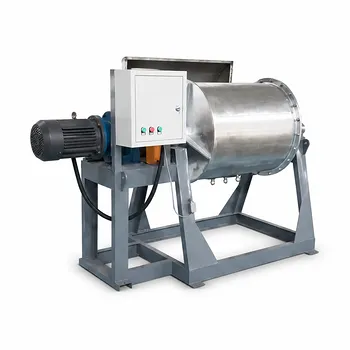
The primary technical tasks of a planetary ball mill during the initial synthesis of Na3SbS4 are defined by a dual-stage process involving physical homogenization and mechanochemical activation. Specifically, the device operates at low speeds (approximately 150 rpm) to uniformly mix raw materials such as Na2S, Sb2S3, and sulfur powder, before shifting to high speeds (approximately 510 rpm) to refine precursor powders and drive preliminary chemical reactions.
Core Takeaway The planetary ball mill functions as a mechanochemical reactor rather than a simple mixer. By precisely controlling kinetic energy input, it bridges the gap between raw powder agglomerates and the refined, reactive precursors necessary for synthesizing high-performance sulfide solid electrolytes.
The Dual-Stage Synthesis Strategy
Stage 1: Low-Speed Homogenization
The initial phase focuses on the macroscopic uniformity of the reactants. Operating at approximately 150 rpm, the mill utilizes the movement of zirconia grinding balls to distribute the raw materials—Na2S, Sb2S3, and sulfur—evenly throughout the vessel.
Preventing Localized Reactions
This low-energy stage is critical for preventing "hot spots" in the powder mixture. By ensuring a uniform blend before high energy is applied, the process minimizes the risk of inconsistent chemical compositions in the final electrolyte.
Stage 2: High-Speed Mechanochemical Activation
Once mixed, the mill increases speed to approximately 510 rpm. This stage shifts the focus from distribution to transformation, delivering the high-energy impact required to fracture particles and increase their internal energy.
Initiating Chemical Changes
At this higher velocity, the mill provides sufficient mechanochemical energy to initiate preliminary chemical reactions. This goes beyond simple grinding; the impact forces facilitate atomic-level interactions that might otherwise require high temperatures to achieve.
The Mechanism of Material Refinement
Disruption of Crystalline Structures
The high-energy impact of the grinding balls disrupts the stable crystalline structures of the raw materials. This introduces defects and increases the surface energy of the powders, making them significantly more reactive for subsequent processing steps.
Increasing Contact Surface Area
The milling process breaks down raw material agglomerates into finer particles. This drastically increases the contact surface area between the sulfur, sodium, and antimony sources, which is a prerequisite for a complete and uniform solid-state reaction.
Facilitating Phase Transitions
In the broader context of sulfide electrolytes, this mechanical processing often drives a transition toward amorphous or glass-ceramic states. While the primary goal here is refinement, this energy input lays the groundwork for the final formation of high-ionic-conductivity crystal structures.
Understanding the Trade-offs
Impact Energy vs. Material Integrity
While high RPMs (like 510 rpm) are necessary for reaction initiation, excessive energy can be detrimental. Over-milling may generate excessive heat, which can degrade sensitive sulfide compounds or lead to unwanted phase changes before the synthesis is complete.
The Risk of Contamination
The use of zirconia grinding balls introduces a risk of contamination through abrasive wear. While zirconia is generally stable, trace impurities can affect the ionic conductivity of the final Na3SbS4 electrolyte, making the duration and intensity of milling critical variables to control.
Making the Right Choice for Your Goal
To optimize your synthesis process, tailor your milling parameters to your specific material requirements:
- If your primary focus is Compositional Uniformity: Prioritize the low-speed (150 rpm) stage to ensure perfect distribution of elemental sulfur and precursors before any reaction begins.
- If your primary focus is Reactivity and Precursor Refinement: Ensure the high-speed (510 rpm) stage is sustained long enough to break down agglomerates and initiate mechanochemical bonding, but monitor strictly for thermal degradation.
Success in synthesizing Na3SbS4 lies in balancing the mechanical force required to drive reactions against the delicate nature of sulfide chemistry.
Summary Table:
| Synthesis Stage | Speed (RPM) | Primary Technical Objective | Key Result |
|---|---|---|---|
| Homogenization | ~150 rpm | Uniform distribution of Na2S, Sb2S3, & S | Prevention of localized "hot spots" |
| Activation | ~510 rpm | High-energy impact & particle fracturing | Increased surface energy & reactivity |
| Refinement | High Speed | Disruption of crystalline structures | Reduction of agglomerates to fine powder |
| Phase Transition | Controlled | Mechanochemical bonding initiation | Preparation for high-ionic-conductivity states |
Elevate Your Solid-State Battery Research with KINTEK
Precision is paramount when synthesizing sensitive sulfide electrolytes like Na3SbS4. KINTEK specializes in advanced laboratory solutions, providing the high-performance crushing and milling systems—including specialized planetary ball mills—and high-temperature furnaces required to master mechanochemical activation.
Our comprehensive portfolio supports every stage of your workflow, from zirconia grinding media and PTFE consumables to high-pressure reactors and battery research tools. Whether you are focused on achieving perfect compositional uniformity or maximizing ionic conductivity, our technical experts are ready to equip your lab with the tools for success.
Ready to optimize your synthesis parameters? Contact KINTEK today for a consultation!
Related Products
- High Energy Planetary Ball Mill for Laboratory Horizontal Tank Type Milling Machine
- Laboratory Planetary Ball Mill Rotating Ball Milling Machine
- High-Energy Omnidirectional Planetary Ball Mill Milling Machine for Laboratory
- High Energy Planetary Ball Mill Milling Machine for Laboratory
- Laboratory Horizontal Planetary Ball Mill Milling Machine
People Also Ask
- What is the role of a planetary ball mill in sulfide-based solid-state batteries? Engineer High-Performance Cathodes
- What are the parameters of a planetary ball mill? Master Speed, Time, and Media for Perfect Grinding
- What is the function of a planetary ball mill for nanostructured eutectic steel? Essential Prep for High-Strength Alloys
- What role does a planetary ball mill play in the preparation of NASICON-type solid electrolytes like LATP and LAGP?
- What is the function of a planetary ball mill in solid-state electrolyte prep? Milling vs. SDS Methods Explained