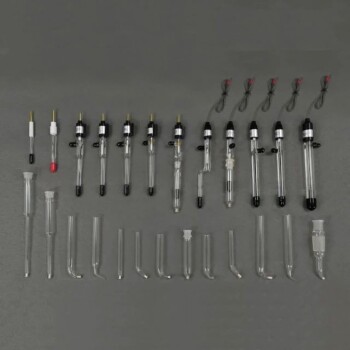
The three-electrode electrochemical cell is the gold standard for catalyst characterization because it decouples the measurement of electrode potential from the current-carrying circuit. This configuration allows researchers to isolate and precisely control the potential of the working electrode, ensuring that the resulting data—such as polarization curves and cyclic voltammetry—reflects the intrinsic redox behavior of the composite catalyst rather than system-wide interference or counter-electrode limitations.
The core advantage of a three-electrode system is its ability to provide high-precision control over the working electrode potential by utilizing an independent reference electrode. This setup eliminates errors caused by counter-electrode polarization and ohmic drop, providing a true representation of the catalyst's electrochemical properties.
Precision Control of Electrode Potential
The Role of the Independent Reference Electrode
The introduction of a dedicated reference electrode (such as Ag/AgCl or SCE) provides a stable, known potential against which the working electrode is measured. This ensures that the voltage applied to the catalyst is maintained with high precision, allowing for the accurate determination of redox potentials and specific capacitance.
Eliminating Counter Electrode Interference
By using three electrodes, the system decouples the potential and performance of the working electrode from the counter electrode. This prevents fluctuations or instabilities at the counter electrode—such as those found in lithium metal or graphite rods—from obscuring the degradation mechanisms or electrochemical stability of the catalyst under test.
Feedback and Potentiostatic Regulation
When integrated with a potentiostat, the three-electrode setup enables real-time feedback and regulation of the working electrode's potential. This is critical for processes like controlled ionization or specific crystal growth, where operating at a precise oxidation potential is necessary to avoid unwanted side reactions.
Accuracy in Current and Activity Measurement
Minimizing Ohmic Drop Interference
One of the most significant technical hurdles in electrochemistry is ohmic drop, which can distort measurement results. The three-electrode configuration effectively eliminates this interference, ensuring that the recorded curves truly reflect the intrinsic electrocatalytic activity of the material in the electrolyte.
Unrestricted Loop Current
Using a large-area counter electrode, such as a platinum plate or graphite rod, ensures that the loop current is not limited by the counter electrode's surface area. This allows the system to capture the full current response of the composite catalyst, providing reliable data for Cyclic Voltammetry (CV) and Galvanostatic Charge-Discharge (GCD) tests.
Prevention of Polarization Errors
In a standard two-electrode setup, polarization current passes through the reference point, leading to measurement errors. The three-electrode system prevents this by ensuring that no significant current flows through the reference electrode, maintaining the integrity of the potential measurement throughout the experiment.
Consistency in Long-Term Testing
Stability During Durability Trials
For extended operational periods, such as chronoamperometry or cycling between ORR and OER modes, maintaining electrochemical consistency is vital. The three-electrode setup provides the stability needed to evaluate how catalysts, such as graphene-supported alloys, perform over hundreds of hours without data drift.
Accuracy in Degradation Analysis
By isolating the working electrode, researchers can precisely evaluate the degradation mechanisms of the cathode or anode material. This isolation ensures that any observed loss in performance is attributable to the catalyst itself rather than changes in the counter electrode or the electrolyte interface.
Understanding the Trade-offs
Complexity and Setup Requirements
While technically superior, the three-electrode configuration is more complex to set up and requires a high-quality potentiostat to manage the three distinct channels. It also demands careful placement of the reference electrode (often using a Luggin capillary) to minimize residual uncompensated resistance.
Maintenance of Reference Electrodes
Reference electrodes are sensitive components that require regular maintenance and calibration to ensure accuracy. If the internal filling solution leaks or becomes contaminated, it can introduce artifacts into the data or even poison the catalyst being tested.
Scalability Limitations
While ideal for laboratory-scale material characterization, the three-electrode setup does not directly translate to industrial-scale devices like fuel cells or batteries, which typically operate in a two-electrode configuration. Results from a three-electrode cell must be carefully interpreted when predicting performance in a full-cell environment.
How to Apply This to Your Research
Making the Right Choice for Your Goal
- If your primary focus is determining intrinsic catalytic activity: Utilize a three-electrode setup with a rotating disk electrode (RDE) to eliminate mass transport limitations and ohmic interference.
- If your primary focus is long-term durability and degradation: Use a high-stability reference electrode (like Hg/Hg₂SO₄ or Ag/AgCl) to ensure the potential remains constant over hundreds of hours of cycling.
- If your primary focus is optimizing charge storage (capacitance): Ensure your counter electrode has a significantly larger surface area than your working electrode to prevent current bottlenecks.
By isolating the working electrode's potential, the three-electrode configuration transforms electrochemical testing from a system-wide observation into a surgical analysis of the catalyst's true capabilities.
Summary Table:
| Feature | Advantage | Technical Impact |
|---|---|---|
| Reference Electrode | Independent potential measurement | Eliminates errors from counter-electrode polarization. |
| Potentiostatic Feedback | Precise potential regulation | Ensures accurate redox potential and specific capacitance data. |
| Decoupled Circuit | High loop current capacity | Captures full current response without surface area bottlenecks. |
| Minimized Ohmic Drop | Reduced signal interference | Reflects the true intrinsic catalytic activity of the material. |
Elevate Your Electrochemical Research with KINTEK Precision
Achieving world-class results in catalyst characterization starts with the right equipment. KINTEK provides researchers with high-precision electrolytic cells and electrodes, tailored for demanding three-electrode configurations. Whether you are performing Cyclic Voltammetry (CV) or long-term durability trials, our solutions ensure maximum stability and data integrity.
Our extensive portfolio supports your entire lab workflow, featuring:
- Electrochemical Tools: High-quality cells, electrodes, and battery research consumables.
- Thermal Processing: A wide range of furnaces, including CVD, PECVD, vacuum, and muffle furnaces.
- Sample Preparation: Hydraulic pellet presses, crushing systems, and high-purity ceramic crucibles.
Ready to eliminate measurement errors and optimize your material testing? Contact KINTEK today to find the perfect lab equipment for your application!
References
- Abeer Enaiet Allah, Abdalla Abdelwahab. Growth of polyoxomolybdate with a porous pyramidal structure on carbon xerogel nanodiamond as an efficient electro-catalyst for oxygen reduction reaction. DOI: 10.1039/d2ra07543a
This article is also based on technical information from Kintek Solution Knowledge Base .
Related Products
- H Type Electrolytic Cell Triple Electrochemical Cell
- Electrolytic Electrochemical Cell Gas Diffusion Liquid Flow Reaction Cell
- Electrolytic Electrochemical Cell with Five-Port
- Electrolytic Electrochemical Cell for Coating Evaluation
- Quartz Electrolytic Electrochemical Cell for Electrochemical Experiments
People Also Ask
- What is a H type cell? A Guide to Divided Electrochemical Cells for Accurate Experiments
- How should the electrolyte be prepared and added to the H-type electrolytic cell? Best Practices for Purity and Safety
- What is the technical necessity of using an H-type electrolytic cell for NO3RR tests? Protect Your Ammonia Yields
- How does the design of an H-type electrolytic cell benefit the neutral water electrolysis process for metal recovery?
- What is the primary function of an H-type electrolytic cell in NitRR? Ensure Accurate Product Yields