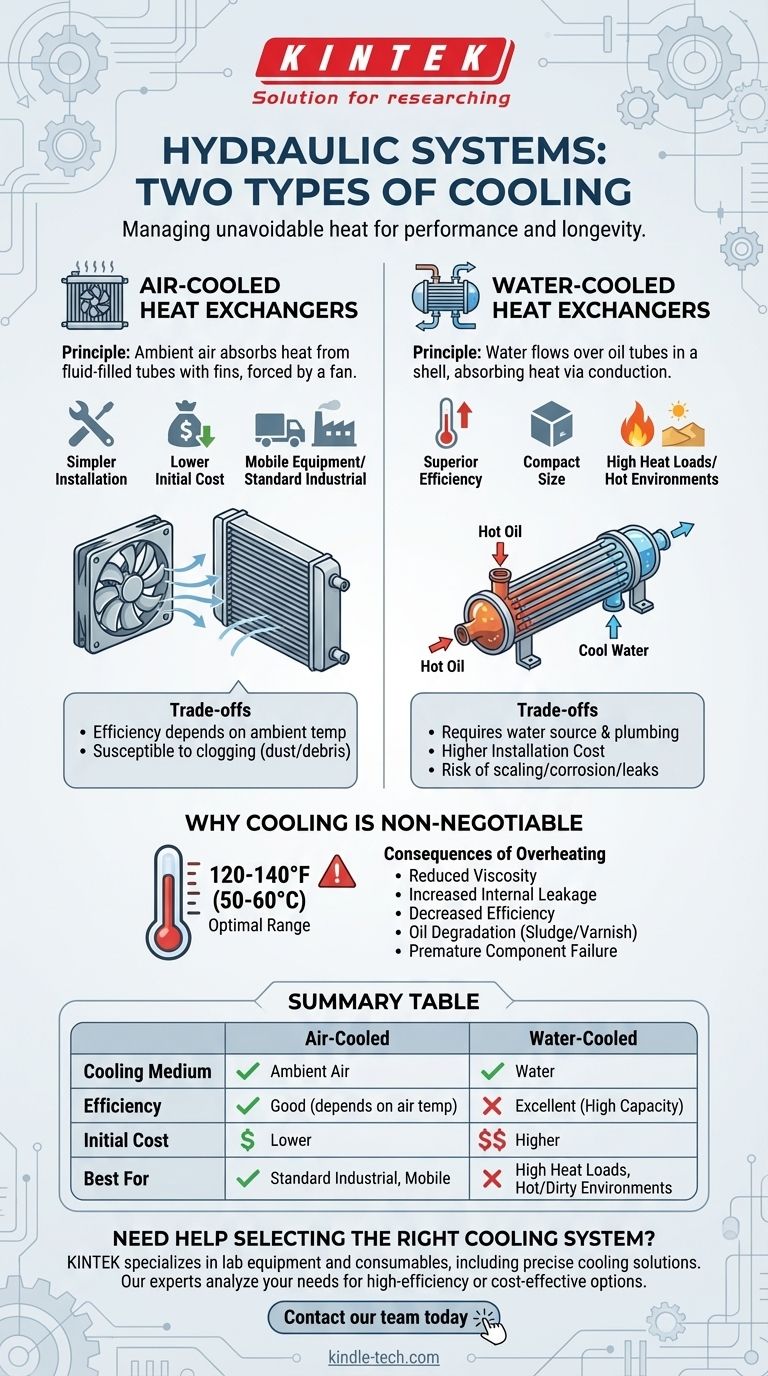
In hydraulic systems, heat is an unavoidable byproduct of inefficiency, and managing it is critical for performance and longevity. The two primary technologies used to remove this heat are air-cooled heat exchangers and water-cooled heat exchangers. Each operates on a different principle and is suited to different environments and operational demands.
The fundamental choice in hydraulic cooling is a trade-off. Air-cooled systems offer simplicity and lower initial cost, while water-cooled systems provide superior efficiency and performance, especially in demanding or hot environments.
Why Cooling is Non-Negotiable in Hydraulic Systems
Every hydraulic system generates waste heat. This heat comes from the internal friction of the fluid itself and the inefficiencies inherent in components like pumps, motors, and relief valves as they convert mechanical energy into fluid power.
The Consequences of Overheating
Unmanaged heat is the primary enemy of a hydraulic system. When oil temperature rises above its optimal range (typically 120-140°F or 50-60°C), its viscosity drops.
This thinning of the fluid leads to reduced lubrication, increased internal leakage, and decreased component efficiency. Prolonged overheating permanently degrades the oil, creating sludge and varnish that clog filters and valves, ultimately leading to premature component failure.
The Two Core Cooling Technologies
To combat heat buildup, nearly all continuous-duty hydraulic systems incorporate a heat exchanger, or "cooler." The choice boils down to using either the surrounding air or a dedicated water source as the cooling medium.
Air-Cooled Heat Exchangers
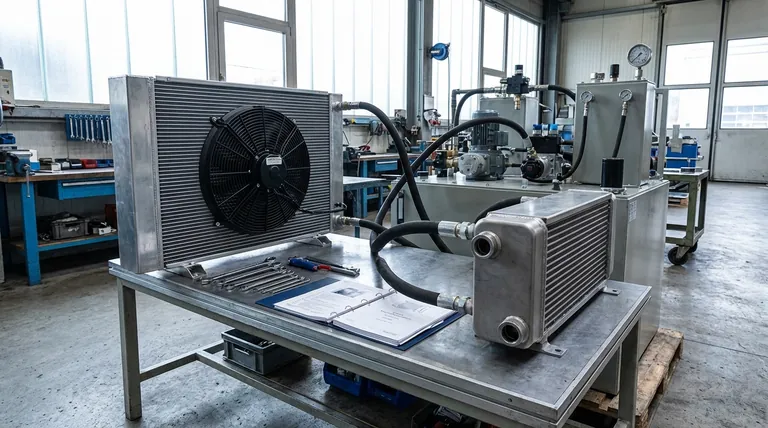
An air-cooled heat exchanger, often called a radiator, works by pumping hot hydraulic fluid through a series of tubes. These tubes are covered in thin fins that dramatically increase the surface area exposed to the air.
A fan, which can be powered by an electric, hydraulic, or engine-driven motor, forces ambient air across these fins. The moving air absorbs heat from the fins and carries it away, cooling the fluid inside.
They are simple, self-contained, and relatively easy to install, making them the most common choice for mobile equipment and many standard industrial applications.
Water-Cooled Heat Exchangers
A water-cooled heat exchanger, most often a shell-and-tube design, uses water to absorb heat from the hydraulic fluid. In this design, hot oil flows through a bundle of tubes contained within a larger shell.
Cool water is circulated through the shell, flowing over the outside of the tubes that carry the oil. Heat transfers from the hot oil, through the tube walls, and into the cooler water, which is then discharged.
These systems are known for their high efficiency and compact size relative to their cooling capacity.
Understanding the Trade-offs: Air vs. Water
Choosing the correct cooler is not about which is "better," but which is right for the specific application. The decision involves balancing efficiency, cost, and the operating environment.
Efficiency and Performance
Water-cooled systems are significantly more efficient at transferring heat than air-cooled systems. Water has a much higher thermal capacity than air, allowing it to absorb more heat, more quickly.
This makes water-cooled units ideal for systems with very high heat loads or for applications where precise temperature control is critical. Their performance is also independent of the ambient air temperature.
Installation and Cost
Air-cooled systems have a lower initial cost and are far simpler to install. They only require mounting and connections for electricity (if using an electric fan) and hydraulic lines.
Water-cooled systems are more complex. They require a reliable source of cool water—from a plant-wide cooling tower, chiller, or municipal supply—as well as associated plumbing, which increases installation cost and complexity.
Operating Environment
The environment is a major factor. Air-coolers can struggle in very hot ambient conditions, as their effectiveness decreases when the air used for cooling is already warm. They are also susceptible to clogging from airborne debris like dust, dirt, and oil mist.
Water-cooled systems excel in hot, dirty, or hazardous environments because their performance is unaffected by air quality or temperature.
Maintenance and Reliability
Air-coolers require regular cleaning of the fins to maintain airflow and performance. The fan and motor are also potential points of failure.
Water-coolers can suffer from internal scaling or corrosion if the water quality is poor. There is also the potential for internal leaks, which could contaminate the hydraulic fluid with water—a catastrophic failure for a hydraulic system.
Making the Right Choice for Your System
Selecting the appropriate cooler requires a clear understanding of your system's priorities and operating conditions.
- If your primary focus is low initial cost and simple installation: An air-cooled system is the default choice for most standard applications.
- If your primary focus is maximum cooling efficiency in a compact footprint: A water-cooled system is superior, provided a suitable water source is available.
- If you operate in a very hot, dusty, or hazardous location: A water-cooled system will provide more stable and reliable performance than an air-cooled counterpart.
- If a reliable water source is unavailable or cost-prohibitive: An appropriately sized (or oversized) air-cooled system is your most practical option.
Ultimately, choosing the right cooling technology is a critical engineering decision that directly protects the health and reliability of your entire hydraulic system.
Summary Table:
| Feature | Air-Cooled Heat Exchanger | Water-Cooled Heat Exchanger |
|---|---|---|
| Cooling Medium | Ambient Air | Water |
| Efficiency | Good (depends on air temp) | Excellent (high thermal capacity) |
| Initial Cost | Lower | Higher |
| Installation | Simpler (needs air flow) | More complex (needs water supply) |
| Best For | Standard industrial, mobile equipment | High heat loads, hot/dirty environments |
Need help selecting the right cooling system for your hydraulic equipment?
KINTEK specializes in lab equipment and consumables, including systems that rely on precise hydraulic cooling for optimal performance. Our experts can help you analyze your specific needs—whether for high-efficiency cooling in demanding environments or a cost-effective solution for standard applications—to ensure your equipment runs reliably and lasts longer.
Contact our team today for a personalized consultation and protect your investment with the right cooling technology.
Visual Guide
Related Products
- Electric Heated Hydraulic Vacuum Heat Press for Lab
- Heated Hydraulic Press Machine with Heated Plates for Vacuum Box Laboratory Hot Press
- Heated Hydraulic Press Machine with Integrated Manual Heated Plates for Lab Use
- Heated Hydraulic Press Machine with Heated Plates for Vacuum Box Laboratory Hot Press
- 24T 30T 60T Heated Hydraulic Press Machine with Heated Plates for Laboratory Hot Press
People Also Ask
- What are the primary functions of high-strength graphite molds? Optimize Vacuum Hot Pressing for Al-Ti-Zr Alloys
- What are the process advantages of using a vacuum hot press vs. HIP? Simplify your steel preparation workflow.
- What is a vacuum hot press? Achieve Superior Material Densification and Bonding
- What are the technical advantages of applying high pressure using a vacuum hot press for Mg-Y-Cu amorphous powders?
- How does the high-temperature and high-pressure environment provided by vacuum hot press equipment improve the interfacial bonding between Mo fibers and the TiAl matrix?