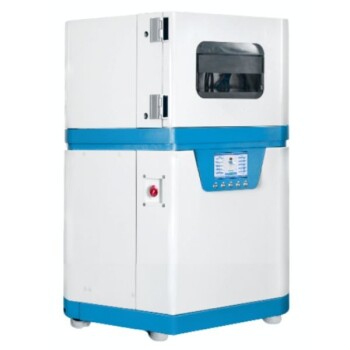
The primary process advantage of a vacuum hot press is the significant simplification of the manufacturing workflow compared to Hot Isostatic Pressing (HIP). By allowing powder to be directly sintered within a mold, this method eliminates the labor-intensive requirements for canning and vacuum sealing, resulting in a more streamlined and cost-effective operation.
Core Takeaway Vacuum hot pressing removes the "process overhead" associated with HIP, specifically the need for sacrificial containers and complex sealing. This makes it a leaner solution for steel preparation where the geometric flexibility of isostatic pressing is not strictly required.
Streamlining the Workflow
The fundamental difference between these two technologies lies in how the powder is contained and pressurized. Vacuum hot pressing removes several intermediate steps that are mandatory in HIP.
Elimination of Canning
In a vacuum hot press, the steel powder is placed directly into a mold for sintering. This completely bypasses the need to fabricate, fill, and weld the complex metal cans or capsules required to contain powder in a HIP unit.
Removal of Vacuum Sealing Steps
Because the sintering occurs within a vacuum environment inside the press, there is no need for a separate, pre-process vacuum sealing stage. This removes a time-consuming variable from the production cycle.
Reduced Post-Processing
HIP components often require extensive machining to remove the sacrificial canning material after consolidation. Vacuum hot pressing avoids this entirely, reducing the amount of post-process machining required to reach the final part dimensions.
Mitigating Risk and Cost
Beyond time savings, the process architecture of a vacuum hot press offers specific economic and reliability advantages.
Prevention of Seal Failures
A major failure mode in HIP is a leak in the containment can, which ruins the sample. By eliminating the canning process, vacuum hot pressing removes the risk of sample failure caused by seal leaks.
Lower Operational Costs
The reduction in consumable materials contributes directly to the bottom line. Manufacturers save costs by avoiding the purchase of canning materials and the labor associated with welding and removing them.
Understanding the Trade-offs
To provide a complete technical picture, it is necessary to acknowledge why HIP remains a standard despite its complexity.
Geometric Limitations
Vacuum hot pressing typically utilizes a mold, which generally limits parts to simpler geometries. In contrast, the isostatic nature of HIP (applying pressure equally from all directions) allows for the consolidation of complex, near-net-shaped components that a mold cannot accommodate.
Density and Microstructure
While vacuum hot pressing is efficient, HIP is often selected when the absolute highest possible density and maximum fatigue life are critical. The isostatic pressure helps eliminate internal porosity and creates a more homogeneous microstructure, which is essential for high-stress applications.
Making the Right Choice for Your Goal
Selecting between these processes depends on balancing workflow efficiency against performance requirements.
- If your primary focus is process efficiency and cost: Choose vacuum hot pressing to eliminate canning steps, reduce failure risks, and minimize material waste.
- If your primary focus is geometric complexity or maximum density: Choose Hot Isostatic Pressing (HIP) to utilize its ability to densify complex shapes and achieve superior fatigue resistance, despite the higher process overhead.
By aligning the process with your specific requirements for shape and operational budget, you ensure the most effective route to a finished steel component.
Summary Table:
| Feature | Vacuum Hot Pressing | Hot Isostatic Pressing (HIP) |
|---|---|---|
| Containment | Direct-to-mold sintering | Sacrificial metal canning required |
| Sealing | Integrated vacuum environment | Complex pre-process vacuum sealing |
| Post-Processing | Minimal machining required | Extensive machining to remove cans |
| Risk Factor | Low (no seal failures) | High (potential for leak-related loss) |
| Ideal Geometry | Simple, symmetrical shapes | Complex, near-net-shaped parts |
| Operational Cost | Lower (less labor/consumables) | Higher (material & labor intensive) |
Maximize Your Lab’s Efficiency with KINTEK Solutions
Are you looking to streamline your material preparation? KINTEK specializes in advanced laboratory equipment designed to reduce process overhead and deliver precision. From high-performance vacuum hot presses and isostatic presses to our comprehensive range of high-temperature furnaces, crushing systems, and hydraulic presses, we provide the tools you need for superior material density and structural integrity.
Whether you are focusing on steel preparation, battery research, or advanced ceramics, our expert team is ready to help you select the ideal solution for your specific geometric and density requirements.
Ready to optimize your production? Contact KINTEK today to discuss your project!
Related Products
- Vacuum Hot Press Furnace Machine Heated Vacuum Press
- Vacuum Hot Press Furnace Machine for Lamination and Heating
- Touchscreen Automatic Vacuum Heat Press
- Vacuum Hot Press Furnace Heated Vacuum Press Machine Tube Furnace
- Electric Heated Hydraulic Vacuum Heat Press for Lab
People Also Ask
- What advantages does a vacuum hot press furnace provide for LSLBO ceramic electrolytes? Achieve 94% Relative Density
- What role does a Vacuum Hot Press (VHP) furnace play in the densification of austenitic stainless steel 316 composites?
- What are the advantages of using a vacuum hot pressing furnace? Superior Densification for 2024Al/Gr/SiC Composites
- Why is it necessary to maintain a high-vacuum environment within a vacuum hot press furnace? Optimize Cu-SiC Sintering
- How does the vacuum system within a vacuum hot press furnace contribute to the quality of aluminum matrix composites?