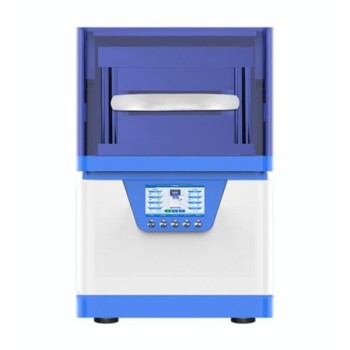
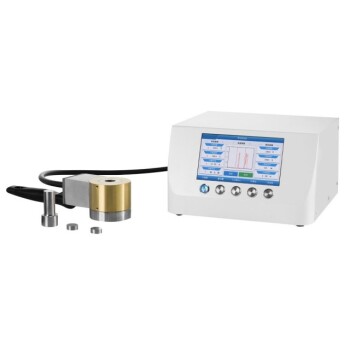
A laboratory hot press is the critical final step in transforming a porous, spray-coated layer into a functional electrolyte. While spray coating deposits the material, the hot press applies controlled heat (typically around 100°C) and pressure (e.g., 2 MPa) to eliminate microscopic voids caused by solvent evaporation. This physical compaction is necessary to create a dense, cohesive film capable of efficient ion transport.
The Core Takeaway Spray coating deposits the material, but hot pressing "activates" the composite. By collapsing voids and fusing the polymer matrix, this process creates the dense, pore-free structure required to increase ionic conductivity by several orders of magnitude.
The Physical Transformation of the Electrolyte
Spray coating involves dissolving polymers and suspending ceramics in solvents. When these solvents evaporate, they inevitably leave behind defects. The hot press addresses these structural weaknesses.
Eliminating Microscopic Voids
As solvents evaporate during the initial drying phase, they leave behind microscopic voids within the film.
If left untreated, these air pockets act as insulators, blocking the path of ions. The application of pressure physically collapses these voids, significantly increasing the overall density of the composite electrolyte.
Inducing Polymer Flow
The application of heat allows the polymer matrix (such as PEO) to melt and flow in a solvent-free state.
This thermal transition allows the polymer to fill the interstitial spaces between ceramic particles that the spray process could not reach. This results in a continuous, pore-free three-dimensional network.
Optimizing Interfacial Contact
For a composite electrolyte to function, ions must move between the soft polymer and the hard ceramic fillers.
The hot press forces the viscous polymer into tight contact with the ceramic particles. This reduces the interfacial resistance that typically bottlenecks performance in loose, unpressed films.
Impact on Electrochemical Performance
The structural changes induced by the hot press directly translate to measurable performance gains in the battery cell.
Drastic Increase in Ionic Conductivity
The primary reference indicates that the compaction achieved by hot pressing can enhance ionic conductivity by several orders of magnitude.
By removing air gaps and ensuring continuous pathways, ions can travel through the material with minimal resistance.
Molecular-Level Bonding
Beyond simple physical contact, the simultaneous heat and pressure facilitate molecular-level bonding.
This allows the polymer to integrate effectively with lithium salts and plasticizers. The result is a unified composite system rather than a collection of separate components.
Enhanced Mechanical Strength
A spray-coated film without pressing is often brittle or powdery.
The formation of a dense network ensures the electrolyte membrane has the mechanical integrity required to withstand handling and the internal pressures of a battery cell.
Understanding the Trade-offs
While essential, the hot pressing process introduces variables that must be carefully managed to avoid damaging the composite.
Thermal Sensitivity
You must balance the temperature against the degradation limits of your polymer.
While heat is necessary for flow, excessive temperatures can degrade the polymer chain or breakdown additives like flame retardants, ruining the chemical stability of the electrolyte.
Pressure Calibration
Applying pressure is a delicate balance between compaction and destruction.
While 2 MPa is a common standard, excessive pressure can crush the ceramic fillers or distort the electrolyte film, leading to short circuits or structural failure.
Making the Right Choice for Your Goal
The parameters you choose for your laboratory hot press should align with the specific limitations of your materials.
- If your primary focus is maximizing conductivity: Prioritize higher temperatures (within stability limits) to ensure maximum polymer flow and void filling.
- If your primary focus is mechanical integrity: Focus on optimizing pressure to ensure maximum density without fracturing the ceramic components.
The hot press is not merely a finishing step; it is the definitive process that dictates the final quality and efficiency of your solid-state electrolyte.
Summary Table:
| Feature | Spray-Coated (Pre-Press) | Hot-Pressed (Post-Press) |
|---|---|---|
| Microstructure | Porous, contains microscopic voids | Dense, cohesive, and pore-free |
| Polymer State | Discontinuous particles | Fused, continuous 3D network |
| Interfacial Contact | High resistance, loose contact | Low resistance, tight ceramic-polymer bonding |
| Ionic Conductivity | Low (insulating air pockets) | High (enhanced by several orders of magnitude) |
| Mechanical Strength | Brittle or powdery | High integrity and handleability |
Elevate Your Battery Research with KINTEK Precision
Don't let voids and interfacial resistance bottleneck your solid-state electrolyte performance. KINTEK specializes in advanced laboratory equipment designed for the rigorous demands of material science. Our high-precision hydraulic presses (pellet, hot, and isostatic) and high-temperature furnaces provide the controlled heat and pressure necessary to transform spray-coated films into high-performance, dense electrolytes.
From crushing and milling systems for your ceramic fillers to battery research tools and high-pressure reactors, KINTEK offers a comprehensive ecosystem for your lab. Our expert-grade PTFE products, ceramics, and crucibles ensure contamination-free processing every time.
Ready to optimize your composite density and ionic conductivity?
Contact KINTEK Today to Find Your Perfect Lab Solution
Related Products
- 30T 40T Split Automatic Heated Hydraulic Press Machine with Heated Plates for Laboratory Hot Press
- Heated Hydraulic Press Machine with Heated Plates Split Manual Laboratory Hot Press
- Automatic Heated Hydraulic Press Machine with Heated Plates for Laboratory Hot Press
- Automatic Laboratory Heat Press Machine
- 24T 30T 60T Heated Hydraulic Press Machine with Heated Plates for Laboratory Hot Press
People Also Ask
- What are the advantages of using a laboratory hydraulic press for hot pressing? Achieve Peak Nano-Composite Density
- What are the core advantages of using a laboratory hot press to produce Bi2Se3? Achieve 93% Density & High Conductivity
- Why is a laboratory hydraulic hot press essential for high-density, additive-free Silicon Carbide? Unlock Pure SiC.
- How does a laboratory hydraulic hot press ensure the quality of PHBV/natural fiber composites? Expert Guide
- What is the function of a laboratory hydraulic hot press in the assembly of solid-state photoelectrochemical cells?