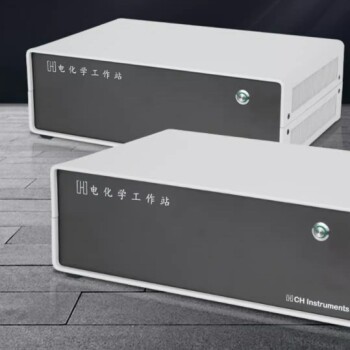
The primary function of an electrochemical workstation during Electrochemical Impedance Spectroscopy (EIS) is to analyze the internal impedance components of an all-solid-state battery across a range of frequency responses. By applying a small alternating current (AC) perturbation signal, the instrument captures data that allows researchers to dissect the complex resistance behaviors occurring within the cell.
Core Insight:
While standard testing measures total resistance, EIS allows for the isolation of specific internal processes. Its true power in all-solid-state research lies in monitoring the evolution of impedance at the solid electrolyte-lithium interface, providing a quantitative metric for stability and the inhibition of harmful side reactions over time.
Analyzing Frequency and Impedance
The AC Perturbation Signal
The workstation does not apply a constant load; instead, it introduces an AC perturbation signal. This variable signal is the fundamental mechanism that allows the system to probe the battery's characteristics without significantly altering its state of charge.
Frequency Response Analysis
The workstation analyzes the battery's response at different frequencies. High frequencies typically reveal ohmic resistance (contact and bulk material properties), while lower frequencies expose charge transfer and diffusion processes.
Component Separation
By sweeping through these frequencies, the workstation separates the impedance components. This allows researchers to distinguish between the resistance of the bulk materials and the resistance occurring specifically at the interfaces.
Monitoring Interface Evolution
Focusing on the Critical Junction
A primary objective of using EIS in this context is monitoring the interface between the solid electrolyte and lithium metal. This junction is often the failure point in solid-state batteries due to poor contact or chemical instability.
Tracking Changes During Cycling
The workstation is used to observe the evolution of impedance as the battery undergoes cycling. It does not just provide a snapshot; it tracks how resistance shifts after repeated charging and discharging.
Detecting Degradation
Rising impedance at this specific interface usually signals degradation. Monitoring this evolution helps identify when and how the physical contact is deteriorating or when resistive layers are forming.
Evaluating Framework Effectiveness
Quantifying Design Success
In the context of 3D anode research, the workstation provides a quantitative evaluation of new designs. It moves beyond qualitative observation to provide hard data on how well a specific framework performs.
Assessing Interface Stability
The data collected directly correlates to interface stability. A stable impedance profile over time indicates that the 3D framework is successfully maintaining contact and structural integrity.
Inhibiting Side Reactions
The workstation helps verify if a design is effectively inhibiting side reactions. An unexpected rise in impedance often correlates to the growth of unwanted chemical byproducts, allowing researchers to validate the protective capabilities of their design.
Understanding the Limitations
Data Requires Contextual Interpretation
While the workstation provides precise quantitative data, it does not inherently diagnose the cause of impedance changes. Researchers must correlate the evolution of impedance with other physical evidence to confirm whether a rise in resistance is due to physical delamination or chemical side reactions.
Dynamic Sensitivity
The measurement is highly sensitive to the perturbation signal. If the signal is too large, it may disturb the equilibrium of the battery; if too small, the response may be lost in noise. Proper calibration is essential for accurate evaluation of the interface.
Making the Right Choice for Your Research
To effectively utilize EIS for all-solid-state battery development, align your analysis with your specific engineering goals:
- If your primary focus is Validation of Design: Use the workstation to perform a quantitative evaluation of how your 3D framework affects total impedance compared to a baseline.
- If your primary focus is Long-Term Reliability: Concentrate on monitoring the evolution of impedance during cycling to detect the onset of side reactions at the solid electrolyte interface.
Success in solid-state battery research depends not just on measuring resistance, but on isolating the specific interface where stability is won or lost.
Summary Table:
| Characteristic Analyzed | Frequency Range | Insights Provided |
|---|---|---|
| Ohmic Resistance | High Frequency | Bulk material properties and contact quality |
| Charge Transfer | Medium Frequency | Kinetics of the electrochemical reactions at interfaces |
| Mass Transport (Diffusion) | Low Frequency | Ion movement (Warburg impedance) within the cell |
| Interface Evolution | Time-based Monitoring | Stability and degradation of solid electrolyte-lithium junction |
| Component Separation | Full Sweep | Distinction between bulk resistance and interface resistance |
Elevate Your Battery Research with KINTEK Precision
Unlock the full potential of your energy storage research with KINTEK. Whether you are monitoring the evolution of impedance in all-solid-state batteries or designing advanced 3D frameworks, we provide the high-performance tools you need for success.
Our comprehensive portfolio includes:
- Battery Research Tools: Precision electrochemical workstations and specialized consumables.
- High-Temperature Systems: Muffle, tube, and vacuum furnaces for material synthesis.
- Sample Preparation: Crushing systems, milling equipment, and hydraulic presses (pellet, hot, isostatic).
- Advanced Reactors: High-temperature high-pressure reactors and autoclaves.
- Lab Essentials: Electrolytic cells, electrodes, ULT freezers, and PTFE/ceramic consumables.
Ready to optimize your lab's performance? Contact us today to discover how KINTEK’s industry-leading equipment can accelerate your innovation.
Related Products
- Lab Electrochemical Workstation Potentiostat for Laboratory Use
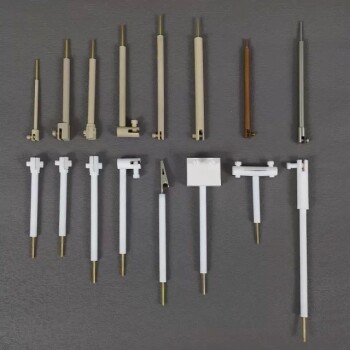
- Electrode Fixture for Electrochemical Experiments
- Glassy Carbon Electrochemical Electrode
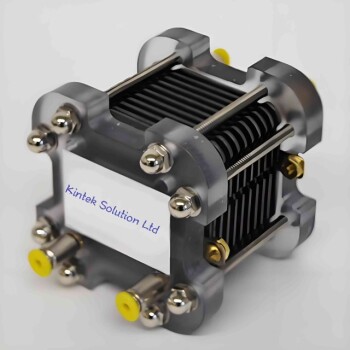
- Electrolytic Electrochemical Cell with Five-Port
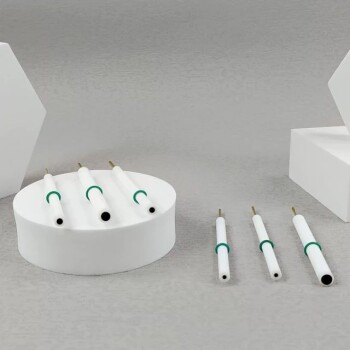
- Sample Support Body for Electrochemical Tests
People Also Ask
- How does an electrochemical workstation assist in assessing corrosion resistance? Quantify Laser-Remelted Steel Performance
- How does an electrochemical testing system evaluate mesoporous oxide electrodes? Precision Analysis for Battery Research
- What are the primary functions of an electrochemical workstation (Potentiostat)? Expert Titanium Alloy Corrosion Analysis
- What is the primary function of a high-precision electrochemical workstation? Optimize Your Reactor Performance
- What role do electrochemical workstations play in researching the corrosion resistance of carbon coatings? Expert Guide