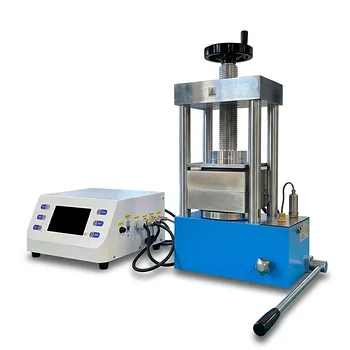
The historical background of Hot Isostatic Pressing (HIP) dates back to the 1950s, originating at the Battelle Memorial Institute. While initially a laboratory innovation, it found its first major industrial application in the 1960s, where it was utilized to prepare nuclear fuel for submarines.
Core Takeaway HIP technology was born from the necessity to bond and densify materials for extreme, safety-critical environments. Its evolution began with nuclear defense applications in the mid-20th century and has since expanded to become the standard for eliminating internal porosity in high-integrity aerospace and medical components.
The Origins and Early Adoption
Invention at Battelle
The fundamental process was invented in the 1950s at the Battelle Memorial Institute. Researchers sought a method to bond components using high pressure and temperature simultaneously.
The Nuclear Catalyst
The technology transitioned from research to practical application in the 1960s. Its primary initial use was the preparation of nuclear fuel for submarines.
Why It Was Necessary
Nuclear applications require absolute material integrity. The HIP process allowed engineers to bond dissimilar materials and densify fuel elements, ensuring reliability in the harsh environment of a submarine reactor.
Evolution of the Technology
Moving Beyond Nuclear
While the process began with nuclear fuel, the underlying mechanics proved valuable for other industries. The ability to apply isostatic pressure (equal pressure from all sides) offered a unique solution for casting defects.
The Role of Inert Gas
The process evolved to utilize inert gas, typically high-purity argon, as the pressure-transmitting medium. This prevented chemical reactions that could degrade sensitive materials during the heating cycle.
Standardization of Parameters
Over time, the industry standardized operating parameters to maximize effectiveness. Modern HIP cycles generally operate between 900 and 1400 °C with pressures ranging from 1000 to 1400 barg, enabling the treatment of a wide variety of alloys.
Technical Drivers of Its Success
Elimination of Internal Voids
The historical endurance of HIP is largely due to its ability to remove internal microporosity. By compressing gas voids within a part, the process significantly improves mechanical properties.
Plastic Deformation and Diffusion
The combination of heat and pressure induces plastic deformation, creep, and diffusion. This heals internal defects and creates a homogeneous annealed microstructure, essential for high-stress components.
Near-Net Shape Manufacturing
The process also advanced the capability to form raw materials into near-net shaped parts. This reduced the need for extensive machining and minimized scrap losses, making the technology economically viable for expensive alloys.
Understanding the Trade-offs
Operational Complexity
Despite its benefits, HIP is an intense process requiring specialized pressure vessels. The need for a resistance-heated furnace inside a high-pressure environment adds significant capital and operational complexity.
Cycle Time Implications
Parts must be loaded cold, heated and pressurized simultaneously, and then cooled within the vessel. This batch-processing approach can introduce bottlenecks compared to continuous manufacturing methods.
Size Limitations
The physical size of the components is limited by the dimensions of the pressure vessel. While suitable for turbine blades or medical implants, extremely large structural components may not fit within standard HIP units.
Implications for Modern Engineering
Assessing Heritage and Reliability
The fact that HIP originated in the nuclear sector highlights its pedigree. It is a process designed for zero-failure environments, making it appropriate for today's most demanding applications.
- If your primary focus is material integrity: Rely on HIP to eliminate internal porosity and improve fatigue life, leveraging a method proven in nuclear and aerospace sectors.
- If your primary focus is complex geometry: Utilize the isostatic nature of the pressure to densify complex shapes without the directional distortion common in other pressing methods.
The history of Hot Isostatic Pressing serves as a testament to its capability: a technology built for the atomic age that now defines the standard for material perfection.
Summary Table:
| Era | Development Milestone | Primary Application/Impact |
|---|---|---|
| 1950s | Invention at Battelle Memorial Institute | Initial research into simultaneous heat and pressure bonding. |
| 1960s | First Major Industrial Application | Preparation of nuclear fuel for submarines; high-integrity bonding. |
| 1970s-80s | Expansion into Aerospace | Elimination of internal porosity in turbine blades and casting defects. |
| Modern Day | Advanced Near-Net Shape (NNS) | Standardized parameters (900-1400°C) for medical implants and 3D printing. |
Elevate Your Material Integrity with KINTEK Expertise
Whether you are continuing the legacy of nuclear excellence or pioneering new aerospace and medical breakthroughs, KINTEK provides the high-precision equipment necessary for zero-failure environments. As specialists in laboratory and industrial solutions, we offer a comprehensive range of isostatic presses, high-temperature furnaces, and crushing and milling systems designed to eliminate internal defects and optimize your material properties.
Why choose KINTEK?
- Advanced Engineering: From vacuum and atmosphere furnaces to specialized hydraulic presses, our tools ensure a homogeneous microstructure for your most critical components.
- Comprehensive Portfolio: We support your entire workflow with cooling solutions, battery research tools, and high-quality consumables like ceramics and crucibles.
- Proven Reliability: Our technology is built to handle the intense pressures and temperatures required for modern material perfection.
Contact KINTEK today to find the perfect HIP or thermal processing solution for your laboratory!
Related Products
- Warm Isostatic Press for Solid State Battery Research
- Isostatic Molding Pressing Molds for Lab
- Electric Split Lab Cold Isostatic Press CIP Machine for Cold Isostatic Pressing
- Automatic Lab Cold Isostatic Press CIP Machine Cold Isostatic Pressing
- Manual Cold Isostatic Pressing Machine CIP Pellet Press
People Also Ask
- What is the temperature of a warm isostatic press? Achieve Optimal Densification for Your Materials
- What is the function of a Warm Isostatic Press (WIP) in all-solid-state pouch cells? Optimize Battery Density
- Why are Warm Isostatic Presses (WIP) necessary for solid-state batteries? Achieve Atomic-Level Contact
- What advantages does a warm isostatic press offer over a traditional uniaxial press for Li6PS5Cl electrolyte sheets?
- How do warm isostatic presses improve dry electrode performance? Enhance ASSB Conductivity with Heat & Pressure