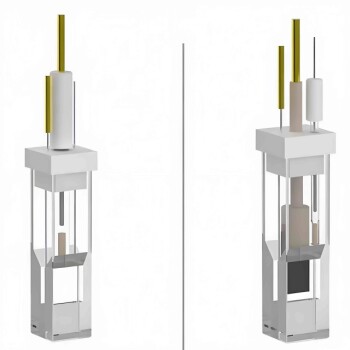
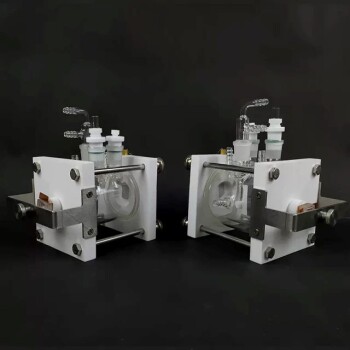
To facilitate effective X-ray Absorption Fine Structure (XAFS) characterization, a specialized in-situ electrochemical cell must combine high X-ray transparency with robust chemical stability. Specifically, it requires acid-resistant window materials like Kapton film and a precise electrolyte layer thickness (typically around 1.5 mm) to minimize photon absorption while maintaining a functional three-electrode system.
Core Insight: The design of an in-situ XAFS cell is an engineering exercise in minimizing interference; the cell must contain the chemical reaction securely without becoming a barrier to the X-rays needed to observe it.
Optimizing the Optical Interface
To capture accurate data, the barrier between your sample and the X-ray source must be virtually invisible to the beam.
Material Selection for Transparency
The cell must utilize window materials that are highly transparent to X-rays.
The primary reference highlights Kapton film as an ideal material for this purpose. It allows X-rays from synchrotron radiation sources to penetrate the cell and interact directly with the catalyst surface.
Chemical Resistance
Transparency cannot come at the cost of containment. The window material must be resistant to acid corrosion.
This ensures the cell remains structurally sound even when holding reactive electrolytes, preventing leaks that could damage sensitive detection equipment or ruin the experiment.
Geometric Precision for Signal Quality
For transmission-type cells, the physical dimensions of the cell are just as critical as the materials used.
Controlling Electrolyte Thickness
You must precisely control the thickness of the electrolyte layer, typically maintaining it at approximately 1.5 mm.
This specific dimension is critical for transmission-type designs. It strikes a necessary balance between electrochemical function and beam attenuation.
Minimizing Photon Absorption
A thin-layer design is essential to minimize the absorption of X-ray photons by the liquid electrolyte itself.
If the liquid layer is too thick, it will absorb the beam before it reaches the detector, degrading the quality of spectra such as the copper K-edge absorption.
Enabling Real-Time Characterization
The ultimate goal of these design requirements is to observe the catalyst in an active working state.
Capturing Valence State Changes
A properly designed cell allows for the real-time capture of metal atom valence state changes.
Because the cell allows X-rays to penetrate while the reaction occurs, you can monitor oxidation states dynamically rather than analyzing a static, post-mortem sample.
Monitoring Coordination Evolution
The design must enable the observation of coordination structure evolution without interrupting the electrochemical reaction.
This continuous monitoring is the only way to correlate specific structural changes in the catalyst with electrochemical performance.
Understanding the Trade-offs
Designing these cells involves balancing two competing physical requirements.
Absorption vs. Electrochemical Function
The primary trade-off lies in the electrolyte layer thickness.
Making the layer thinner improves X-ray transmission and signal quality, but if it becomes too thin, it may impede the function of the three-electrode environment.
You must maintain the 1.5 mm standard to ensure the cell supports proper ion transport and potential control while still permitting high-quality data collection.
Making the Right Choice for Your Experiment
To ensure your setup yields valid spectroscopic data, prioritize your design parameters based on your specific research goals.
- If your primary focus is Signal-to-Noise Ratio: Prioritize minimizing the electrolyte path length to approximately 1.5 mm to reduce photon absorption by the solvent.
- If your primary focus is Chemical Stability: Ensure your window materials (e.g., Kapton) are verified for resistance against the specific pH and corrosivity of your electrolyte.
- If your primary focus is Reaction Dynamics: Verify that the cell assembly allows for continuous operation so you can map coordination changes directly to applied potential in real-time.
Successful in-situ XAFS requires a cell that is robust enough to host the chemistry yet "invisible" enough to let the physics be seen.
Summary Table:
| Feature | Requirement | Benefit |
|---|---|---|
| Window Material | Kapton Film (Acid-resistant) | High X-ray transparency & chemical containment |
| Electrolyte Layer | ~1.5 mm Thickness | Balances ion transport with minimal beam attenuation |
| Electrode System | Standard Three-Electrode | Ensures precise potential control during reactions |
| Data Capability | Real-time Monitoring | Captures valence state & coordination evolution |
Elevate Your Research with KINTEK’s Precision Engineering
Unlock the full potential of your synchrotron experiments with KINTEK’s specialized in-situ electrochemical cells. Designed specifically for XAFS characterization, our cells feature optimized geometries and high-transparency materials to ensure you capture every coordination change without signal interference.
From high-temperature high-pressure reactors and electrolytic cells to advanced crushing, milling, and hydraulic systems, KINTEK provides researchers with the robust tools needed for cutting-edge material science. Let our expertise in laboratory consumables and high-performance equipment accelerate your discoveries.
Ready to optimize your experimental setup? Contact us today to find the perfect solution for your lab!
References
- Zhirong Zhang, Jie Zeng. Distance effect of single atoms on stability of cobalt oxide catalysts for acidic oxygen evolution. DOI: 10.1038/s41467-024-46176-0
This article is also based on technical information from Kintek Solution Knowledge Base .
Related Products
- Thin-Layer Spectral Electrolysis Electrochemical Cell
- Super Sealed Electrolytic Electrochemical Cell
- Electrolytic Electrochemical Cell Gas Diffusion Liquid Flow Reaction Cell
- Electrolytic Electrochemical Cell for Coating Evaluation
- Flat Corrosion Electrolytic Electrochemical Cell
People Also Ask
- What are the recommended post-experiment procedures for cleaning and storing the thin-layer spectroelectrochemical cell?
- What preparation steps are required before initiating an experiment with the thin-layer spectroelectrochemical cell?
- What operational environments and sealing options are available for the thin-layer spectroelectrochemical cell?
- For what types of systems, temperature ranges, and sealing configurations is the thin-layer spectroelectrochemical cell designed? Ideal for Aqueous and Non-Aqueous Analysis
- What are the necessary preparation steps before using a thin-layer spectroelectrochemical cell? A Guide to Reliable Results