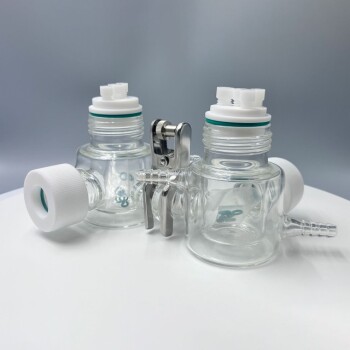
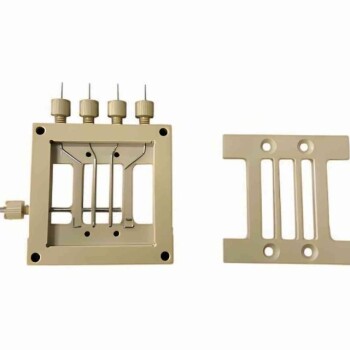
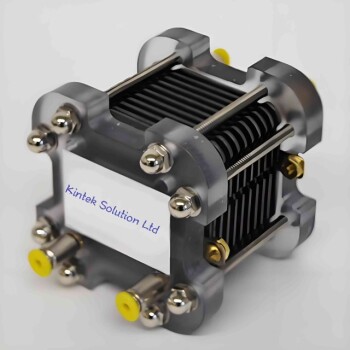
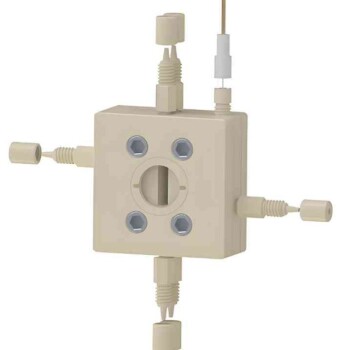
A three-electrode electrolytic cell establishes a standardized physicochemical environment designed to isolate the true electrochemical behavior of a coating. By configuring the nanoparticle-reinforced coating as the working electrode, a platinum rod as the counter electrode, and a saturated calomel electrode (SCE) as the reference, this setup creates a stable testing loop. This specific arrangement ensures precise potential control and eliminates interference from auxiliary electrode polarization, enabling the accurate measurement of weak corrosion signals during long-term immersion in simulated seawater.
Core Takeaway The three-electrode system decouples the current-carrying circuit from the potential-measuring circuit. This isolation is critical for filtering out experimental noise, allowing researchers to observe minute phenomena—such as self-healing behaviors or early-stage corrosion—without the data being distorted by the polarization of the counter electrode.
The Architecture of the Testing Environment
To understand the conditions provided, one must look at how the specific components interact to create a controlled electrochemical system.
The Working Electrode (The Sample)
The nanoparticle-reinforced coating serves as the working electrode. This is the primary subject of the investigation, exposed directly to the corrosive environment (electrolyte).
The Counter Electrode (The Current Carrier)
A platinum electrode acts as the counter (or auxiliary) electrode. Its primary role is to complete the electrical circuit, facilitating the flow of current through the electrolyte without participating chemically in the reaction that is being measured.
The Reference Electrode (The Baseline)
A saturated calomel electrode (SCE) is used as the reference. It provides a stable, known potential against which the working electrode's potential is measured, ensuring that data remains consistent over long-term testing.
Precision and Signal Clarity
The primary value of this experimental condition is its ability to eliminate measurement artifacts that plague simpler setups.
Eliminating Polarization Interference
In two-electrode systems, the counter electrode can become polarized, introducing errors into the voltage reading. The three-electrode cell eliminates this interference by measuring voltage through the reference electrode, through which negligible current flows.
Capturing Weak Signals
High-performance coatings often exhibit very low corrosion rates initially. This setup lowers the noise floor, allowing for the precise capture of weak corrosion signals that might otherwise be lost in background noise.
Uniform Current Distribution
The geometry and arrangement of the cell promote a uniform current distribution across the surface of the working electrode. This ensures that the data reflects the average behavior of the entire coating surface, rather than localized anomalies.
Detecting Dynamic Coating Behaviors
Long-term immersion tests are not static; they track how a coating evolves. This setup provides the specific conditions necessary to monitor these changes dynamically.
Monitoring Self-Healing Mechanisms
Nanoparticle-reinforced coatings often possess self-repairing properties. The high sensitivity of this cell allows researchers to detect the specific electrochemical signatures of self-healing behaviors as they occur in real-time.
Simulating Seawater Environments
The cell is designed to hold a specific electrolyte, typically facilitating a long-term simulation of seawater environments. This allows researchers to correlate electrochemical data directly with real-world marine performance.
Critical Considerations for Data Validity
While the three-electrode cell provides a superior testing environment, the quality of the data depends on maintaining the integrity of the components.
Reference Electrode Stability
The accuracy of the entire system hinges on the stability of the saturated calomel electrode. If the reference potential drifts during long-term immersion, the resulting corrosion data will be skewed, making the "standardized" environment unreliable.
Counter Electrode Inertness
The use of platinum is intentional because it is chemically inert. Using a less noble metal as a counter electrode could introduce contaminant ions into the electrolyte, altering the "physicochemical environment" and affecting the coating's performance.
Making the Right Choice for Your Goal
When designing your experiment, align your focus with the specific capabilities of this setup:
- If your primary focus is detecting self-healing activity: Rely on the interference-free environment to identify the subtle drops in corrosion current that indicate active repair of the coating matrix.
- If your primary focus is accurate life-cycle prediction: Leverage the stable baseline provided by the SCE to track charge transfer resistance over weeks or months without instrument drift.
By isolating the working electrode from polarization effects, you ensure that every signal captured is a true reflection of the coating's performance.
Summary Table:
| Component/Feature | Role in Setup | Key Benefit for Testing |
|---|---|---|
| Working Electrode | Nanoparticle-reinforced coating | Direct subject of electrochemical investigation |
| Counter Electrode | Platinum rod (Inert) | Completes the circuit without chemical interference |
| Reference Electrode | Saturated Calomel (SCE) | Provides a stable baseline for potential measurement |
| Circuit Isolation | Decouples current/potential | Eliminates polarization noise and measurement artifacts |
| Signal Sensitivity | Low noise floor | Accurate capture of weak self-healing/corrosion signals |
Elevate Your Electrochemical Research with KINTEK
Precision is paramount in long-term corrosion and material testing. KINTEK specializes in providing high-quality electrolytic cells and electrodes specifically designed to eliminate experimental noise and ensure stable, repeatable data.
Beyond electrochemical tools, our comprehensive portfolio supports your entire lab workflow with:
- High-Temperature Systems: Muffle, tube, vacuum, and CVD/PECVD furnaces.
- Pressure & Processing: High-temperature high-pressure reactors, autoclaves, and hydraulic presses.
- Sample Preparation: Crushing, milling, and sieving equipment.
- Lab Essentials: Cooling solutions (ULT freezers), PTFE products, and specialized ceramics.
Whether you are analyzing nanoparticle-reinforced coatings or advanced battery materials, KINTEK brings the reliability and performance your research deserves.
Ready to upgrade your laboratory capabilities? Contact KINTEK today to find the perfect solution!
References
- Sherif Elbasuney, Mohamed Gobara. Chromium(III)-substituted hydroxyapatite/silica sol–gel coating: towards novel green coating for corrosion protection of AA2024. DOI: 10.1007/s10971-023-06187-7
This article is also based on technical information from Kintek Solution Knowledge Base .
Related Products
- H Type Electrolytic Cell Triple Electrochemical Cell
- PTFE Electrolytic Cell Electrochemical Cell Corrosion-Resistant Sealed and Non-Sealed
- Electrolytic Electrochemical Cell Gas Diffusion Liquid Flow Reaction Cell
- Electrolytic Electrochemical Cell with Five-Port
- Customizable PEM Electrolysis Cells for Diverse Research Applications
People Also Ask
- What is a H type cell? A Guide to Divided Electrochemical Cells for Accurate Experiments
- How should the electrolyte be prepared and added to the H-type electrolytic cell? Best Practices for Purity and Safety
- What is the technical necessity of using an H-type electrolytic cell for NO3RR tests? Protect Your Ammonia Yields
- How does the design of an H-type electrolytic cell benefit the neutral water electrolysis process for metal recovery?
- What is the primary function of an H-type electrolytic cell in NitRR? Ensure Accurate Product Yields