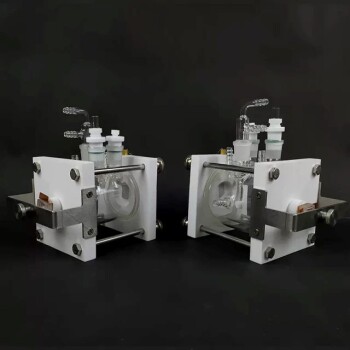
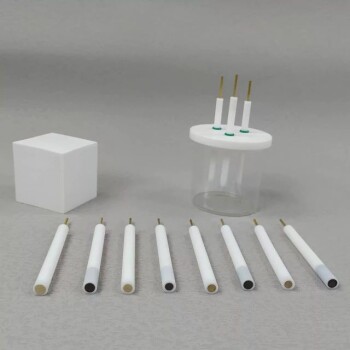
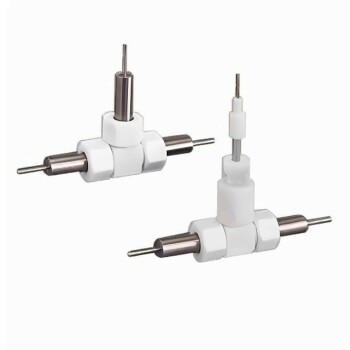
A three-electrode electrochemical cell functions as a precision instrument designed to create a highly controlled electrolytic environment for the electrochemical etching (ECE) of graphene. By coordinating a working electrode, a counter electrode, and a reference electrode, the system applies exact voltage potentials to selectively remove unwanted material.
Core Takeaway: The three-electrode configuration enables the application of specific voltages necessary to differentiate between material layers. This selectivity allows for the exfoliation of amorphous carbon byproducts without compromising the structural integrity of the underlying high-quality graphene.
The Mechanism of Selective Etching
Establishing a Controlled Environment
The primary purpose of the three-electrode cell in this context is control. Unlike simpler setups, this configuration maintains a stable environment where electrochemical reactions can be manipulated with high accuracy.
Targeting Amorphous Carbon
The ECE process uses this controlled environment to address a specific contamination issue: amorphous carbon layers. These layers often cover the prepared graphene, obscuring its properties and limiting its utility.
Voltage-Driven Exfoliation
Through the application of specific voltages, the cell drives a reaction that targets the amorphous carbon. The electrical potential is tuned to exfoliate these unwanted layers, effectively peeling them away from the sample.
Revealing the Graphene Structure
The ultimate output of this function is the exposure of the high-quality underlying graphene. By stripping away the amorphous "noise," the cell prepares the pristine graphene structure for accurate analysis and downstream applications.
Understanding the Operational Trade-offs
The Necessity of Precision
The term "selectively exfoliate" implies a narrow operational window. If the voltage is too low, the amorphous carbon will remain, leaving the graphene covered.
Risks of Over-Etching
Conversely, if the voltage control fails or is set too high, the process risks damaging the high-quality graphene structure itself. The three-electrode system is specifically employed to mitigate this risk by stabilizing the potential at the working electrode.
Optimizing the Etching Outcome
The effectiveness of the electrochemical etching process relies entirely on how well the voltage is tuned to the specific materials present.
- If your primary focus is Material Purity: Ensure the voltage is sufficient to fully exfoliate the amorphous carbon layers, as under-etching will leave contaminants that affect analysis.
- If your primary focus is Structural Integrity: Utilize the reference electrode's stability to prevent voltage spikes that could degrade the underlying graphene lattice during the etching process.
Success in ECE depends on leveraging the three-electrode cell's ability to maintain precise electrical parameters throughout the exfoliation.
Summary Table:
| Feature | Function in Graphene Etching | Benefit to Researcher |
|---|---|---|
| Working Electrode | Host for the graphene sample | Site of targeted electrochemical reaction |
| Reference Electrode | Maintains stable potential | Prevents over-etching and lattice damage |
| Counter Electrode | Completes the electrical circuit | Ensures balanced current flow |
| Voltage Control | Selective exfoliation of carbon layers | Removes impurities while preserving structure |
Elevate Your Graphene Research with KINTEK Precision
Achieving the perfect etch requires equipment that offers uncompromising stability and control. KINTEK specializes in advanced laboratory solutions, providing the high-performance electrolytic cells and electrodes essential for delicate electrochemical etching processes.
Whether you are performing material exfoliation or complex battery research, our comprehensive range—including high-temperature furnaces, hydraulic presses, and specialized ceramics—is designed to meet the rigorous demands of modern material science.
Ready to optimize your lab’s efficiency and material purity? Contact our experts today to find the perfect electrochemical setup for your specific applications.
References
- Tao Peng, Shichun Mu. Direct Transformation of Amorphous Silicon Carbide into Graphene under Low Temperature and Ambient Pressure. DOI: 10.1038/srep01148
This article is also based on technical information from Kintek Solution Knowledge Base .
Related Products
- H Type Electrolytic Cell Triple Electrochemical Cell
- Electrolytic Electrochemical Cell Gas Diffusion Liquid Flow Reaction Cell
- Electrolytic Electrochemical Cell with Five-Port
- Electrolytic Electrochemical Cell for Coating Evaluation
- Quartz Electrolytic Electrochemical Cell for Electrochemical Experiments
People Also Ask
- What is a H type cell? A Guide to Divided Electrochemical Cells for Accurate Experiments
- How should the electrolyte be prepared and added to the H-type electrolytic cell? Best Practices for Purity and Safety
- What is the technical necessity of using an H-type electrolytic cell for NO3RR tests? Protect Your Ammonia Yields
- How does the design of an H-type electrolytic cell benefit the neutral water electrolysis process for metal recovery?
- What is the primary function of an H-type electrolytic cell in NitRR? Ensure Accurate Product Yields