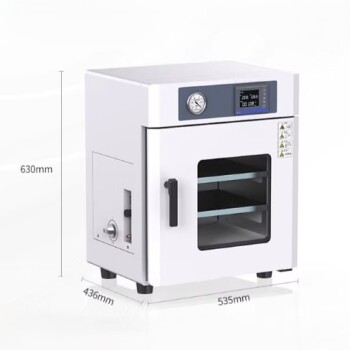
A vacuum drying oven functions as a precision purification tool essential for ensuring the electrochemical stability of Hybrid Solid Electrolyte (HSE) membranes and NaFePO4 cathode electrodes. It utilizes a low-pressure environment to lower the boiling points of solvents, such as DMAc and NMP, allowing them to be thoroughly evaporated at controlled temperatures (60°C to 95°C) while protecting the materials from oxidation and atmospheric moisture.
The Core Criticality
While simple heating can dry materials, it often risks thermal degradation or oxidation. The vacuum drying oven solves this by decoupling temperature from evaporation efficiency, ensuring that highly sensitive solid-state battery components are stripped of performance-killing impurities without damaging their structural integrity.
The Principles of Vacuum Drying
Lowering the Boiling Point
The primary mechanism relies on the relationship between pressure and vaporization. By creating a vacuum, the oven significantly reduces the boiling point of organic solvents like DMAc (Dimethylacetamide) and NMP (N-methyl-2-pyrrolidone).
Minimizing Thermal Stress
This pressure reduction allows solvents to evaporate rapidly at moderate temperatures, specifically between 60°C and 95°C. This ensures the material dries thoroughly without requiring excessive heat that could degrade the polymer matrix or binders.
Protection Against Contamination
The vacuum environment acts as a barrier against the outside world. It prevents atmospheric moisture and oxygen from reacting with the sensitive electrode materials or electrolytes during the heating process.
Specific Impact on HSE and NaFePO4 Production
Purifying HSE Membranes
For Hybrid Solid Electrolyte membranes, the removal of residual solvents like DMAc is non-negotiable. If these solvents remain, they can lead to increased interface impedance, limiting the battery's efficiency.
Stabilizing NaFePO4 Cathodes
Sodium-based systems, including NaFePO4 cathodes, are exceptionally sensitive to moisture. The vacuum oven removes trace moisture and NMP residues from the slurry, preventing side reactions that would otherwise compromise the long-term cycling stability of the battery.
Ensuring Mechanical Integrity
Proper vacuum drying ensures that binders and active materials form a uniform, strongly adherent film. This mechanical stability is vital for preventing the electrode from delaminating or cracking during battery assembly and operation.
Understanding the Trade-offs
Temperature vs. Evaporation Rate
While the vacuum allows for lower temperatures, operating at the lower end of the 60°C-95°C range may extend the processing time required to achieve complete dryness. Rushing this process by spiking the temperature risks damaging the polymer components of the HSE.
Vacuum Level Management
Applying a vacuum that is too aggressive too quickly can cause the solvents to boil violently ("bumping"). This can disrupt the coating uniformity, creating pinholes or uneven surfaces in the electrode or membrane.
Making the Right Choice for Your Goal
To maximize the utility of a vacuum drying oven for your specific production needs, consider these priorities:
- If your primary focus is Electrochemical Stability: Prioritize longer drying times at moderate temperatures to ensure the absolute removal of trace moisture, which is the primary cause of side reactions in sodium batteries.
- If your primary focus is Material Structure: strict adherence to the 60°C–95°C range is required to prevent thermal degradation of the polymer matrix in HSE membranes.
Ultimately, the vacuum drying oven is not just a drying device, but a preservation chamber that safeguards the chemical purity required for high-performance energy storage.
Summary Table:
| Feature | Function in HSE & NaFePO4 Production | Key Benefit |
|---|---|---|
| Low-Pressure Environment | Lowers boiling points of solvents (DMAc, NMP) | Prevents thermal degradation of polymer matrix |
| Controlled Temperature | Operates between 60°C and 95°C | Ensures thorough evaporation without structural damage |
| Oxygen-Free Chamber | Blocks atmospheric moisture and oxygen | Prevents side reactions in sensitive sodium-based systems |
| Solvent Removal | Eliminates residual impurities and trace moisture | Reduces interface impedance and improves cycling stability |
Elevate Your Battery Research with KINTEK Precision Solutions
Achieving the perfect electrochemical profile for your HSE membranes and NaFePO4 cathodes requires more than just heat—it requires a controlled environment. KINTEK specializes in advanced laboratory equipment designed for the rigorous demands of energy storage development.
Our high-performance vacuum drying ovens provide the precise temperature and pressure control needed to purify your materials without compromising their structural integrity. Beyond drying, we offer a comprehensive suite of tools for battery researchers, including:
- High-Temperature Muffle & Tube Furnaces for electrode sintering.
- Crushing & Milling Systems for uniform material preparation.
- Hydraulic Presses & Pellet Dies for electrode fabrication.
- Battery Research Tools & Consumables tailored for cutting-edge energy storage.
Don't let impurities limit your battery's potential. Contact KINTEK today to find the perfect equipment for your laboratory and ensure your materials meet the highest standards of purity and performance.
Related Products
- 56L Vertical Laboratory Vacuum Drying Oven
- 23L Laboratory Vacuum Drying Oven
- Laboratory Scientific Electric Heating Blast Drying Oven
- Benchtop Laboratory Vacuum Freeze Dryer
- Dental Porcelain Zirconia Sintering Ceramic Vacuum Press Furnace
People Also Ask
- Why is a laboratory vacuum drying oven recommended for rice straw residues? Protect Your Biomass Integrity
- What role does a laboratory vacuum drying oven play in the preparation of modified multi-walled carbon nanotubes?
- What is the importance of using a laboratory vacuum drying oven? Preserving Slow-Release Microcapsule Integrity
- Why is a Laboratory Vacuum Drying Oven recommended for PBAT microspheres? Protect Sensitive Polymer Integrity
- What role does a laboratory vacuum drying oven play in processing nanoparticle powder samples? Protect Sample Integrity