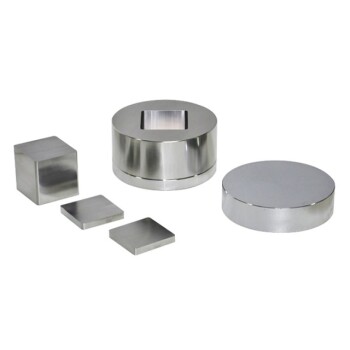
During the vacuum hot press sintering of TiNiNb alloys, a graphite mold functions primarily as a robust shaping vessel and an efficient pressure transmission medium. It is responsible for defining the final geometric dimensions of the alloy while ensuring that external hydraulic pressure is distributed uniformly throughout the powder compact to achieve full densification.
Core Insight: The graphite mold is not merely a container; it is an active component of the sintering system. By maintaining mechanical stability at high temperatures, it converts uni-axial hydraulic force into uniform pressure distribution, ensuring the TiNiNb alloy becomes a solid, dense material rather than a porous structure.
Primary Functions in Sintering
Geometric Definition
The most immediate function of the graphite mold is to serve as the shaping tool. It confines the loose TiNiNb alloy powder into a specific, predetermined form, such as a cylinder or block.
Because the mold maintains its shape without softening, the final dimensions of the sintered part are directly controlled by the internal geometry of the mold.
Uniform Pressure Transmission
In vacuum hot pressing, pressure is applied externally, often via hydraulic rams. The graphite mold acts as the transmission medium for this force.
It ensures that the substantial axial pressure (often up to 25 MPa) is transferred evenly to the powder compact. This uniformity is critical; without it, the alloy would suffer from density gradients, resulting in weak spots or structural inconsistencies.
Thermal and Mechanical Roles
High-Temperature Rigidity
Sintering requires temperatures (often around 900°C) where many tool materials would deform or lose strength. Graphite possesses exceptional high-temperature mechanical stability.
It retains its strength and does not soften under heat, ensuring that the high pressure applied to the powder does not cause the mold itself to bulge or fail.
Thermal Conductivity
The mold serves as an effective thermal conductor. It facilitates the transfer of heat from the furnace elements to the alloy powder.
This ensures that the temperature distribution within the TiNiNb powder is uniform, preventing uneven sintering where the outer shell might melt or densify before the core.
The Chemical Environment
Creating a Reducing Atmosphere
Beyond its physical roles, the graphite mold influences the chemical environment inside the furnace. At high temperatures, the graphite reacts with residual oxygen to generate a trace amount of Carbon Monoxide (CO).
Oxide Decomposition
This generation of CO creates a localized reducing atmosphere surrounding the alloy powder. This environment assists in decomposing oxide layers on the surface of the powder particles, which promotes cleaner metallurgical bonding between the metal grains.
Understanding the Critical Trade-offs
While graphite is the standard for this process, it is essential to understand the balance of its properties.
Carbon Interaction
The creation of a reducing atmosphere is generally beneficial for removing oxides. However, one must be aware that graphite introduces carbon into the immediate environment.
Mechanical Limits
While graphite is strong in compression, it is brittle. The mold must be designed with sufficient wall thickness to handle the axial pressure without cracking. If the pressure transmission creates excessive hoop stress, the mold can fracture, compromising the vacuum and the sample.
Making the Right Choice for Your Goal
When designing a sintering process for TiNiNb alloys, your reliance on the graphite mold changes based on your specific quality targets:
- If your primary focus is Densification: Prioritize the mold's fit and tolerance; gaps between the punch and die will lead to pressure loss and lower density.
- If your primary focus is Dimensional Accuracy: Account for the thermal expansion mismatch between the TiNiNb and the graphite to prevent the part from cracking during cooling.
- If your primary focus is Material Purity: Rely on the graphite's reducing atmosphere to clean particle surfaces, but minimize dwell times to prevent excessive carbon diffusion into the alloy.
Ultimately, the graphite mold acts as the guarantor of quality, translating raw heat and force into a precise, fully dense engineering material.
Summary Table:
| Function Category | Role of Graphite Mold | Impact on TiNiNb Alloy |
|---|---|---|
| Physical Shaping | Geometric containment & definition | Ensures precise final dimensions and block/cylindrical forms. |
| Pressure Dynamics | Uniform transmission of axial force | Prevents density gradients; achieves full material densification. |
| Thermal Control | High-temperature stability & conductivity | Ensures uniform heat distribution without mold deformation. |
| Chemical Environment | Generation of reducing atmosphere (CO) | Decomposes surface oxides for cleaner metallurgical bonding. |
Optimize Your Materials Research with KINTEK Precision
High-performance TiNiNb alloys require precise thermal and mechanical control. At KINTEK, we specialize in providing the high-quality laboratory equipment and consumables essential for successful vacuum hot press sintering. From high-temperature furnaces (CVD, vacuum, and atmosphere) to precision-engineered graphite molds and crucibles, our solutions ensure your materials reach their full potential.
Whether you are refining battery research, developing dental materials, or advancing metallurgical bonding, KINTEK offers a comprehensive range of:
- Sintering Systems: Vacuum, induction melting, and muffle furnaces.
- Pressure Equipment: Hydraulic presses (pellet, hot, and isostatic).
- Consumables: Ceramics, PTFE products, and high-purity graphite.
Ready to achieve superior densification and material purity? Contact our technical experts today to discuss how KINTEK can support your laboratory’s unique requirements.
Related Products
- 2200 ℃ Graphite Vacuum Heat Treat Furnace
- Ultra-High Temperature Graphite Vacuum Graphitization Furnace
- 600T Vacuum Induction Hot Press Furnace for Heat Treat and Sintering
- Vacuum Heat Treat and Molybdenum Wire Sintering Furnace for Vacuum Sintering
- Vacuum Heat Treat and Pressure Sintering Furnace for High Temperature Applications
People Also Ask
- Why do you heat treat in a vacuum? Achieve Perfect Surface Finish and Material Integrity
- How does heat transmit in a vacuum? Mastering Thermal Radiation for Purity & Precision
- What is the process of vacuum heat treating? Achieve Superior Hardening with a Clean, Bright Finish
- How does a vacuum heat treat furnace work? Achieve Pristine, Oxide-Free Metal Parts
- What is graphite heating? A Guide to Durable, High-Temp Industrial Furnace Solutions