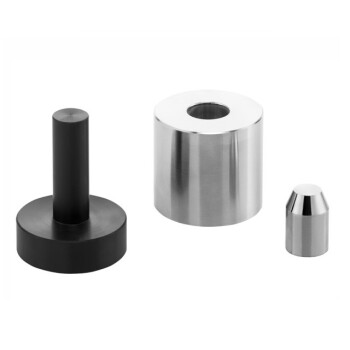
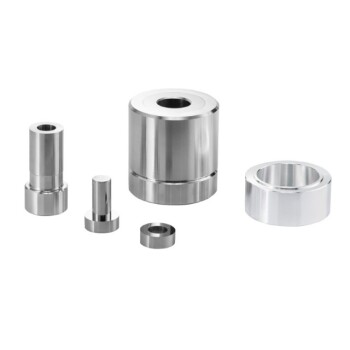
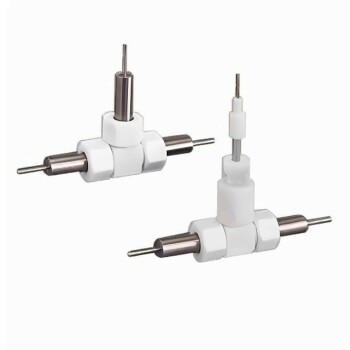
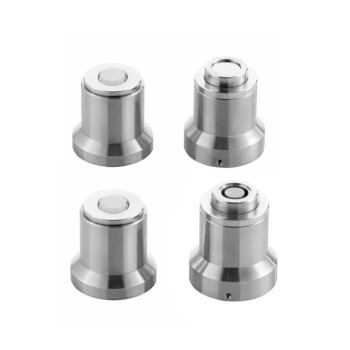
The core function of specialized pressurized battery test cell dies is to apply and sustain a constant, steady stack pressure on the all-solid-state battery (ASSB) assembly throughout the entire electrochemical testing process. Unlike traditional liquid batteries, ASSBs rely on this continuous mechanical force to maintain the critical physical contact between the solid electrolyte and the electrode particles.
The Central Insight In the absence of a liquid electrolyte to fill voids, the performance of a solid-state battery is entirely dependent on mechanical integrity. Pressurized dies act as an external stabilizer, actively compressing the cell to counteract material volume changes and preventing the structural delamination that leads to immediate failure.
The Physics of Solid-to-Solid Contact
Bridging the Contact Gap
In liquid-based batteries, the electrolyte flows to fill every pore, ensuring ionic conductivity. In ASSBs, the interface consists of rigid solids pressing against rigid solids.
Without external force, these surfaces have microscopic gaps that block ion flow. The test cell die applies pressure (typically ranging from 1.5 MPa to over 17 MPa) to force these materials into "tight contact," creating a continuous pathway for lithium ions.
Reducing Interfacial Impedance
The primary electrochemical benefit of this pressure is the reduction of interfacial impedance. By maximizing the surface area of contact between the cathode, anode, and solid electrolyte, the die minimizes the resistance the battery must overcome to move ions.
If the die fails to maintain this pressure, impedance rises sharply, resulting in poor voltage performance and unreliable test data.
Managing Volume Volatility During Cycling
Counteracting Material "Breathing"
During charging and discharging, battery materials—particularly high-nickel cathodes and lithium metal anodes—undergo significant physical changes. They expand during lithium deposition and contract during stripping.
The pressurized die serves as a constraint system. It resists the anisotropic volume expansion, keeping the battery stack compressed even as the internal materials attempt to swell.
Preventing Interface Delamination
The most critical role of the die during long-term cycle testing is preventing delamination.
If the pressure is not constant, the contraction phase of a cycle can cause the electrode to pull away from the electrolyte. This separation creates a physical disconnect, effectively breaking the circuit and ending the battery's useful life. The die ensures the layers remain bonded despite these internal physical shifts.
The Importance of Precision Assembly
Ensuring Uniformity
While the die is critical during testing, precision dies are also essential during the initial pressing process.
High-quality dies ensure the cathode and electrolyte layers are pressed to a completely flat, smooth surface with uniform thickness.
Avoiding Stress Concentrations
If a die produces a rough or uneven surface, pressure will not be distributed equally during testing.
This leads to stress concentrations—localized points of high pressure that can crack the ceramic electrolyte or cause short circuits. A precision die mitigates this risk by ensuring perfectly parallel alignment.
Understanding the Trade-offs
The Risk of Artificial Performance
A common pitfall in ASSB research is relying on extremely high stack pressures (e.g., >10 MPa) to achieve good results.
While this proves the chemistry can work, it may mask issues that would appear at commercially viable pressures (typically <2 MPa). High-pressure dies can sometimes force contact in a way that is impossible to replicate in a manufactured electric vehicle pack.
Mechanical Degradation
Excessive pressure is not always beneficial. Over-compressing the cell can crush softer electrode particles or damage the microstructure of the solid electrolyte. The test die must provide optimized pressure—enough to maintain contact, but not enough to mechanically degrade the active materials.
Making the Right Choice for Your Goal
To select the correct pressurized test cell strategy, you must define the specific objective of your experiment:
- If your primary focus is Fundamental Material Stability: Use a die capable of high pressures (10+ MPa) to eliminate contact issues and isolate the electrochemical behavior of the material itself.
- If your primary focus is Commercial Viability: Select a die that allows for lower, controlled pressures (1–5 MPa) to mimic the mechanical constraints of a real-world battery pack.
- If your primary focus is Long-Term Cycle Life: Ensure your test cell features a mechanism (like a calibrated spring or hydraulic piston) that actively compensates for volume expansion to maintain constant pressure over hundreds of cycles.
Ultimately, the pressurized die is not just a sample holder; it is an active mechanical component that is as critical to your data validity as the battery chemistry itself.
Summary Table:
| Feature | Role in ASSB Testing | Impact on Electrochemical Performance |
|---|---|---|
| Pressure Application | 1.5 MPa to 17+ MPa | Forces rigid surfaces into tight contact for ion flow. |
| Interfacial Control | Reduces contact gaps | Minimizes interfacial impedance and resistance. |
| Volume Management | Counteracts expansion/contraction | Prevents delamination during charge/discharge cycles. |
| Precision Alignment | Ensures uniform thickness | Prevents stress concentrations and electrolyte cracking. |
| Structural Support | Acts as an external stabilizer | Maintains mechanical integrity without liquid electrolytes. |
Elevate Your Solid-State Battery Research with KINTEK
Precision is paramount when testing the next generation of energy storage. KINTEK specializes in high-performance laboratory equipment designed for the rigorous demands of all-solid-state battery (ASSB) R&D.
Our specialized pressurized battery test cell dies and hydraulic pellet presses ensure constant stack pressure and uniform contact, eliminating the variables that compromise your electrochemical data. Beyond battery research tools, KINTEK offers a comprehensive range of high-temperature furnaces, crushing and milling systems, and advanced cooling solutions to support your entire laboratory workflow.
Ready to achieve more reliable, commercially viable battery data? Contact KINTEK today to find the perfect testing solution for your lab!
Related Products
- Button Battery Tablet Press Sealing Mold for Lab Use
- Ring Press Mold for Lab Applications
- Customizable Swagelok Type Test Cells for Advanced Battery Research Electrochemical Analysis
- Button Battery Disassembly and Sealing Mold for Lab Use
- Laboratory Hydraulic Press Lab Pellet Press for Button Battery
People Also Ask
- What role do battery test molds or coin cell cases play? Optimize Your All-Solid-State Battery Assembly Today
- What is the function of a tablet press? Transforming Powder into Precise, Uniform Tablets
- What is tablet pressing in pharmaceutical industry? The Core Process for Producing Solid Oral Dosage Forms
- What is the difference between single punch and rotary tablet press? Choose the Right Machine for Your Lab or Production
- What are pill presses called? The Correct Term is Tablet Press for Pharmaceutical Manufacturing