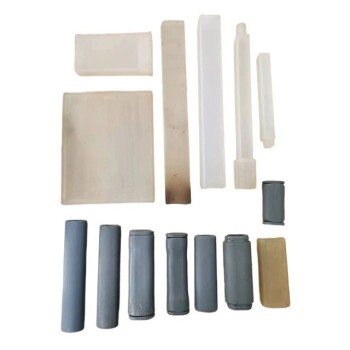
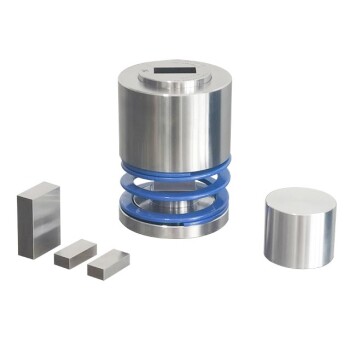
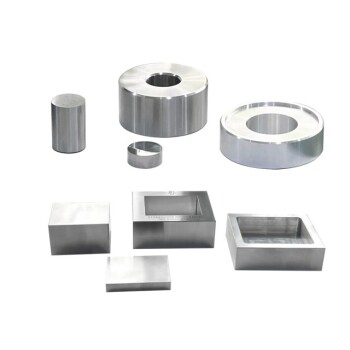
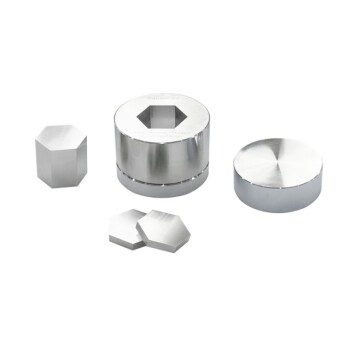
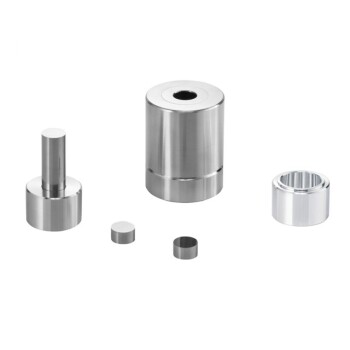
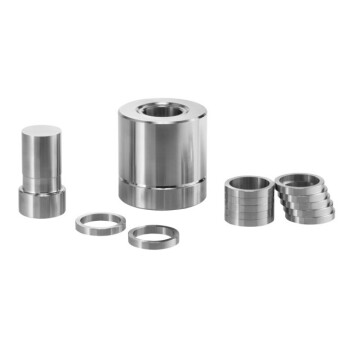
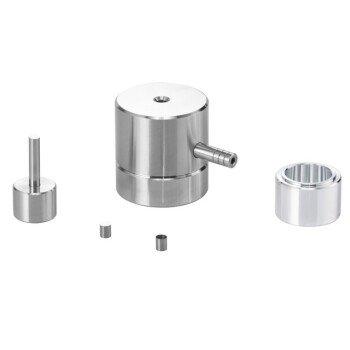
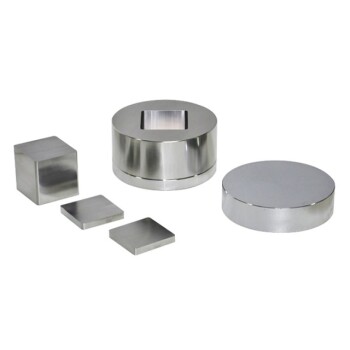
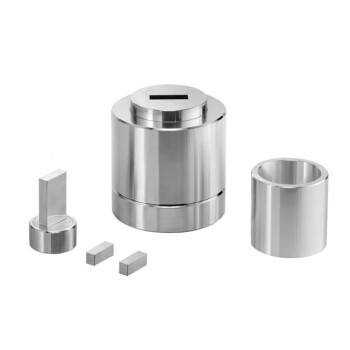
Customized metal molds act as the foundational architecture for solid-state battery manufacturing, serving as rigid containers that withstand immense pressure to shape powder materials. They play a critical role in densification by allowing forming pressures up to 500 MPa without deforming, ensuring the structural integrity of electrode and electrolyte layers.
While high pressure is the engine of densification, the mold is the steering mechanism. Its ability to maintain absolute rigidity under extreme stress is the defining factor in creating the flat, precise surfaces required for effective ion transport in solid-state batteries.
The Mechanics of High-Pressure Forming
Withstanding Extreme Loads
The primary function of the customized metal mold is to serve as a rigid container for powder molding. To achieve high density in solid-state components, the mold must withstand forming pressures reaching 500 MPa. Failure to handle this load would result in catastrophic tool failure or insufficient densification of the powder.
Preventing Structural Deformation
The mold must maintain its shape perfectly while under this immense stress. It acts as a constraint, forcing the powder materials to compress rather than allowing the tool to expand. This ensures that the applied pressure is directed entirely into compacting the material, rather than warping the container.
Precision and Geometric Fidelity
Achieving Precise Dimensions
Customized molds are responsible for defining the precise geometric dimensions of the battery components. Whether shaping electrolyte pellets or electrode layers, the mold acts as the definitive template. This consistency is vital for scalability, ensuring that every manufactured unit meets the exact same specifications.
Ensuring Surface Flatness
Beyond general shape, the mold dictates the surface topography of the pressed components. It ensures the creation of flat surfaces on the pellets and layers. A perfectly flat surface is not merely an aesthetic requirement; it is a functional necessity for the battery's internal architecture.
Facilitating Component Integration
Enabling Tight Contact
The ultimate goal of using high-precision molds is to ensure tight contact between battery layers. Solid-state batteries rely on the physical interface between the electrode and electrolyte for ion movement. The mold's precision eliminates microscopic gaps that could impede this movement or increase resistance.
Supporting Subsequent Stacking
The geometric uniformity provided by the mold is crucial for the assembly phase. Because the components have flat, predictable surfaces, they allow for seamless subsequent battery stacking. This ensures the final battery assembly is mechanically stable and volumetrically efficient.
Understanding the Trade-offs
The Rigidity vs. Durability Balance
While the mold must be rigid enough to handle 500 MPa, excessive hardness can lead to brittleness. A mold that does not deform might instead crack under cyclic loading if the material properties are not perfectly balanced. This necessitates a careful selection of metals that offer both high yield strength and fracture toughness.
Precision vs. Cost
Achieving the tolerances required for "tight contact" drives up the cost of mold fabrication. Customizing metal molds for specific geometries prevents the use of cheaper, off-the-shelf tooling. However, attempting to cut costs on mold precision will invariably result in poor interfacial contact and reduced battery performance.
Maximizing Manufacturing Outcomes
To ensure your densification process yields high-performance solid-state components, consider the following strategic priorities:
- If your primary focus is Maximum Density: Prioritize mold materials with the highest possible yield strength to ensure zero deformation at pressures approaching 500 MPa.
- If your primary focus is Assembly Efficiency: Prioritize molds machined with ultra-fine surface finishes to guarantee the flatness required for seamless stacking.
The quality of your metal mold dictates the quality of your interface, making it the single most critical passive component in your manufacturing line.
Summary Table:
| Feature | Role in Densification | Technical Impact |
|---|---|---|
| Rigidity | Withstands up to 500 MPa | Prevents tool deformation; ensures full pressure transfer. |
| Geometric Precision | Defines component dimensions | Ensures consistency across units for large-scale manufacturing. |
| Surface Flatness | Dictates layer topography | Optimizes interfacial contact for efficient ion transport. |
| Structural Constraint | Forces powder compaction | Maintains integrity of electrode and electrolyte layers. |
Elevate Your Battery Research with KINTEK Precision Engineering
High-performance solid-state batteries demand perfect interfacial contact and uncompromising structural integrity. KINTEK specializes in providing high-end laboratory equipment and consumables, including customized metal molds and high-pressure hydraulic presses designed to withstand the rigors of 500 MPa densification.
Our expertise extends across a comprehensive range of solutions for battery research, including:
- Hydraulic Presses & Tooling: Pellet, hot, and isostatic presses for maximum material density.
- Advanced Furnace Systems: Muffle, tube, and vacuum furnaces for precise thermal processing.
- Material Preparation: Crushing, milling, and sieving equipment for uniform powder precursors.
- Electrochemical Tools: High-quality electrolytic cells, electrodes, and battery consumables.
Don't let inferior tooling limit your battery's performance. Our technical team is ready to help you design the perfect mold for your specific architecture. Contact KINTEK today to discover how our high-precision equipment can streamline your manufacturing process and boost your research outcomes.
Related Products
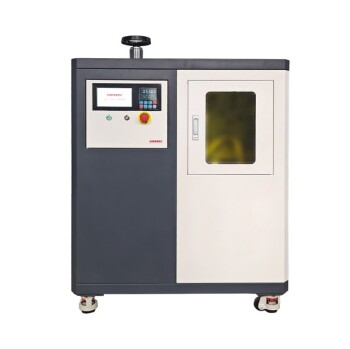
- Warm Isostatic Press for Solid State Battery Research
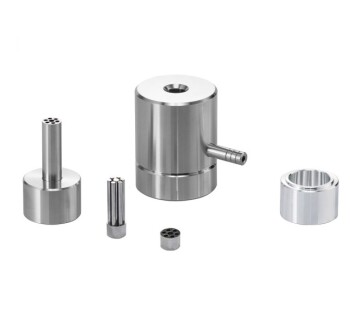
- Special Shape Press Mold for Lab
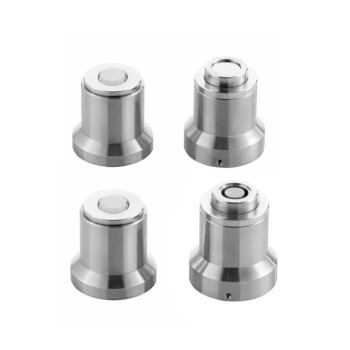
- Button Battery Tablet Press Sealing Mold for Lab Use
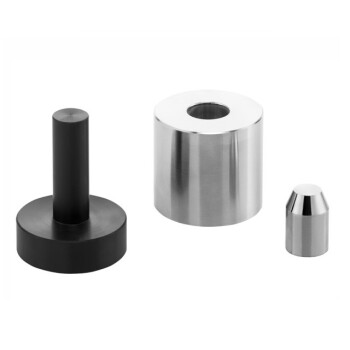
- Anti-Cracking Press Mold for Lab Use
- Button Battery Disassembly and Sealing Mold for Lab Use
People Also Ask
- What is the temperature of a warm isostatic press? Achieve Optimal Densification for Your Materials
- What is the function of a Warm Isostatic Press (WIP) in all-solid-state pouch cells? Optimize Battery Density
- Why are Warm Isostatic Presses (WIP) necessary for solid-state batteries? Achieve Atomic-Level Contact
- What advantages does a warm isostatic press offer over a traditional uniaxial press for Li6PS5Cl electrolyte sheets?
- How do warm isostatic presses improve dry electrode performance? Enhance ASSB Conductivity with Heat & Pressure