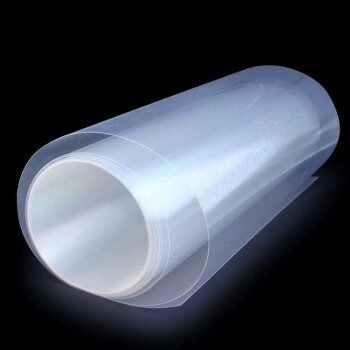
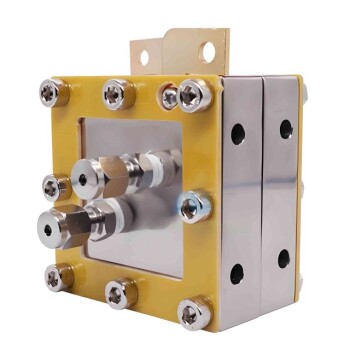
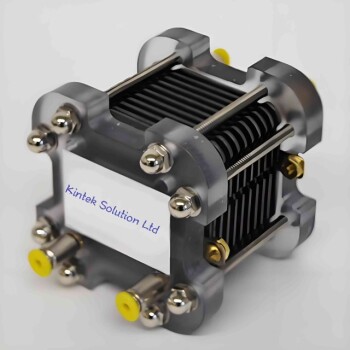
The ion exchange membrane acts as the critical physiological barrier within a two-compartment electrolytic cell used for medium-chain carboxylic acid (MCCA) conversion. Its primary function is to physically isolate the anode and cathode solutions to prevent product interference, while simultaneously acting as a selective gatekeeper that permits specific ions to pass through to maintain the necessary electrical charge balance.
Core Takeaway By strictly compartmentalizing the cell, the membrane prevents electrode products from mixing and creating hazardous or impure conditions. Most importantly for MCCA synthesis, it restricts the migration of hydroxide ions to the anode, preserving the specific chemical environment required to suppress side reactions and drive efficient conversion.
The Mechanics of Isolation and Conductivity
Physical Compartmentalization
The most immediate role of the membrane is to divide the cell into two distinct chambers. This physical isolation ensures that the chemical species generated at the anode do not immediately interact with those generated at the cathode. Without this barrier, the reaction products would mix freely, leading to reduced product purity and potential chemical incompatibility.
Maintaining Charge Balance
While the membrane blocks bulk fluid mixing, it must remain electrically conductive to close the circuit. It achieves this by allowing specific ions to transport across the barrier. This selective permeability is essential for maintaining electroneutrality in the electrolytes, allowing the electrochemical reaction to sustain current flow.
Critical Impact on MCCA Conversion
Controlling Anode pH Levels
In the specific context of MCCA conversion (such as n-hexanoic acid conversion), the membrane plays a vital role in regulating pH. Water splitting at the cathode generates hydroxide ions, which naturally seek to migrate toward the anode. The membrane effectively slows this migration of hydroxide ions into the anode chamber.
Suppressing Side Reactions
The control of hydroxide migration is not just about balance; it is about reaction survival. If hydroxide ions flood the anode chamber, the local pH rises, creating conditions favorable for unwanted side reactions. By suppressing this pH rise, the membrane ensures the environment remains favorable for the desired Kolbe electrolysis rather than competing reactions.
Safety and Purity Considerations
Preventing Gas Cross-Contamination
Beyond liquid isolation, the membrane serves as a gas separator. In electrolytic processes, hydrogen and oxygen gases are frequently evolved at opposite electrodes. The membrane effectively prevents the physical mixing of these evolved gases.
Eliminating Safety Risks
The separation of hydrogen and oxygen is a critical safety feature. Mixing these gases within the reactor can create explosive mixtures. By keeping them isolated, the membrane eliminates these explosion risks and ensures the hydrogen product remains pure.
Understanding the Operational Trade-offs
Migration Efficiency vs. Isolation
While the membrane allows for ion transport, it acts as a resistor to mass transport compared to a solution without a barrier. The "trade-off" here is that while you gain chemical control, you introduce a rate-limiting step regarding ion movement.
The Imperfection of Selectivity
As noted in the analysis of n-hexanoic acid conversion, the membrane slows hydroxide migration but may not strictly eliminate it forever. The effectiveness of the setup depends on the membrane's ability to keep the migration rate lower than the reaction rate. If the membrane degrades or is selected incorrectly, pH control is lost, and the efficiency of the MCCA conversion will plummet.
Making the Right Choice for Your Goal
When designing your Kolbe electrolysis setup, the choice of membrane defines your process limits.
- If your primary focus is Process Efficiency (Yield): Prioritize a membrane with high selectivity against hydroxide transport to maintain the acidic anode conditions required for MCCA conversion.
- If your primary focus is Safety and Product Purity: Ensure the membrane has high structural integrity and low gas permeability to rigorously prevent hydrogen and oxygen crossover.
The membrane is not just a separator; it is the active regulator that allows you to decouple the anode chemistry from the cathode environment.
Summary Table:
| Feature | Primary Function | Impact on MCCA Conversion |
|---|---|---|
| Physical Isolation | Separates anode and cathode chambers | Prevents product mixing and maintains chemical purity |
| Selective Permeability | Allows specific ion transport | Maintains charge balance while slowing hydroxide migration |
| pH Regulation | Blocks hydroxide flow to the anode | Suppresses unwanted side reactions and drives Kolbe efficiency |
| Gas Separation | Keeps hydrogen and oxygen apart | Eliminates explosion risks and ensures high gas purity |
Precision is paramount in electrochemical research. At KINTEK, we understand that the right components define your process limits. Whether you are conducting MCCA synthesis or advanced battery research, our comprehensive range of electrolytic cells, electrodes, and high-performance consumables provides the reliability you need. From specialized ceramics to precision hydraulic presses and cooling solutions, KINTEK equips your laboratory with the tools to achieve superior yield and safety. Contact our experts today to find the perfect solution for your electrolysis setup!
References
- Katharina Neubert, Falk Harnisch. Platinized Titanium as Alternative Cost‐Effective Anode for Efficient Kolbe Electrolysis in Aqueous Electrolyte Solutions. DOI: 10.1002/cssc.202100854
This article is also based on technical information from Kintek Solution Knowledge Base .
Related Products
- Anion Exchange Membrane for Laboratory Use
- Proton Exchange Membrane for Batteries Lab Applications
- Customizable PEM Electrolysis Cells for Diverse Research Applications
- FS Electrochemical Hydrogen Fuel Cells for Diverse Applications
- Polyethylene Separator for Lithium Battery
People Also Ask
- What is the role of an Anion Exchange Membrane (AEM)? Boost Safety and Efficiency in Photoelectrochemical Systems
- What role does an anion exchange membrane play in a PEC battery? Ensure Safe, High-Purity Hydrogen Production
- What role do ion exchange membranes play in zero-gap CO2 reduction? Master the Engine of Selective Transport
- What should be considered when selecting an ion exchange membrane? Key Factors for Optimal Performance
- Why are ion exchange membranes essential in electrochemical cell configurations? Optimize Cell Efficiency and Safety