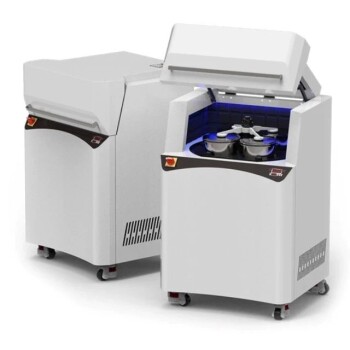
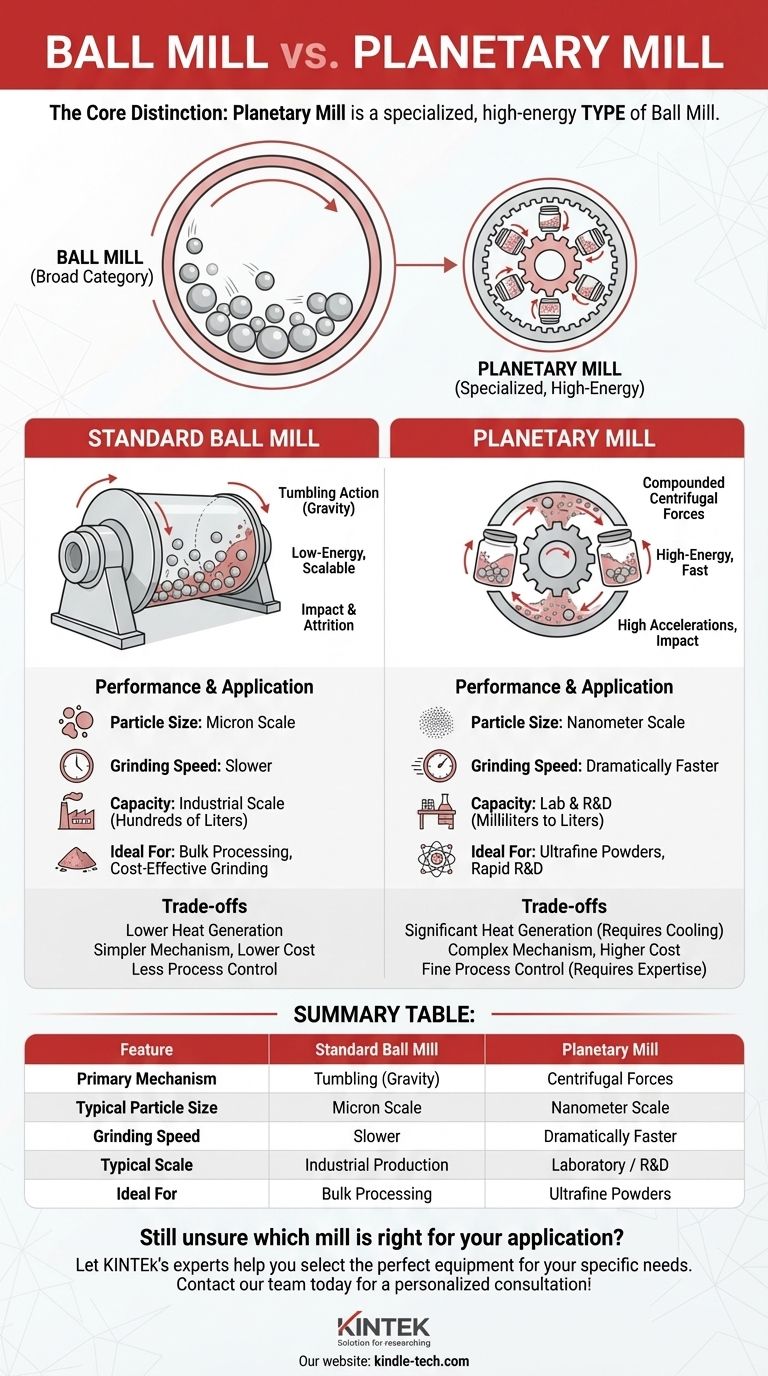
The core distinction is simple: a planetary mill is a specific, high-energy type of ball mill. While "ball mill" is a broad category of equipment that uses grinding media (balls) to break down material, a "planetary mill" refers to a distinct design that uses rotational and centrifugal forces for extremely fine grinding, often on a smaller scale.
The term "ball mill" describes any mill using grinding media, which often relies on gravity and tumbling action. A "planetary mill" is a specialized, high-energy class of ball mill that uses a sun-and-planet gear system to generate intense forces, achieving much finer particle sizes in less time.
The Fundamental Difference: Mechanism of Force
The primary distinction between a general ball mill (like a horizontal rolling mill) and a planetary mill lies in how they generate the grinding forces. This mechanical difference dictates their performance and ideal applications.
The Classic Ball Mill: Tumbling and Attrition
A standard horizontal ball mill is essentially a rotating drum filled with grinding media (balls) and the material to be processed.
As the drum rotates, the balls are lifted up the side and then cascade or tumble back down, crushing and grinding the material through impact and attrition (shearing).
The energy of this process is largely governed by gravity and the rotational speed of the drum. It is a relatively low-energy, but highly scalable, process.
The Planetary Mill: Compounded Centrifugal Forces
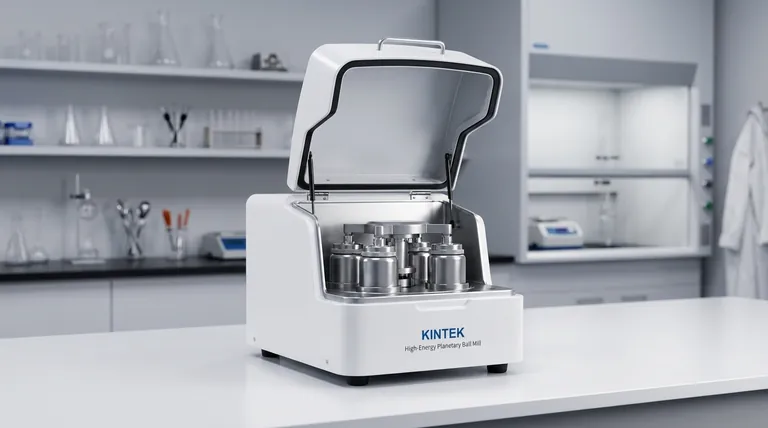
A planetary mill consists of one or more grinding jars (the "planets") mounted on a larger rotating disk (the "sun wheel").
Critically, the sun wheel and the grinding jars rotate in opposite directions. This opposing motion creates a powerful interaction of centrifugal forces.
The grinding balls inside the jars are subjected to extremely high accelerations, leading to very high-energy impacts. This allows for significantly faster and finer grinding than a simple tumbling mill.
How This Impacts Performance and Application
The difference in mechanical action leads to clear differences in how these mills are used.
Final Particle Size
A planetary mill's high-energy action can break particles down to the nanometer scale. This makes it the preferred tool for creating ultrafine powders in advanced materials research.
A standard rolling ball mill is more suited for grinding materials to the micron scale. It is excellent for bulk processing where extreme fineness is not the primary goal.
Grinding Speed
Due to the immense forces generated, a planetary mill can achieve a desired particle size dramatically faster than a standard ball mill.
Capacity and Scale
Planetary mills are typically used for laboratory and R&D-scale applications, with jar capacities ranging from a few milliliters to a couple of liters.
Horizontal rolling ball mills are highly scalable and can be built for large-scale industrial production, with capacities reaching several hundred liters.
Understanding the Trade-offs
Choosing the right mill requires understanding the inherent limitations and costs of each design.
Energy and Heat Generation
The high-energy collisions in a planetary mill generate significant heat. This can be a major issue for temperature-sensitive materials and may require external cooling.
Standard ball mills are a lower-energy system and generate much less heat, making them safer for a wider range of materials without special precautions.
Mechanical Complexity and Cost
The sun-and-planet gear system of a planetary mill is mechanically complex. This results in a higher initial cost and more potential points of failure compared to the simple design of a rolling mill.
Process Control
Planetary mills offer more variables to control, such as the rotational speed of both the sun wheel and the jars. This allows for fine-tuning the grinding process but also requires more expertise to operate effectively.
Making the Right Choice for Your Goal
Your application's specific requirements should dictate your choice.
- If your primary focus is R&D, achieving nanoparticle sizes, or rapid grinding: A planetary ball mill is the correct tool due to its high-energy, high-efficiency mechanism.
- If your primary focus is bulk processing, micron-level particle sizes, or cost-effective industrial production: A standard horizontal rolling ball mill is the more practical and scalable solution.
- If your primary focus is testing new formulations with minimal material: A small-scale laboratory rolling mill provides a cost-effective way to prove a concept before scaling up.
Ultimately, recognizing that a planetary mill is a specialized tool within the broader ball mill family is the key to selecting the right equipment for your material processing needs.
Summary Table:
| Feature | Standard Ball Mill | Planetary Mill |
|---|---|---|
| Primary Mechanism | Tumbling action (gravity) | Centrifugal forces (opposite rotation) |
| Typical Particle Size | Micron scale | Nanometer scale |
| Grinding Speed | Slower | Dramatically faster |
| Typical Scale | Industrial production (large capacity) | Laboratory/R&D (small capacity) |
| Ideal For | Bulk processing, cost-effective grinding | Ultrafine powders, rapid R&D grinding |
Still unsure which mill is right for your application?
Let KINTEK's experts help you select the perfect equipment for your specific needs. We specialize in providing high-quality lab equipment, including both standard ball mills and high-energy planetary mills, to ensure your research or production process is efficient and effective.
Contact our team today for a personalized consultation and discover how our solutions can enhance your lab's capabilities!
Visual Guide
Related Products
- High Energy Planetary Ball Mill for Laboratory Horizontal Tank Type Milling Machine
- High-Energy Omnidirectional Planetary Ball Mill Milling Machine for Laboratory
- Laboratory Planetary Ball Mill Rotating Ball Milling Machine
- Laboratory Planetary Ball Mill Cabinet Planetary Ball Milling Machine
- High Energy Planetary Ball Mill Milling Machine for Laboratory
People Also Ask
- How does a planetary ball mill enhance the electrocatalytic activity of La0.6Sr0.4CoO3-δ? Boost Your Catalyst Performance
- How does a planetary ball mill prepare silver and diamond composites? Achieve Perfect Homogeneity and Density Balance
- What are the parameters of a planetary ball mill? Master Speed, Time, and Media for Perfect Grinding
- What is the function of a planetary ball mill for nanostructured eutectic steel? Essential Prep for High-Strength Alloys
- What is the role of a planetary ball mill in sulfide-based solid-state batteries? Engineer High-Performance Cathodes