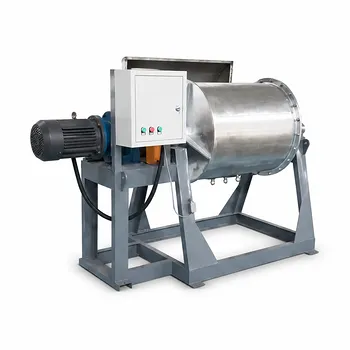
Planetary ball milling serves as the definitive homogenization technique for creating silver and diamond composite powders. By utilizing specific rotational speeds and complex multi-dimensional motion, the mill achieves a high-uniformity physical mixture of silver powder and chromium-plated diamond particles.
The fundamental challenge in combining silver and diamond is their drastic density difference, which typically leads to separation. A planetary ball mill solves this by applying intense, multi-axis centrifugal forces to prevent component segregation, ensuring the homogeneous microstructure necessary for successful sintering.
Overcoming Density Barriers
The primary obstacle in preparing silver-diamond composites is that silver is significantly denser than diamond. Standard mixing methods often fail because the lighter diamond particles tend to "float" or separate from the heavy silver matrix.
Multi-Dimensional Mixing Action
Planetary ball mills do not simply rotate; they utilize a unique multi-dimensional motion.
The grinding jar rotates on its own axis while simultaneously orbiting a central sun wheel in the opposite direction.
Preventing Component Segregation
This complex motion generates high-energy centrifugal and Coriolis forces.
These forces are strong enough to counteract the natural tendency of the materials to separate based on weight.
The result is a mixture where the density differences are effectively neutralized, locking the diamond particles into a uniform distribution within the silver powder.
Optimizing the Microstructure
Beyond simple mixing, the ball milling process prepares the physical structure of the powder for the final manufacturing steps.
Dispersion of Chromium-Plated Diamond
The process is specifically optimized for mixing silver with chromium-plated diamond particles.
The plating improves the interface between the metal and the carbon, while the milling ensures these distinct particles are dispersed evenly.
This prevents the agglomeration (clumping) of diamonds, which would create weak points in the final material.
Critical Foundation for Sintering
The ultimate goal of this powder preparation is to facilitate stable sintering.
If the powder is not homogeneous, the final solid material will have inconsistent properties.
By ensuring a homogeneous microstructure at the powder stage, the mill guarantees that the subsequent sintering process yields a stable, high-quality composite.
Understanding the Trade-offs
While planetary ball milling is highly effective, it introduces specific variables that must be managed to avoid degrading the material.
Risk of Impurity Contamination
The high-energy impact that mixes the powder also causes wear on the grinding media (the balls and jar linings).
If the wrong media is used, debris from the balls can contaminate the silver-diamond mixture, altering its electrical or thermal properties.
Structural Integrity of the Diamond
Diamonds are hard but brittle, and excessive milling energy can fracture them.
It is vital to balance the rotational speed to achieve mixing without pulverizing the diamond particles or stripping their chromium plating.
Making the Right Choice for Your Goal
To maximize the effectiveness of a planetary ball mill for silver-diamond composites, align your process parameters with your specific end-goals.
- If your primary focus is microstructural homogeneity: Prioritize multi-dimensional motion settings to counteract the density gap between silver and diamond effectively.
- If your primary focus is material purity: Select grinding media that is harder than the composite components or chemically compatible to minimize contamination from wear.
Mastering the planetary ball mill allows you to turn two disparate materials with conflicting physical properties into a single, unified, and high-performance composite.
Summary Table:
| Feature | Impact on Silver-Diamond Composite Preparation |
|---|---|
| Multi-Axis Motion | Counteracts density differences to prevent diamond particles from 'floating'. |
| Centrifugal Forces | Neutralizes component segregation, ensuring a uniform physical mixture. |
| Dispersion Control | Prevents agglomeration of chromium-plated diamonds for consistent microstructure. |
| Process Optimization | Balances rotational speed to maintain diamond integrity while achieving homogeneity. |
Elevate Your Material Research with KINTEK Precision
Ready to master the complex homogenization of silver, diamond, or other high-performance composites? KINTEK specializes in advanced crushing and milling systems, including high-energy planetary ball mills designed to overcome density barriers and ensure microstructural perfection.
Our comprehensive laboratory portfolio also features:
- High-Temperature Furnaces (Muffle, Vacuum, CVD/PECVD) for flawless sintering.
- Hydraulic Presses (Pellet, Hot, Isostatic) for high-density material consolidation.
- High-Pressure Reactors & Autoclaves for advanced chemical synthesis.
- Essential Consumables including high-purity ceramics, crucibles, and PTFE products.
Don't let material segregation compromise your results. Contact KINTEK today to discover how our equipment and expertise can optimize your laboratory workflow and deliver superior composite materials.
Related Products
- High Energy Planetary Ball Mill for Laboratory Horizontal Tank Type Milling Machine
- High-Energy Omnidirectional Planetary Ball Mill Milling Machine for Laboratory
- Laboratory Planetary Ball Mill Rotating Ball Milling Machine
- High Energy Planetary Ball Mill Milling Machine for Laboratory
- High Energy Planetary Ball Mill Machine for Laboratory Horizontal Tank Type
People Also Ask
- What is the role of a planetary ball mill in sulfide-based solid-state batteries? Engineer High-Performance Cathodes
- What are the parameters of a planetary ball mill? Master Speed, Time, and Media for Perfect Grinding
- What is the function of a planetary ball mill for nanostructured eutectic steel? Essential Prep for High-Strength Alloys
- What role does a planetary ball mill play in the preparation of NASICON-type solid electrolytes like LATP and LAGP?
- What is the function of a planetary ball mill in solid-state electrolyte prep? Milling vs. SDS Methods Explained