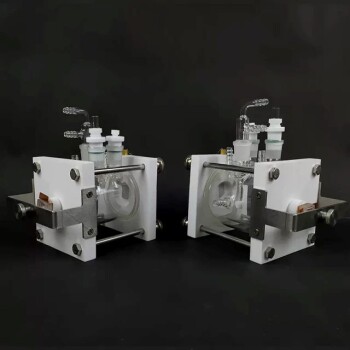
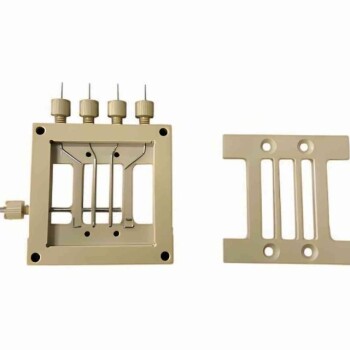
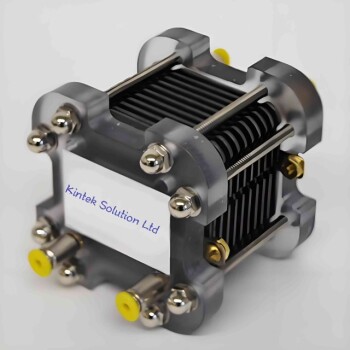
The primary function of a dual-electrode electrolytic cell in electrophoretic deposition (EPD) is to generate the electromotive force required to move suspended particles. By establishing a constant voltage between a cathode and an anode, the cell creates an electric field that drives charged ceramic particles to migrate through a liquid medium and deposit onto a conductive surface.
The dual-electrode cell acts as the driving engine for EPD, utilizing controlled voltage to ensure rapid, uniform ceramic deposition on conductive substrates, regardless of their geometric complexity.
How the Mechanism Works
Establishing the Driving Force
The core operation of the cell relies on maintaining a specific electrical potential. By applying constant voltage across the two electrodes, the system creates a stable electric field within the suspension.
Particle Migration
Ceramic particles suspended in the liquid medium are electrically charged. Once the voltage is applied, the electric field forces these particles to migrate toward the electrode with the opposite charge (the substrate).
Controlled Deposition
As the particles reach the conductive substrate, they accumulate to form a coating. This direct manipulation of particles via the electric field allows for a high degree of control over the deposition process.
Strategic Advantages
Uniformity Across Surfaces
One of the most significant benefits of this cell configuration is the ability to achieve uniform coating thickness. Because the deposition is driven by the electric field rather than line-of-sight (like spraying), the coating forms evenly across the surface.
Coating Complex Geometries
The dual-electrode cell excels at coating substrates with complex shapes. The electric field wraps around the conductive object, ensuring that recessed areas and intricate details receive consistent coverage.
Process Efficiency
The mechanism enables rapid deposition. The direct application of voltage ensures that the ceramic buildup occurs quickly, making the process time-efficient for manufacturing contexts.
Critical Constraints
The Conductivity Requirement
While the user prompt mentions polymer substrates, the reference explicitly states the deposition happens on a conductive substrate.
Implications for Polymers
Because standard polymers are insulators, the dual-electrode cell cannot function on them directly. The polymer surface must be metallized or treated to become conductive before the EPD process can successfully deposit ceramic particles.
Making the Right Choice for Your Goal
- If your primary focus is geometric precision: Rely on the dual-electrode cell's ability to follow field lines to coat intricate shapes without shadowing effects.
- If your primary focus is production speed: Leverage the constant voltage mechanism to drive rapid particle migration for shorter cycle times.
By precisely controlling the voltage within the electrolytic cell, you can ensure a robust and consistent ceramic interface on your target substrate.
Summary Table:
| Feature | Function in EPD Process |
|---|---|
| Driving Force | Establishes a constant voltage and stable electric field |
| Particle Movement | Triggers migration of charged ceramic particles toward the substrate |
| Coating Uniformity | Ensures even thickness across flat and complex surfaces |
| Geometric Capability | Enables coating of intricate shapes and recessed areas |
| Process Speed | Facilitates rapid deposition through direct electrical manipulation |
Elevate Your Materials Research with KINTEK
Ready to achieve superior coating uniformity and precision? KINTEK specializes in advanced laboratory solutions, providing high-performance electrolytic cells and electrodes specifically designed for intricate deposition processes. Whether you are working on electrophoretic deposition, battery research, or material synthesis, our comprehensive range of high-temperature furnaces, hydraulic presses, and specialized consumables—including PTFE and ceramics—ensures your lab operates at the cutting edge of technology.
Empower your research with reliable equipment tailored to your needs. Contact us today to explore our full portfolio!
References
- Alina Marguță, Dumitru Nedelcu. COATED POLYMERS -A REVIEW. DOI: 10.54684/ijmmt.2022.14.2.128
This article is also based on technical information from Kintek Solution Knowledge Base .
Related Products
- H-Type Double-Layer Optical Electrolytic Electrochemical Cell with Water Bath
- Double Layer Five-Port Water Bath Electrolytic Electrochemical Cell
- Double-Layer Water Bath Electrolytic Electrochemical Cell
- Multifunctional Electrolytic Electrochemical Cell Water Bath Single Layer Double Layer
- Electrolytic Electrochemical Cell Gas Diffusion Liquid Flow Reaction Cell
People Also Ask
- What is the overall structure of the H-type double-layer optical water bath electrolytic cell? Precision Design for Controlled Experiments
- How is the electrolyte managed in H-type electrolytic cells for specific reactions? Achieve Precise Control and High Purity
- What checks should be performed on the H-type electrolytic cell before use? Ensure Accurate Electrochemical Data
- What is important regarding temperature control for the H-type electrolytic cell? Ensure Precision and Data Integrity
- What is the overall structure of the H-type electrolytic cell? Understanding Dual-Chamber Electrochemical Designs