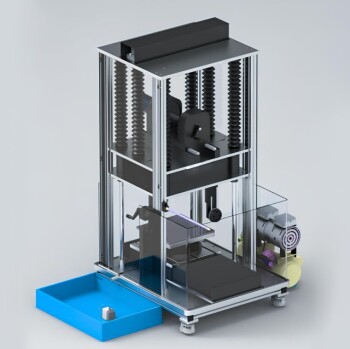
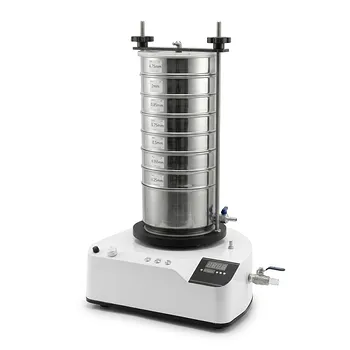
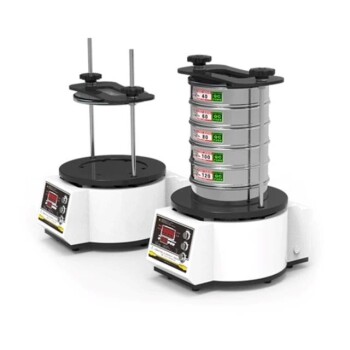
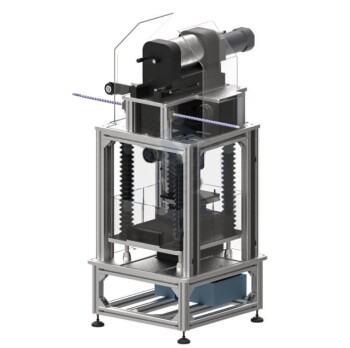
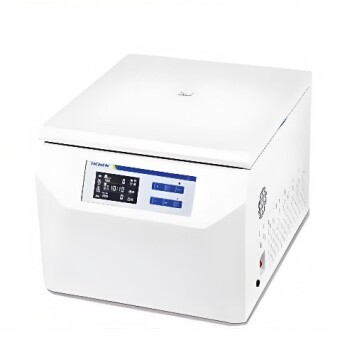
The function of a high-precision sieving system is to act as a rigorous physical filter for Meranti wood sawdust, isolating a specific particle size range between 0.297 mm and 0.542 mm. By mechanically segregating the raw biomass, this system ensures that only material meeting these precise dimensional specifications moves forward to the pyrolysis reactor.
The core value of sieving lies in standardization. By strictly controlling particle geometry, you eliminate thermal variables, ensuring that heat penetrates every particle at the same rate to maximize bio-oil production.
The Critical Role of Particle Uniformity
To understand why sieving is indispensable, you must look beyond simple sorting. The goal is to optimize the thermodynamics of the subsequent chemical reaction.
Optimizing Heat Transfer Efficiency
Pyrolysis relies on rapid, controlled heating. The sieving process guarantees that the sawdust particles fall within the 0.297 mm to 0.542 mm range.
This specific size window is not arbitrary. It creates a surface-area-to-volume ratio that allows heat to transfer efficiently from the reactor environment to the core of the biomass particle.
Ensuring Even Heating
Without sieving, the feedstock would contain a chaotic mix of fine dust and large chips.
Large particles heat slowly, often resulting in incomplete decomposition (leaving unreacted core material). Conversely, ultra-fine dust may react too quickly or entrain in the gas flow. Sieving ensures every particle behaves predictably under thermal stress.
Impact on Production Quality
The mechanical action of the sieve directly influences the chemical output of the system.
Maximizing Bio-oil Yield
The primary reference indicates that a uniform particle size distribution is critical for optimizing yield.
When particles heat evenly, the conversion of solid biomass into liquid bio-oil is maximized. Inconsistent sizes lead to unpredictable cracking reactions, which often result in excess char or gas rather than the desired bio-oil.
Enhancing Product Consistency
A stable input leads to a stable output. By controlling the physical characteristics of the Meranti sawdust, the sieving system stabilizes the reaction conditions within the reactor.
This stability is essential for maintaining the quality of the final bio-oil, ensuring it meets the necessary standards for heating value and stability.
Understanding the Trade-offs
While high-precision sieving is vital for quality, it introduces specific constraints to the workflow that must be managed.
Material Rejection and Waste
A strict sieve range of 0.297 mm to 0.542 mm means that a portion of your raw material will inevitably be rejected.
Particles smaller than 0.297 mm (fines) and larger than 0.542 mm (oversize) must be separated. This requires additional handling, such as re-milling the oversize particles or finding alternative uses for the fines, which adds a layer of complexity to the preparation phase.
Processing Bottlenecks
Sieving is a physical bottleneck. It dictates the rate at which the reactor can be fed.
If the sieving system cannot keep pace with the drying oven or the reactor's capacity, it becomes the limiting factor in overall throughput.
Making the Right Choice for Your Goal
The level of precision you apply to sieving should align with your end-product requirements.
- If your primary focus is Bio-oil Quality: Strictly adhere to the 0.297 mm to 0.542 mm range to ensure maximum heat transfer efficiency and chemical stability.
- If your primary focus is Process Yield: Prioritize the removal of oversize particles, as these are the primary culprits for incomplete reactions and reduced conversion rates.
Precision in preparation is the single most effective way to guarantee predictability in production.
Summary Table:
| Feature | Specification/Detail | Impact on Pyrolysis |
|---|---|---|
| Target Size Range | 0.297 mm – 0.542 mm | Optimizes surface-area-to-volume ratio |
| Sieving Goal | Particle Uniformity | Ensures even heating and prevents incomplete decomposition |
| Primary Benefit | Maximize Bio-oil Yield | Minimizes excess char and gas production |
| Key Constraint | Material Selection | Requires management of fines and oversized particles |
Precision Sieving for Predictable Results
At KINTEK, we understand that high-quality pyrolysis starts with precise material preparation. Our advanced sieving equipment and crushing and milling systems are engineered to provide the exact particle size distribution needed to optimize your bio-oil yield and product consistency.
Whether you are processing Meranti wood or other biomass, our laboratory solutions—from high-temperature furnaces and vacuum reactors to hydraulic presses and essential consumables like crucibles—ensure your research meets the highest standards of accuracy.
Ready to enhance your lab's throughput and chemical stability? Contact our experts today to find the perfect equipment for your specific application.
References
- Yeti Widyawati. Application of Central Composite Design in the Pyrolysis Process for Making Bio-Oil Based on Meranti Wood Sawdust (Shorea pinang). DOI: 10.37637/ab.v6i3.1457
This article is also based on technical information from Kintek Solution Knowledge Base .
Related Products
- Three-dimensional electromagnetic sieving instrument
- 12 Inch 24 Inch High Precision Automatic Diamond Wire Cutting Machine Laboratory Saw Precision Wire EDM Cutting Machine
- Laboratory Vibratory Sieve Shaker Machine for Dry and Wet Three-Dimensional Sieving
- Laboratory Wet Three-Dimensional Vibratory Sieve Shaker Machine
- Laboratory Test Sieves and Sieving Machines
People Also Ask
- Why is sieving equipment essential for the classification of processed bio-activated carbon? Optimize Performance
- What are the limitations of sieving? Understanding the Constraints of Particle Size Analysis
- What are advantages and disadvantages of sieving method? A Guide to Reliable & Cost-Effective Particle Sizing
- How is sieving important? The Critical Role of Particle Size Analysis in Quality Control
- What is sieving and how does it work? A Guide to Accurate Particle Size Analysis