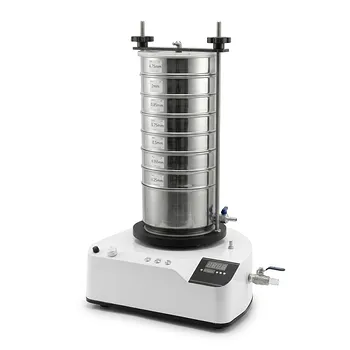
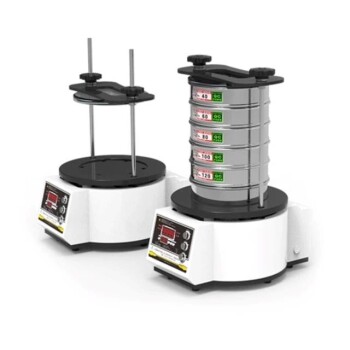
High-precision sieving is the critical control point that transforms ground zeolite from a raw aggregate into a functional chemical tool. By categorizing particles into a uniform size distribution immediately after grinding, these systems ensure that the physical characteristics of the material directly support its chemical function in removing heavy metals like lead, cadmium, and copper.
By establishing strict control over particle size, sieving systems standardize the variables of wastewater treatment. This consistency stabilizes contact times and ion diffusion rates, maximizing the adsorption kinetics required for efficient heavy metal removal.
The Mechanical Foundation of Chemical Efficiency
Eliminating Variability After Grinding
Raw zeolite is typically subjected to grinding, a process that naturally produces a chaotic mix of particle sizes. High-precision sieving acts as a quality filter, classifying this mix into a narrow, defined specification.
Uniformity is not just aesthetic; it is functional. It ensures that every batch of material behaves predictably when introduced to a fluid system.
Standardizing Contact Time
In wastewater treatment, the duration of interaction between the water and the zeolite is paramount.
If particle sizes vary too widely, they will flow or settle at different rates. Sieving ensures consistent aerodynamic and hydrodynamic properties, allowing for stable, calculated contact times across the entire volume of water.
Optimizing Adsorption Kinetics
Stabilizing the pH Environment
The chemical ability of zeolite to capture pollutants is sensitive to pH levels.
Inconsistent particle sizes can lead to uneven dissolution or reaction rates, causing localized fluctuations in acidity or alkalinity. Uniform particles help maintain a stable pH environment, creating the ideal baseline for chemical reactions to occur.
Controlling Ion Diffusion Rates
The core mechanism of zeolite treatment is the movement of ions—specifically heavy metals—into the material's structure.
Diffusion rates are dictated by surface area and particle size. By ensuring all particles are the same size, sieving standardizes the rate at which ions diffuse. This allows engineers to accurately predict and optimize the removal of target contaminants.
Maximizing Heavy Metal Removal
The ultimate goal of this process preparation is the removal of toxic elements.
The stability provided by precise sieving directly enhances adsorption efficiency. This is particularly effective for targeted heavy metal ions, specifically lead, cadmium, and copper, ensuring they are captured effectively rather than passing through the system due to poor kinetic performance.
Understanding the Trade-offs
Yield vs. Precision
Achieving a "high-precision" cut often requires a stricter rejection rate during the classification process.
To maintain a uniform distribution, material that is slightly too coarse or too fine must be separated and potentially re-processed. This prioritizes quality over immediate volume, ensuring that the material that makes it to the treatment phase performs at maximum efficiency.
Making the Right Choice for Your Goal
If your primary focus is Adsorption Efficiency:
- Prioritize tight sieving specifications to maximize ion diffusion rates for heavy metals like lead and copper.
If your primary focus is Process Stability:
- Focus on particle uniformity to guarantee consistent pH environments and predictable contact times during treatment.
High-precision sieving turns physical consistency into chemical predictability.
Summary Table:
| Key Benefit | Impact on Zeolite Performance | Wastewater Application Outcome |
|---|---|---|
| Particle Uniformity | Standardizes aerodynamic and hydrodynamic flow | Consistent contact time & predictable settling rates |
| Size Classification | Controls total surface area to volume ratio | Optimized adsorption kinetics for lead, cadmium, and copper |
| pH Stabilization | Prevents localized chemical fluctuations | Maintains ideal baseline for efficient ion exchange |
| Quality Control | Eliminates variability from the grinding process | Reliable batch-to-batch chemical performance |
Elevate Your Material Research with KINTEK Precision
Consistency is the foundation of chemical performance. At KINTEK, we understand that high-performance zeolite and catalyst preparation require rigorous particle size control. We offer a comprehensive suite of laboratory solutions—from advanced crushing and milling systems to high-precision sieving equipment and hydraulic presses—to ensure your materials meet exact specifications every time.
Whether you are optimizing adsorption for wastewater treatment or scaling up battery research, our expert team provides the tools you need for success, including:
- Sieving and Milling Systems for uniform particle distribution.
- High-Temperature Furnaces and Reactors for material synthesis.
- Consumables such as ceramics, crucibles, and PTFE products.
Ready to standardize your results and maximize efficiency? Contact KINTEK today to find the perfect equipment for your lab!
References
- Natalia Kordala, Mirosław Wyszkowski. Zeolite Properties, Methods of Synthesis, and Selected Applications. DOI: 10.3390/molecules29051069
This article is also based on technical information from Kintek Solution Knowledge Base .
Related Products
- Three-dimensional electromagnetic sieving instrument
- 12 Inch 24 Inch High Precision Automatic Diamond Wire Cutting Machine Laboratory Saw Precision Wire EDM Cutting Machine
- Laboratory Vibratory Sieve Shaker Machine for Dry and Wet Three-Dimensional Sieving
- Laboratory Wet Three-Dimensional Vibratory Sieve Shaker Machine
- Laboratory Test Sieves and Sieving Machines
People Also Ask
- Why is sieving equipment essential for the classification of processed bio-activated carbon? Optimize Performance
- What are the limitations of sieving? Understanding the Constraints of Particle Size Analysis
- What are advantages and disadvantages of sieving method? A Guide to Reliable & Cost-Effective Particle Sizing
- How is sieving important? The Critical Role of Particle Size Analysis in Quality Control
- What is sieving and how does it work? A Guide to Accurate Particle Size Analysis