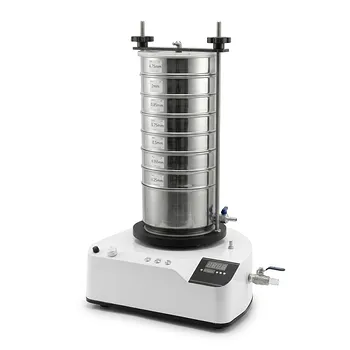
Powder classification using standard sieves is essential because it establishes precise control over the particle size distribution and dispersity of the raw material. This control is the deciding factor in the permeability of the powder filling layer, which dictates how effectively gas can flow through the material during the reaction.
Core Takeaway Standard sieves serve as a critical process control tool to optimize gas permeability within the raw mix. This optimization enables efficient nitrogen filtration, ensures the combustion wave propagates stably, and directly results in a higher degree of nitriding in the final product.
The Critical Link Between Particle Size and Permeability
Defining the Material Structure
Standard sieves allow for the extraction of ferroalloy powders with specific, consistent particle size distributions.
This step is not merely about sorting; it is about engineering the physical structure of the powder filling layer.
Influencing Gas Flow
The particle size and dispersity of the powder directly determine its permeability.
Permeability is the measure of how easily a fluid (in this case, nitrogen gas) can pass through the porous medium of the powder.
Optimizing Filtration Combustion
Enhancing Nitrogen Efficiency
Permeability is a key parameter for the mechanism known as filtration combustion.
By using sieves to precisely screen particle sizes, you optimize the efficiency of nitrogen filtration throughout the material.
Stabilizing the Reaction
Consistent permeability ensures that the combustion wave propagates stably through the reactants.
Without this stability, the reaction can become erratic, leading to uneven synthesis.
Maximizing Product Quality
The ultimate goal of using standard sieves is to increase the final degree of nitriding.
A controlled, stable combustion process fueled by efficient gas filtration allows for a more complete reaction.
Common Pitfalls to Avoid
The Risk of Inconsistent Distributions
If raw materials are not classified using standard sieves, the resulting particle size distribution will likely be random and uncontrolled.
This lack of control leads to unpredictable fluctuations in permeability within the powder bed.
Consequences for the Reaction
Inconsistent permeability disrupts the nitrogen filtration process required for successful SHS reactions.
This disruption compromises the stability of the combustion wave, resulting in lower-quality products with insufficient nitriding.
How to Apply This to Your Project
To ensure high-quality SHS synthesis, prioritize the preparation phase of your raw materials:
- If your primary focus is Process Stability: rigorous sieving is required to ensure a uniform combustion wave propagation by maintaining consistent permeability.
- If your primary focus is Product Quality: strict adherence to specific particle size fractions will maximize nitrogen filtration efficiency and increase the final degree of nitriding.
Precision in powder classification is the foundation of a successful, high-yield SHS reaction.
Summary Table:
| Parameter | Influence on SHS Reaction | Impact on Final Product |
|---|---|---|
| Particle Size Control | Determines initial powder layer structure | Ensures chemical homogeneity |
| Gas Permeability | Regulates nitrogen filtration efficiency | Prevents incomplete nitriding |
| Dispersity | Dictates combustion wave stability | Eliminates unpredictable reaction zones |
| Sieve Accuracy | Standardizes raw material preparation | Guarantees batch-to-batch consistency |
Elevate Your Material Synthesis with KINTEK Precision
Achieving the perfect SHS reaction starts with precise material preparation. At KINTEK, we specialize in providing high-performance sieving equipment and laboratory crushing systems designed to give you total control over particle size distribution.
Whether you are engineering advanced ceramics or conducting battery research, our comprehensive range of milling systems, high-temperature furnaces, and hydraulic presses ensures your lab operates at the cutting edge of technology. Don't let inconsistent permeability compromise your results. Let our experts help you select the ideal tools for your specific application.
Contact KINTEK Today to Optimize Your Lab Workflow
References
- I. M. Shatokhin, O. P. Shiryaev. Self-propagating high-temperature synthesis (SHS) of composite ferroalloys. DOI: 10.17580/cisisr.2019.02.11
This article is also based on technical information from Kintek Solution Knowledge Base .
Related Products
- Custom PTFE Teflon Parts Manufacturer for PTFE Mesh F4 Sieve
- Laboratory Test Sieves and Sieving Machines
- Vibratory Sieve Shaker Machine Dry Three-Dimensional Vibrating Sieve
- Laboratory Vibratory Sieve Shaker Machine Slap Vibrating Sieve
- Three-dimensional electromagnetic sieving instrument
People Also Ask
- What are the primary reasons for selecting PTFE as a matrix? Enhance Composites with Carbon Nanotube Reinforcement
- How is PTFE utilized for insulation in Alloy 22 corrosion setups? Ensure Signal Purity & Accuracy
- Is PTFE corrosion resistant? Discover the Ultimate Chemical Resistance for Your Lab
- What are the specific applications of PTFE in micro-batch slug flow systems? Enhance Your Microfluidic Reaction Purity
- What is the mesh size of a sieve? A Guide to Particle Size and Sieve Selection